
CONTENTS
- 1. Family-Sponsored Immigration | A Program Granting Permanent Residence Through Relative Sponsorship

- 2. Family-Sponsored Immigration | Eligibility of the Sponsor
- - Requirements by Preference Category
- 3. Family-Sponsored Immigration | Steps in the Sponsored Immigration Application
- - Priority Dates by Country
- 4. Family-Sponsored Immigration | The Petitioner's Financial Sponsorship
- 5. Family-Sponsored Immigration | Preparing Key Supporting Documents
- - An Immigration Attorney's Tips on Family-Sponsored Immigration

1. Family-Sponsored Immigration | A Program Granting Permanent Residence Through Relative Sponsorship
Family-sponsored immigration is a program through which a U.S. citizen or lawful permanent resident sponsors an immediate family member or a certain relative residing abroad so that they may be granted lawful permanent residence within the United States.
U.S. immigration policy fundamentally values family unity, and it is divided according to the family relationship into an unlimited issuance group (IR) and a priority issuance group subject to annual quotas (Family Preference).
Family-sponsored immigration is broadly divided into the following two types.
• Immediate Relative Immigrant Visas (IR): spouses, parents, and unmarried children under 21 • The closest family relationships, with no annual quota limit
• Family Preference Immigrant Visas: siblings, unmarried adult children aged 21 or older • and the spouses of permanent residents. An annual issuance quota limit applies


2. Family-Sponsored Immigration | Eligibility of the Sponsor
Those who may petition for family-sponsored immigration are as follows.
Sponsor | Person Sponsored |
U.S. Citizen | Spouse, parents, unmarried children under 21 (IR) / unmarried children aged 21 or older (F1) / married children (F3) / siblings (F4) |
U.S. Permanent Resident | Spouse (F2A) / unmarried children under 21 (F2A) / unmarried children aged 21 or older (F2B) |
A U.S. permanent resident cannot sponsor siblings or married children.
 Requirements by Preference Category
[Family-Sponsored Immigration Quotas]
F1 : 23,000 persons
F2 : 114,200 persons (F2A 77%, F2B 23%)
F3 : 23,400 persons
F4 : 65,000 persons
Visa Type | Eligible Persons |
IR-1 ~ IR-5 | A citizen's spouse, parents, unmarried children under 21, and adopted children |
F1 | A citizen's unmarried children aged 21 or older |
F2A | A permanent resident's spouse and unmarried children under 21 |
F2B | A permanent resident's unmarried children aged 21 or older |
F3 | A citizen's married children and their spouses |
F4 | A citizen's siblings and their spouses |
3. Family-Sponsored Immigration | Steps in the Sponsored Immigration Application
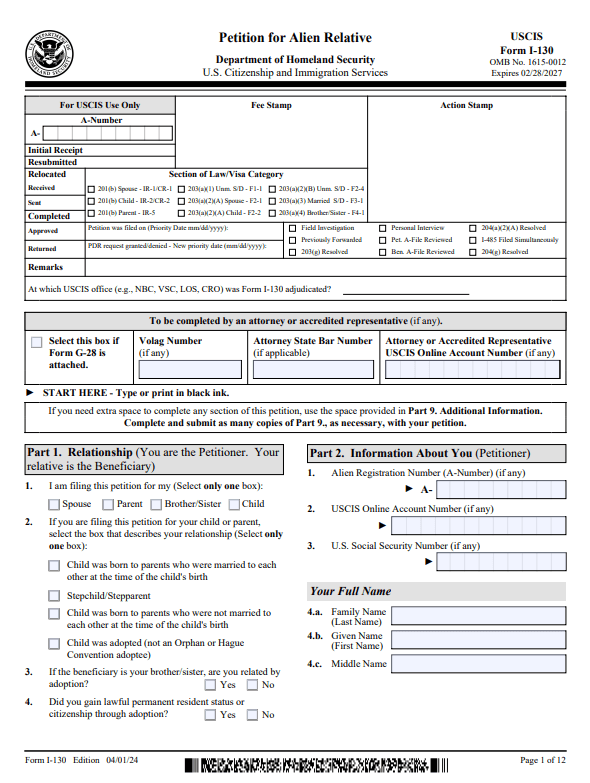
The family-sponsored immigration process proceeds through the stages of the citizen's or permanent resident's petition stage → approval → visa issuance (or adjustment of status) → entry or acquisition of permanent residence.
1) Filing the Petition (I-130)
The sponsor must file Form I-130 (Petition for Alien Relative) with the U.S. Citizenship and Immigration Services (USCIS).
The filing date then becomes the Priority Date, which serves as the basis for the subsequent waiting order in the visa quota.
2) Approval and Transfer to the NVC
Once the I-130 petition is approved by the U.S. Citizenship and Immigration Services, the documents are transferred to the National Visa Center (NVC).
For immediate relatives (IR), the immigrant visa process proceeds at once without any separate waiting period, and for preference relatives (F1 through F4), interview schedules are assigned in order according to the priority date.
3) Visa Interview and Issuance
The NVC requests the necessary additional documents and payment of fees.
After that, once all requirements are met, the interview is conducted at the relevant U.S. Embassy in Korea or the embassy in the place of residence.
If approval is granted after the interview, the immigrant visa is issued.
When entering the United States holding the immigrant visa, permanent residence is granted unconditionally at the port of entry.
The permanent resident card is received by mail after entry.
Priority Dates by Country
Based on the worldwide immigration issuance quota and the number of applicants waiting from a particular country, the U.S. Department of State announces a Cut-Off Date each month through the Visa Bulletin.
In particular, China, India, Mexico, and the Philippines have high sponsorship demand and long waiting periods, so their Cut-Off Dates are managed separately.
As of August 2025, F2A visa applicants with a priority date before February 1, 2022, are scheduled to have visas issued. (Issuance is approved for applicants earlier than the final action date.)
4. Family-Sponsored Immigration | The Petitioner's Financial Sponsorship
Every family-sponsored immigration petitioner must take economic responsibility for the sponsored person's life in the United States through an Affidavit of Support (I-864).
The sponsor is usually the petitioner; however, if income is insufficient, a co-sponsor may be added.
The sponsor must hold income of at least 125% of the Federal Poverty Guideline, that is, the income standard used by the U.S. federal government to set eligibility criteria for various programs for low-income individuals.
For a household of four, income of at least 40,187 dollars is required.
- Co-Sponsor : the co-signature of a U.S. citizen or permanent resident who separately meets the qualifications from the principal applicant
- Use of Assets Permitted : if certain requirements are met, a shortfall in income may be substituted with assets
5. Family-Sponsored Immigration | Preparing Key Supporting Documents
1. Proof of Relationship
2. Financial Sponsorship Related
3. Proof of Identity
An Immigration Attorney's Tips on Family-Sponsored Immigration
Preventing Missing Documents
Complete the key forms such as I-130, I-864, and DS-260 without any gaps
Maintain the scan quality of supporting documents
Notarized English translation required
Managing the Priority Date
Check the Visa Bulletin (published by the Department of State) monthly and prepare for the interview immediately when your Cut-Off Date arrives
Medical Examination Before Entry
Medical examination and vaccinations at a designated hospital
Preparing for the U.S. Embassy in Korea Interview
Prepare for additional questions confirming the family relationship at the interview
In the case of accompanying immigration, all family members attend the interview (children under 14 may be excepted)
Confirming the Visa's 6-Month Validity
Family-sponsored immigration to the United States varies in its procedure, waiting period, and required documents depending on the form and status of the family.
From the I-130 petition to the NVC interview, the completion of financial sponsorship, and entry after visa issuance, the requirements at each stage must be clearly understood.
If, above all, false documents are submitted, serious consequences such as a permanent bar on entry may result.
Entry may also be denied even though a visa has been issued.
Therefore, if you wish to carry out the family-sponsored immigration process promptly and without delay, we recommend that you consult with an immigration attorney holding qualifications such as foreign legal consultant (U.S.) advising on U.S. law and foreign attorney (U.S.) to establish a sound strategy.