
CONTENTS
- 1. U.S. Visa Denial | Causes of Visa Denial

- 2. U.S. Visa Denial | Main Grounds for Visa Denial
- - Incomplete Documentation or Additional Review
- - Immigrant Intent in a Nonimmigrant Visa
- - Subject to Public Assistance or Public Charge
- - Fraud, Misrepresentation, and Unlawful Presence
- 3. U.S. Visa Denial | Basic Principles of Reapplication
- - Response Measures by Ground of Visa Denial
- 4. U.S. Visa Denial | Supporting Documentation for a Waiver Application
- - Strategy for a Waiver Application
- 5. U.S. Visa Denial | How an Immigration Attorney Provides Assistance
- - Strengths of the Firm's Immigration Attorneys

1. U.S. Visa Denial | Causes of Visa Denial
If your schedule has been disrupted by a U.S. visa denial, please read this carefully.
U.S. visas are applied for in various forms depending on the purpose, such as immigration, study, employment, investment, tourism, and visits.
Although most visa applications are approved, U.S. immigration law (INA) and related regulations are based on the principle of thorough screening, so there is no guarantee that every visa will necessarily be issued.
The interview at the U.S. Embassy or Consulate in Korea is a key stage of that screening.
The applicant's documents, statements, past records, intent to return, and financial capacity are comprehensively reviewed to decide on approval or denial.
A U.S. visa denial does not permanently bar the opportunity to enter the United States, but a record of denial may affect a subsequent application.
Because repeated visa denials can increase the disadvantages, it is advisable to accurately identify the underlying grounds of denial and respond carefully.


2. U.S. Visa Denial | Main Grounds for Visa Denial
When a U.S. visa is denied, the applicant is in most cases notified of the statutory provision applied to them.
The consulate informs the visa applicant whether a waiver application may be filed for the ground of ineligibility.
The following are the principal grounds for U.S. visa denial.
 Incomplete Documentation or Additional Review
A U.S. visa denial may occur where the application is incomplete or additional documents are required, or where the consular officer determines that the applicant is not eligible for visa issuance and conducts additional administrative processing.
If the applicant receives a green sheet (a 221(g) letter) and supplements the requested documents within the deadline, visa issuance may be possible.
If the applicant promptly submits the missing documents or information and reapplies within one year from the date of the U.S. visa denial, there may be a possibility of obtaining a U.S. visa again.
Immigrant Intent in a Nonimmigrant Visa
This is a ground for refusal applied where a nonimmigrant visa applicant has failed to establish the fact that the applicant will 'return to the home country' after a temporary stay in the United States.
Where the applicant cannot establish ties with the home country strong enough to require leaving the United States after the temporary stay has ended, a U.S. visa refusal may result.
For a U.S. visa refusal under this provision, the applicant may reapply for a visa by attaching materials establishing that a significant change in circumstances has created such ties and that there is no intent to immigrate or to overstay unlawfully.
What are ties with the home country?
- Absence of strong social and economic ties with Korea
- Unstable employment status
- Vague academic purpose or insufficient documentation such as a letter of admission
- Insufficient basis for financial support
- Answers that may raise suspicion during the interview, or contradictory statements
Subject to Public Assistance or Public Charge
A consular officer may refuse a visa where the officer determines that the applicant may be likely to become a public charge in the United States.
In such a case, the applicant may reapply after supplementing the grounds for refusal, for example by adding supporting documents that can demonstrate sufficient financial means.
For an immigrant, this may be demonstrated by submitting an affidavit of financial support from a sponsor in the United States, or by personal funds, a job offer in the United States, support from a resident, or similar means.
Fraud, Misrepresentation, and Unlawful Presence
Making a false statement of facts or committing fraud to obtain a visa or to enter the United States constitutes a ground for a U.S. visa denial.
In addition, where a person is deemed to have stayed in the United States unlawfully by remaining beyond the expiration date of the authorized period of stay without an extension of stay, U.S. visa issuance is also denied.
In the case of a visa denial due to unlawful stay, visa issuance is denied for the following periods.
- Unlawful stay of 180 days or more but less than one year : visa issuance denied for three years after departure
- Unlawful stay of one year or more : visa issuance denied for ten years after departure
3. U.S. Visa Denial | Basic Principles of Reapplication
After a U.S. visa denial, immediate reapplication is not recommended.
Many applicants try to reapply immediately with the same documents once a visa is denied, but if they reapply while the grounds for denial remain unresolved, the same result will follow.
In the case of section 214(b) in particular, the result cannot change without a substantive change in circumstances or new supporting evidence.
It is therefore advisable to record as thoroughly as possible the denial letter provided by the consulate and the questions and answers given during the interview, and after confirming the legal provisions cited in the letter and the reasons for them, to determine whether reapplication is possible or whether a waiver is needed.
Response Measures by Ground of Visa Denial
Missing documents or additional review
| Accurate analysis of the requested documents Translation, notarization, and review against the originals of additional supporting documents Submission within the deadline is required (generally within one year) |
Immigrant intent under a nonimmigrant visa
| Proof of strengthened ties to the home country Evidence of stable employment (certificate of employment, income records, employment contract) Evidence of family relationships (such as caregiving responsibilities for family members) Evidence of real estate ownership and financial assets Clarification of the purpose of study or visit (supporting documents such as an admission letter and receipts for tuition payments) |
Public charge, fraud or misrepresentation, and unlawful stay
| Resolution of grounds of inadmissibility such as criminal or health matters Submission of a petition and materials for leniency to assess whether a waiver may be available |
4. U.S. Visa Denial | Supporting Documentation for a Waiver Application
U.S. immigration law helps individuals restore the possibility of visa reissuance and entry through an application for a waiver of inadmissibility to the United States.
To apply for a waiver of a visa denial, the following must be substantiated.
① Materials responding to the grounds for inadmissibility
-Detailed information on the matter that became the ground for inadmissibility (a copy of the judgment, a translation of the judgment, and the defendant's statement)
-Precedents or interpretations of judicial exceptions establishing that the matter constitutes a petty offense or an exception
② Materials substantiating Extreme Hardship
-Documents proving the relationship with a family member who is a U.S. citizen or permanent resident (a family relationship certificate, a marriage certificate, a birth certificate, and the like)
-Materials on the medical, economic, and emotional suffering that would arise if the applicant cannot enter the United States
- A hospital diagnosis and treatment plan
- Materials on the burden of living expenses (income and tax returns)
- Psychiatric counseling records or an expert opinion
③ Other materials substantiating specific grounds for inadmissibility
-Vaccination exemption: a medical opinion on the medical grounds and a history of vaccine side effects
-Communicable disease exemption: a physician's opinion on the current state of health
-Misrepresentation: the context of the statement and evidence of innocence, or of remorse and improvement
-Criminal offense: volunteer activities, employment records, and certificates of completed education that establish the absence of any likelihood of reoffending
Strategy for a Waiver Application
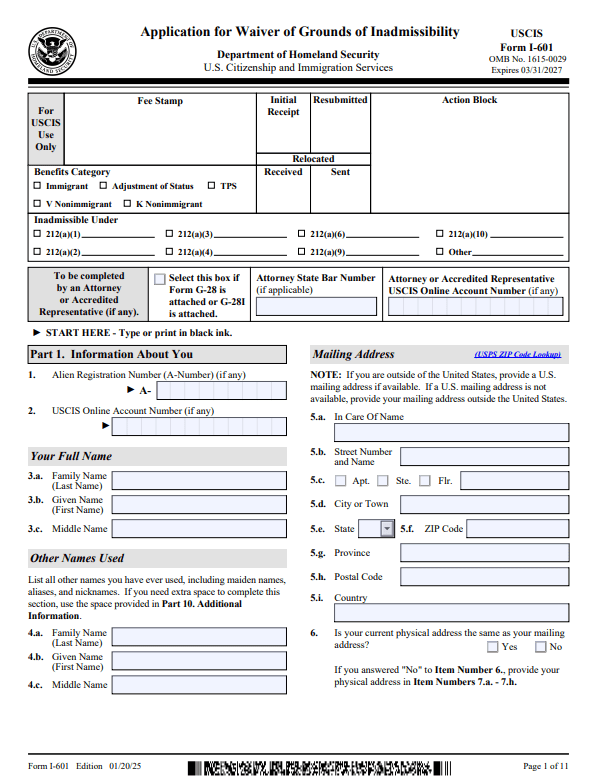
For a waiver application following a U.S. visa denial, the applicant must demonstrate the legitimacy and significance of the need to enter the United States.
Because the review may be conducted according to the principle of proportionality based on the grounds and cause of the visa denial and its seriousness, it can also help to demonstrate that the grounds are minor or amount to a simple mistake.
It is also advisable to actively emphasize that the applicant’s entry will not affect U.S. national interests or security.
All Korean documents must be submitted together with English translations that include the translator’s certificate of qualification.
5. U.S. Visa Denial | How an Immigration Attorney Provides Assistance

[U.S. Visa Reapplication Procedure]
| Review of the denial letter → Examination of the waiver process and the possibility of reapplication → Preparation of required documents and interview simulation → Completion of a new DS-160 and re-payment of the fee → A new consular interview → Reissuance of the visa |
A U.S. visa denial can happen to anyone.
By accurately identifying the reasons for the visa denial and preparing sufficient supporting evidence and reasoning before reapplying, an applicant may have another opportunity.
However, repeating a reapplication without strategic advice from a professional, such as an immigration attorney, can result in the same outcome or may even lead to a long-term entry restriction.
For materials demonstrating one's social and economic ties in Korea, specific materials proving the purpose of entry, thorough interview preparation, and, if necessary, even a waiver, it may be advisable to work together with an immigration attorney who has experience in U.S. immigration law practice.
Strengths of the Firm's Immigration Attorneys
This firm forms a task force composed of attorneys with extensive experience in immigration law practice, including a foreign attorney (United States) for U.S. legal advice and attorneys qualified as U.S. certified public accountants and attorneys, to respond to U.S. visa denial procedures.
Consultation requests can be reserved 24 hours a day, 365 days a year, and this firm, which listens to clients on weekends and public holidays as well, welcomes inquiries regarding U.S. visa matters.
See More