
CONTENTS
- 1. Denial of Entry to the United States | A Strict Legal Process Under the INA

- - Examples of Travelers Denied Entry
- 2. Denial of Entry to the United States | Main Grounds for Denial of Entry
- - Criminal Record
- - Immigration Violations Such as Unlawful Presence
- - Misrepresentation and Document Forgery
- - Health-Related Grounds and Threats to U.S. Security
- 3. Denial of Entry to the United States | The Waiver Process After a Denial of Entry
- - Structure of a Waiver Application
- - Essential Elements of Proof for a Waiver Application
- 4. Denial of Entry to the United States | Thorough Document Preparation Required
- - From Analyzing the Grounds for Denial of Entry, Together With an Immigration Attorney

1. Denial of Entry to the United States | A Strict Legal Process Under the INA

This explains how to respond to a denial of entry to the United States.
The U.S. entry process for immigration purposes is a strict legal screening process under U.S. immigration law (INA).
Regardless of whether the purpose is nonimmigrant or immigrant, U.S. Customs and Border Protection (CBP) or the consulate reviews the purpose of the visit, the planned stay, the authenticity of documents, and any criminal record together to determine admissibility.
If a ground of inadmissibility is confirmed, then depending on the ground, the visa or ESTA (the U.S. Visa Waiver Program) may be canceled immediately, and entry itself may be denied.
In cases such as unlawful presence, additional consequences may follow, including a three-year or ten-year entry bar, an inability to re-enter (Entry ban), and registration of a criminal record.
To prepare for a notice of denial of entry to the United States, you should establish a response strategy tailored to the specific ground and accurately understand and make use of the waiver process.
 Examples of Travelers Denied Entry
- A: Denied entry after an overstay the person was unaware of was treated as a misrepresentation
- B: Denied entry for failing to carry basic travel documents (return ticket, accommodation, funds)
- C: Denied for entry under a false purpose, using ESTA while actually intending short-term language study
- D: Denied at inspection for lack of credibility due to inconsistent statements about the length of stay and the return ticket
- E: Denied entry over concerns of unlawful employment because the stated purpose of caring for a grandchild differed from the ESTA purpose
- F: Denied for violating ESTA conditions after being suspected of immigrant intent for carrying permanent residence documents


2. Denial of Entry to the United States | Main Grounds for Denial of Entry
The United States has significantly tightened its entry screening compared to the past, citing reasons such as illegal immigration and an increasing terrorist threat.
In particular, even if a U.S. visa has been issued, this does not guarantee entry, so the inspecting officer may verify the purpose of entry, the length of stay, and other factors and deny entry.
The main grounds for denial of entry to the United States are as follows.
Criminal Record

A crime involving moral turpitude (CIMT) is a ground of inadmissibility under INA §212(a)(2).
Even simple theft or a minor offense can become an issue depending on whether it is repeated or whether probation was involved.
After analyzing the level of punishment, the judgment, and the disposition history such as suspension of indictment for the offense, you must submit materials proving Extreme Hardship when filing an I-601 waiver.
What is a crime involving moral turpitude?
Under immigration law, a CIMT, that is, a crime involving moral turpitude, is an offense defined in connection with immoral conduct.
- Murder
- Assault and robbery
- Sexual offenses such as rape and indecent acts
- Kidnapping and abduction
- Arson
- Perjury
- Fraud and embezzlement
- Drunk driving and hit-and-run
- Drugs
- Tax evasion
- Prostitution, and the like
Immigration Violations Such as Unlawful Presence
If a person violates the permitted length of stay in the United States and is unlawfully present for 180 days or more, a three-year entry bar is imposed, and if the period of unlawful presence reaches one year or more, a ten-year entry bar is imposed.
Of course, even if 180 days have not yet passed, violating the visa's permitted period of stay also becomes a ground for visa denial.
Immigration violations such as unlawful employment, a removal history, and re-entry attempts become grounds for denial of entry to the United States and apply in the same way.
If there is a history of unlawful presence in the United States, a waiver application must be filed, and obtaining approval before the immigrant visa interview is important.
Misrepresentation and Document Forgery
If false information is provided, forged documents are submitted, or a false purpose of visit is stated in a visa interview or an ESTA application, then the misrepresentation provision applies and may result in denial of entry to the United States.
If misrepresentation, fraud, or the like is detected, entry is impossible other than through a waiver application.
When filing a waiver, you should prepare by submitting a written statement and supporting documents centered on sincere reflection on the past mistake and the hardship of family separation.
Health-Related Grounds and Threats to U.S. Security
Among the grounds for denial of entry to the United States are cases involving carriers of a communicable disease, persons who have not been vaccinated, and persons with a history of mental illness.
In such cases, you must prepare a hospital diagnosis, a vaccination record, and a treating physician's opinion and prove that there is no likelihood of a health-related issue, such as a communicable disease, arising from the relevant item.
In addition, involvement with a terrorist organization or participation in a violent demonstration may also result in denial of entry.
This also falls among the grounds for which a waiver is unavailable, but if the allegation is groundless or the person has been wrongly accused, they may reapply with the help of an immigration attorney.
3. Denial of Entry to the United States | The Waiver Process After a Denial of Entry
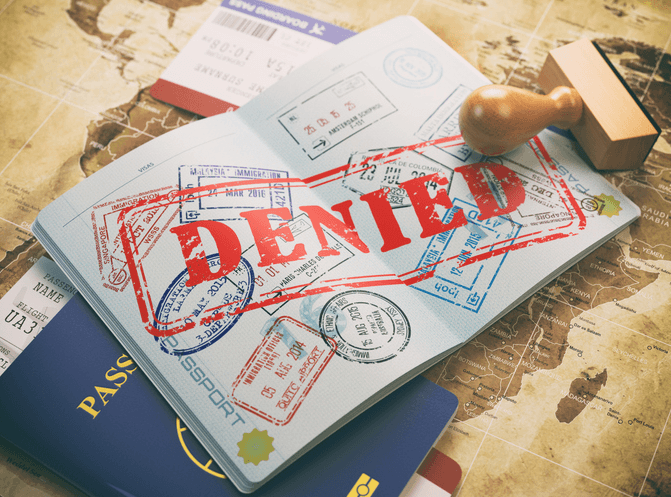
If a denial of entry is decided through a consular interview, secondary inspection, a review of past records, or similar measures, then a notice is issued and a return order is made.
A record of denial of entry to the United States may be registered permanently in databases such as the visa system, so this should be kept in mind.
The procedure for filing a waiver is as follows.
Structure of a Waiver Application
If it is proven that, due to a denial of entry to the United States or similar circumstances, the family of a U.S. citizen or permanent resident would suffer extreme hardship, then the person may proceed with a process to be formally waived of the ground of inadmissibility.
After the waiver is approved, a visa is issued and entry to the United States becomes possible.
Essential Elements of Proof for a Waiver Application
A waiver application requires precise proof that meets the legal standards.
The U.S. government decides on a waiver based on the following items.
①Responding to the ground of inadmissibility
You must prove that the relevant ground was a one-time, unintentional, minor matter, or explain that enough time has passed that there is no concern of reoffending.
Example) The criminal judgment, a criminal record certificate, a written pledge to prevent reoffending, and the like
②Extreme Hardship to the Family
If a spouse, parent, or child who is a U.S. citizen or permanent resident would suffer serious medical, financial, or emotional harm because of the applicant's denial of entry, then the following supporting documents are needed.
Supporting documents)
- Documents proving the family relationship (marriage or birth certificate, and the like)
- Family illness diagnoses, medical expense records, proof of financial dependence
- Materials regarding the children's education and emotional stability
③Assessment of the impact of entry
You must prove that, even if the applicant enters, they will not pose a threat to public safety or the national interest and will not become a public charge.
In this case, you may submit letters of recommendation, proof of community activities, a job offer, and supplementary documents.
Example) Letters of recommendation from institutions and associations, proof of community activities, a job offer, a health diagnosis proving recovery from illness
In particular, in the case of a denial of entry caused by misrepresentation, a waiver is the only means of relief.
A truthful written statement, or an explanation of how the misrepresentation came about because the applicant failed to understand the intent of the inspecting officer's question, along with a specific account of the circumstances, is important.
4. Denial of Entry to the United States | Thorough Document Preparation Required

The success of a waiver application following a denial of entry to the United States is determined by thorough document preparation.
In accordance with the guidelines provided by U.S. Citizenship and Immigration Services, the following items must be reviewed.
In addition, Korean-language documents must be accompanied by an accurate English translation and a translator's certification.
Item | Matters to Prove | Supporting Documents |
Ground of inadmissibility | Details of the relevant ground | Judgment, administrative disposition order, written account of circumstances, and the like |
Family hardship | Likelihood of extreme hardship arising | Hospital records, medical certificates, tax documents, employment documents |
Identity and conduct | Willingness to reform, efforts to prevent reoffending | Volunteer activity records, letters of recommendation, written statements, and the like |
Proof of sincerity | Truthfulness consistent with the purpose of the waiver | Consistent statements, acknowledgment of the consequences, and the like |
From Analyzing the Grounds for Denial of Entry, Together With an Immigration Attorney
The waiver process has no standardized form, and the key is to persuade the consular officer through a free-form written statement and supporting evidence.
For this reason, sincerity and a systematic approach become important factors in the assessment.
A denial of entry to the United States may lead to a long-term entry restriction and visa denial, so you should make appropriate use of the waiver rules and carefully prepare a waiver application before entry and a proactive response process.
We recommend that you have an immigration attorney review the grounds for denial of entry in advance and then follow the appropriate procedure.
Our firm's attorneys, including those who hold foreign attorney (U.S.) and U.S. certified public accountant qualifications, will assist you with the process of restoring U.S. entry permission through accurate preparation of the waiver process and construction of the waiver argument, drawing on their practical experience and know-how regarding denial of entry to the United States.
See More