
CONTENTS
- 1. Employment-Based Immigration (EB-1) | Priority Worker Immigrant Visa

- 2. Employment-Based Immigration (EB-1) | Criteria for Extraordinary Ability
- - Extraordinary Ability (EB-1A)
- - Outstanding Professors and Researchers (EB-1B)
- - Multinational Managers and Executives (EB-1C)
- 3. Employment-Based Immigration (EB-1) | Strategy for Proving Extraordinary Ability
- 4. Employment-Based Immigration (EB-1) | Common Procedures After the Petition
- - Attorney's Preliminary Advice on Promising Routes

1. Employment-Based Immigration (EB-1) | Priority Worker Immigrant Visa
Employment-Based Immigration (EB-1) is a first-preference visa for priority workers.
The U.S. immigration system issues approximately 140,000 employment-based immigrant visas each fiscal year (October 1 to September 30 of the following year).
Among these, Employment-Based Immigration (EB‑1, Employment‑Based First Preference) is a special immigrant visa granted the highest priority.
Among Korean applicants, distinguished professionals in fields such as academia and research, executives of global corporations, and sports and the arts mainly obtain permanent residence through EB‑1A and EB‑1B.
EB‑1 does not require separate labor certification (PERM), and accompaniment by family members is straightforward.
It also has the advantage of a relatively quick review process and a high likelihood of permanent residence approval.



2. Employment-Based Immigration (EB-1) | Criteria for Extraordinary Ability
EB‑1 is divided into three subcategories: persons of extraordinary ability (Extraordinary Ability, EB‑1A), outstanding professors and researchers (Outstanding Professors & Researchers, EB‑1B), and multinational managers and executives (Multinational Managers & Executives, EB‑1C).
 Extraordinary Ability (EB-1A)
This category requires proof of sustained national or international acclaim in the sciences, arts, education, business, or athletics, and at least 3 of the 10 criteria listed below must be met.
In particular, evidence of receiving an internationally recognized award such as a Pulitzer Prize, an Oscar, or an Olympic medal is required.
Because the applicant possesses extraordinary ability, no job offer from another sponsor or labor certification is required, but it must be proven that the applicant will continue to work in the relevant field.
[Criteria for Extraordinary Ability]
- Evidence of receipt of nationally or internationally recognized prizes or awards
- Evidence of membership in associations that require outstanding achievement for membership
- Evidence of published material about the applicant in major trade publications or media
- Evidence of having been asked to evaluate the work of others
- Evidence of original scientific, scholarly, artistic, athletic, or business contributions of major significance to the field
- Evidence of scholarly articles authored in major trade publications or media
- Evidence that the applicant's work has been displayed at artistic exhibitions or showcases
- Evidence of performing a leading or critical role for a distinguished organization
- Evidence of commanding a high salary or substantial remuneration
- Evidence of commercial success in the performing arts
Outstanding Professors and Researchers (EB-1B)

Professors and researchers who have received international recognition for outstanding achievement in a particular academic field also qualify for Employment-Based Immigration (EB-1).
The petitioner must provide proof of an offer of full-time, professorial, or permanent research employment, and the beneficiary must likewise prove at least 3 years of teaching and research experience.
To prove this, evidence meeting at least two of the 6 criteria below must be included.
Multinational Managers and Executives (EB-1C)
A multinational corporation manager or executive who has worked for at least 1 of the past 3 years at an overseas affiliate, parent company, subsidiary, or branch of a U.S. employer that has operated a business in the United States for at least 1 year also qualifies for Employment-Based Immigration (EB-1).
In the above case, labor certification is not required, but a job offer is mandatory.
The employer must prove the ability to pay the beneficiary's wages through annual reports, tax returns, audited financial statements, and the like.
See More
3. Employment-Based Immigration (EB-1) | Strategy for Proving Extraordinary Ability
Item | Details |
EB-1A Proof Strategy | - No labor certification or employer required, so the process proceeds quickly
> Proof for each criterion: awards, certificates, articles, invitations to serve as a judge > A summary of the criteria met and an explanation of the supporting evidence in the I‑140 petition |
EB-1B Proof Strategy | - A balanced review structure for professors and researchers
> Letters of recommendation and proof of experience submitted together with the employer's I‑140 |
EB-1C Proof Strategy | - Exclusively for managers/executives of multinational corporations
> Overseas work experience: certificate of employment, pay statements, specifying position and role |
4. Employment-Based Immigration (EB-1) | Common Procedures After the Petition
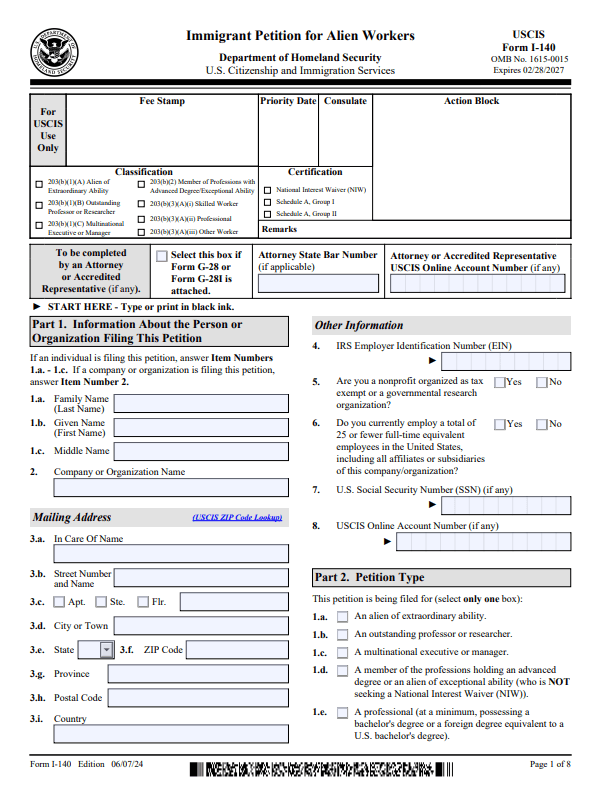
For Employment-Based Immigration (EB-1), the immigration process can begin after the Immigrant Petition for Alien Worker (I-140) is filed.
In the case of Employment-Based Immigration (EB-1), all categories are exempt from labor certification, so the process is relatively simple, and in particular, an EB-1A applicant may file the petition on their own behalf.
Afterward, once U.S. Citizenship and Immigration Services approves the petition, it is forwarded to the National Visa Center (NVC), and the process proceeds with submission of visa documents, followed by an interview, a medical examination and vaccinations, and visa issuance.
In addition, a spouse and children under 21 may immigrate as accompanying family members with E‑14 or E‑15 status.
[Points to Note After Filing the Immigration Application]
- Passport valid for at least 6 months
- Medical examination at a hospital designated by the embassy (Gangnam Severance Hospital, Sinchon Yonsei Severance Hospital, Yeouido St. Mary's Hospital, Busan Haeundae Paik Hospital)
- Vaccinations for hepatitis A, hepatitis B, influenza, measles, and the like
- Do not open the sealed envelope of the passport in which the visa was issued
Attorney's Preliminary Advice on Promising Routes

EB‑1 is the route with the highest social and legal standing among U.S. employment-based immigration categories.
Because it offers many advantages, such as exemption from labor certification, a fast approval timeline, and the ability to bring family members, it requires meeting strict standards of excellence.
For Korean applicants in fields such as academia, research, corporate management, and the arts and sports, EB‑1A, B, and C are all promising routes worth considering.
Please establish a sound strategy for Employment-Based Immigration (EB‑1) approval together with an immigration attorney.
See More