
CONTENTS
- 1. Unfair Dismissal | Prohibitory Provisions Under the Labor Standards Act

- 2. Unfair Dismissal | Representative Types
- - Determining the Justification of the Grounds for Dismissal
- 3. Unfair Dismissal | Step-by-Step Remedies
- - Remedy by the Labor Relations Commission (Initial and Reexamination)
- - Filing Administrative Litigation When Objecting to a Reexamination
- - Lawsuit for Confirmation of Nullity of Dismissal (Civil Litigation)
- - Collection of Evidence
- 4. Unfair Dismissal | Response Measures
- - Defense Checklist from the Employer's Position

1. Unfair Dismissal | Prohibitory Provisions Under the Labor Standards Act

Unfair dismissal means a dismissal without justifiable grounds that is not permitted under the Labor Standards Act and labor-related statutes.
Article 23 of the Labor Standards Act provides that an employer shall not dismiss, lay off, suspend, transfer, reduce the wages of, or otherwise punish a worker without justifiable reason.
A justifiable dismissal is recognized only on the grounds provided by law, such as a worker’s attributable cause or unavoidable managerial circumstances.
In addition, a dismissal must be notified in writing, stating the grounds and the timing, and the employer must give 30 days’ advance notice of dismissal or pay at least 30 days’ ordinary wages as a dismissal allowance.
If such procedures are violated, the dismissal may be deemed unfair even if the grounds are partially recognized.
See More


2. Unfair Dismissal | Representative Types

The following are the representative types of unfair dismissal.
1. Dismissal lacking formal requirements
Cases in which the employer gives notice of dismissal orally without delivering a written notice of dismissal, or in which the dismissal takes effect immediately without advance notice, are representative procedural defects.
The employer should note that the grounds for dismissal and the timing of dismissal must be given in writing.
2. Dismissal disguised as based on managerial reasons
For a dismissal based on managerial reasons, it must be proven that restructuring of the business is in substance necessary. (The transfer, acquisition, or merger of a business may be a valid ground.)
The employer must notify the labor union or other employee representative of the dismissal at least 50 days in advance and consult in good faith, and a dismissal that disregards this constitutes unfair dismissal.
3. Discriminatory or retaliatory dismissal
A retaliatory dismissal on grounds such as joining or engaging in union activities, raising a grievance, or filing a petition with the Ministry of Employment and Labor is also a representative form of unfair dismissal.
In addition, an employee may not be dismissed during the 30 days before and after a period of leave taken for medical treatment of an occupational injury or illness, or during a period of leave taken by a woman before and after childbirth and the 30 days thereafter. (This does not apply where a lump-sum compensation is paid or where continuation of the business is impossible.)
4. Dismissal disguised as expiration of a fixed-term contract
Where a fixed-term employment contract has been repeatedly renewed so that it is in substance equivalent to an open-ended employment relationship, dismissal that formally relies on the expiration of the contract term may be treated as a refusal to renew the contract and thus as unfair dismissal.
Likewise, if a dispatched worker is dismissed solely on the ground that the worker filed an application for correction of discriminatory treatment, this constitutes unfair dismissal.
In such a case, an application for remedy is available, and an employer who engaged in discriminatory treatment is subject to imprisonment for up to two years or a fine of up to 10 million won.
5. Restrictions on grounds for dismissal under the Occupational Safety and Health Act
Where an employee stops work and evacuates on the ground of an imminent danger of an industrial accident, the employer may not dismiss or otherwise treat the evacuated employee unfavorably.
If an employer dismisses an employee on the ground that the employee reported the employer's violation of statutes to the Ministry of Employment and Labor or a labor inspector, the employer is subject to imprisonment for up to five years or a fine of up to 50 million won under the Occupational Safety and Health Act.
 Determining the Justification of the Grounds for Dismissal
The law explains the criteria for determining the legitimacy of a dismissal as follows.
- Disability : The circumstances in which the worker's disability arose, whether the employer was at fault, the remaining working capacity, the possibility of reassignment, the employer's efforts to accommodate, and other factors
- Unauthorized absence : A ground for dismissal may exist where there is a basis in the rules of employment (illness or other unavoidable reasons also constitute unauthorized absence where there is no approval)
- Poor work attitude : Repeated unauthorized outings, tardiness, and other insincere work conduct constitute grounds for dismissal (insufficient job capability and the like require strict assessment)
- Damage to the company : Where the company has been harmed by embezzlement, breach of trust, gross negligence, or the like, dismissal is justified, and disciplinary action may be taken separately from damages
- Unlawful union activity : Unlawful union activity and industrial action constitute grounds for dismissal (violence, destruction, and unauthorized absence are improper acts for which dismissal is justified)
- Urgent managerial necessity : Beyond a mere deficit, restructuring, technological innovation, discontinuation of business, and the like are recognized
3. Unfair Dismissal | Step-by-Step Remedies
If you have been unfairly dismissed, the first response is a prompt application for remedy to the Labor Relations Commission.
Under Article 28 of the Labor Standards Act, where an employer dismisses a worker without justifiable reason, the worker may apply to the Labor Relations Commission for remedy within three months from the date of the dismissal.
Once a case is filed with the Labor Relations Commission, the procedure proceeds in the order of ① application for remedy → ② investigation → ③ examination → ④ decision → (reexamination and administrative litigation) → ⑤ confirmation and closure.
Remedy by the Labor Relations Commission (Initial and Reexamination)
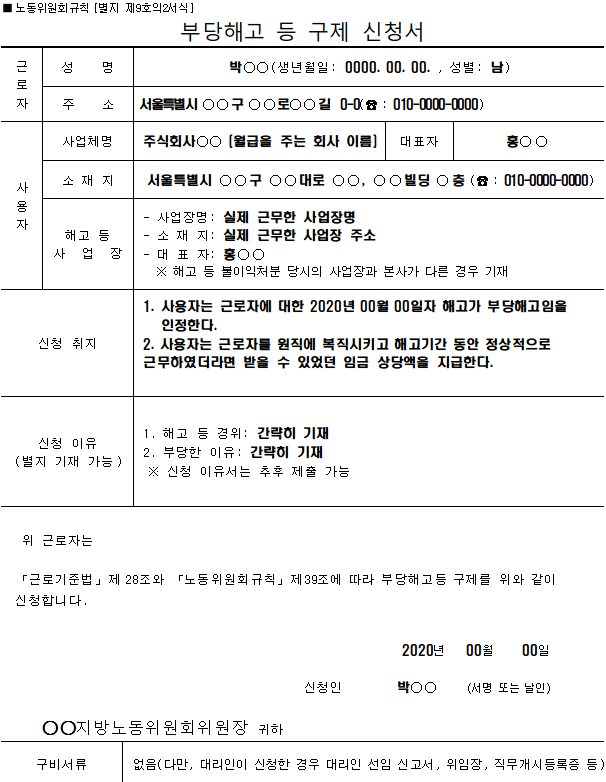
An employee may apply for relief to the Regional Labor Relations Commission with jurisdiction over the location of the workplace.
The Regional Labor Relations Commission investigates the lawfulness of the dismissal and its procedural propriety, and then confirms the facts through a hearing.
In this process, the employee should submit sufficient supporting evidence, such as the employment contract, the dismissal notice, messenger records, and recordings.
If the determination recognizes the dismissal as unfair, the employer must comply with corrective orders such as reinstatement and payment of wages, and if the employer fails to comply, the Ministry of Employment and Labor may enforce a compliance order.
Where a party contests the initial determination of the Labor Relations Commission, both the employer and the employee may apply for review by the National Labor Relations Commission within 10 days from the date of notification of the relief order or the decision of dismissal.
Filing Administrative Litigation When Objecting to a Reexamination
If one also disputes the reexamination decision, one may file an administrative litigation within 15 days from the date of receiving the written reexamination decision.
If one also disputes the first-instance judgment in the administrative litigation, one may appeal within 2 weeks from the date the written judgment was served.
If one also disputes the appellate judgment, a final appeal to the Supreme Court is possible, but the final appeal is limited to violations of the Constitution, statutes, orders, or rules.
Lawsuit for Confirmation of Nullity of Dismissal (Civil Litigation)
A worker who claims unfair dismissal may separately file an action for confirmation of the invalidity of dismissal as a civil suit, and the two may be pursued concurrently on an elective basis.
An action for confirmation of the invalidity of dismissal is a lawsuit seeking a court declaration that a dismissal effected by the unilateral intent of the employer is invalid, and if the dismissal is confirmed to be invalid as a result of the lawsuit, the worker may claim not only reinstatement but also an amount equivalent to the wages for the dismissal period.
For a civil suit as well, if a party does not accept the first-instance judgment, an appeal may be filed within two weeks from the date of service of the written judgment, and if a party does not accept the appellate judgment, a final appeal may be filed.
Collection of Evidence
For an employee to obtain a remedy for unfair dismissal, the following materials can be of significant help.
4. Unfair Dismissal | Response Measures

In connection with unfair dismissal, it is important from the employee's standpoint to closely confirm whether the dismissal notice had just cause and followed proper procedures.
As a dispute may become prolonged depending on the case, organizing the facts and evidence from the early stage and establishing a response strategy with the assistance of a professional can serve as an important factor in protecting one's rights.
Defense Checklist from the Employer's Position
Dismissal is a serious matter directly affecting a worker's livelihood, and it also carries significant legal risk for the employer.
An unfair dismissal dispute should be contested through lawful procedures by promptly organizing the facts and evidence, and where necessary, proceeding with the advice of a professional, such as a labor attorney or an attorney, can be very important for the protection of one's rights.
Daeryun LLC reviews the circumstances and evidentiary relationships of each individual matter closely and prepares a response strategy appropriate to the situation.
If you require a legal consultation on a related matter, you may leave a consultation reservation through the link below.