
CONTENTS
- 1. Lawsuit to Confirm Worker Status | Definition of Worker Status

- 2. Lawsuit to Confirm Worker Status | The Legal Doctrine of the Concept of a Worker
- - Criteria for Determining Subordination in Employment
- - Criteria for Determining Economic Dependence
- - Summary of Precedents Recognizing Worker Status
- 3. Lawsuit to Confirm Worker Status | Key Issues Under Discussion
- - The Issue of Disguised Dispatch and In-House Subcontracting of Workers
- - The Issue of Workers in Special Types of Employment
- 4. Lawsuit to Confirm Worker Status | Burden of Proof and Evidence Collection
- 5. Lawsuit to Confirm Worker Status | Procedure and Flow
- - Effects of Recognition and the Employer's Obligations
- - Key Issues That Determine the Outcome of the Litigation

1. Lawsuit to Confirm Worker Status | Definition of Worker Status

A lawsuit to confirm employee status is, simply put, a lawsuit in which a worker seeks legal confirmation of their employment type and status.
As various forms of employment relationships have emerged in our society, the question, "Am I a worker?", is no longer a concern only for some workers.
As new forms of employment increase, such as platform workers, workers in special types of employment, in-house subcontractor workers, and dispatched workers, whether a person is in a relationship of subordination to an employer often becomes the point of dispute.
When the status as a worker is legally unclear in this way, the lawsuit filed in order to be recognized as a worker is precisely the lawsuit to confirm employee status.
2. Lawsuit to Confirm Worker Status | The Legal Doctrine of the Concept of a Worker

Article 2 of the Labor Standards Act defines a worker as 'a person who, regardless of the type of occupation, provides labor to a business or workplace for the purpose of wages and is subordinate to the employer'.
Therefore, the matter cannot be determined merely by whether an employment contract has been concluded with the employer, and a person can be regarded as a worker only where subordination in the use of labor and economic subordination are recognized in substance.
 Criteria for Determining Subordination in Employment
In determining the existence of a relationship of subordination to an employer, the case law comprehensively examines the following factors.
- Whether the employer specifically determines the content of the work and directs and supervises it
- Whether the person providing labor works exclusively for the employer
- Whether the working hours and the place of work are set by the employer
- Who provides the materials, equipment, and other items necessary for performing the work
- Whether the person providing labor may hire a third party, among other factors


Criteria for Determining Economic Dependence
Economic dependency means a state in which a worker is economically dependent on the employer, lacks independence, and cannot in substance be regarded as a self-employed person.
For example, this applies where the source of income depends entirely on the employer or where the structure for paying compensation is subject to the employer's control.
Summary of Precedents Recognizing Worker Status
The Supreme Court has held that, in determining whether a person is a worker under the Labor Standards Act, the court should not be bound by the form stated in the contract (such as contract for work or mandate) but should consider whether the person actually worked in a subordinate manner under the employer's direction and supervision for the purpose of wages. (Supreme Court, decided January 25, 2017, 2015Da59146).
In a case involving a beauty academy instructor, the court found that even though the instructor did not receive specific direction and supervision regarding the content of the lectures, reported business income tax, and was not enrolled in the four major insurances, these were merely characteristics of the lecturing work or forms set by the employer and did not constitute grounds to deny actual subordination. (Supreme Court, decided September 7, 2007, 2006Do777)
In other words, this is a case confirming that worker status cannot easily be denied based solely on the contract or the method of tax treatment, and that the substance is most important.
However, worker status is sometimes not recognized for a workplace composed only of cohabiting relatives, domestic workers, or cases in which a subordinate relationship is not recognized (such as post office insurance solicitors and golf course caddies who have not entered into a labor supply contract).
3. Lawsuit to Confirm Worker Status | Key Issues Under Discussion

Because a lawsuit to confirm employee status goes beyond a mere interpretation of the contract to determine whether a substantive employment relationship exists, the following issues are frequently discussed.
The Issue of Disguised Dispatch and In-House Subcontracting of Workers
There are many cases in which, despite the existence of actual user-subordination, the form of a subcontract is borrowed to deny employee status.
Typically, where a person works in the form of in-house subcontracting at a large company's plant but the principal contractor in substance directly instructs and supervises the work, this may be regarded as disguised subcontracting.
In particular, while worker dispatch is sometimes operated lawfully by a dispatch business operator, there are cases in which the using employer, in violation of the requirements under the Dispatch Act, directly uses the worker while disguising the arrangement as a contract with a dispatch company.
In such a case, the worker may file a lawsuit to confirm employee status against the actual user.
Supreme Court, Judgment of March 26, 2020, Case No. 2017 Da 217724, 217731
Workers belonging to an in-house cooperating company that had concluded a subcontract with Company H, which engages in the business of manufacturing and selling automobiles and other products, and who worked at that company's research institute, among others, sought a lawsuit to confirm employee status against the company.
The Supreme Court found that the workers and others, after being employed by the cooperating company, were dispatched to Company H's research institute and received its direction and orders, and were therefore in a worker dispatch relationship.
In addition, the Supreme Court upheld the lower court's determination that Company H came under an obligation to directly employ the workers from the day following the day on which the two-year period from the commencement date of the dispatched work expired, and that Company H, having failed to perform the direct employment obligation, was liable to pay damages equivalent to the wages.
The Issue of Workers in Special Types of Employment
Delivery drivers, home-study teachers, and substitute drivers, among others, may be regarded as non-regular employees who are registered as 'self-employed persons' but who in reality work under the direction and supervision of an employer.
Even where they are designated as 'individual business operators' under their contracts, they may be regarded as employees if subordination is recognized in the actual relationship.
Supreme Court Decision 2016Da277538, decided April 23, 2019
This decision concerned a case in which an employee who had concluded a home-based postal delivery entrustment contract with a post office head under the Korea Post and worked as a home-based entrusted mail carrier, among others, sought confirmation of employee status against the State.
The Supreme Court upheld the lower court's determination that the person was, in a subordinate relationship, an employee providing labor under the direction and supervision of the Korea Post.
4. Lawsuit to Confirm Worker Status | Burden of Proof and Evidence Collection

In a lawsuit to confirm worker status, the worker as plaintiff must prove subordination in the use of labor and economic dependence. It is therefore important to gather sufficient evidence in advance.
① Employment contract and pay statement
An employment contract and a certificate of employment, if available, can support the basic existence of an employment relationship, and a pay statement serves as a key document in a lawsuit to confirm worker status, proving that the employer paid wages directly.
② Evidence of direction and supervision of work
Through attendance records, work logs, and messenger or email communications, it is necessary to secure proof that the employer gave specific work instructions.
CCTV or GPS records are sometimes used as well.
③ Witnesses and statements of colleagues
A written statement or testimony from a colleague who worked at the same site can be strong evidence supporting actual subordination in the use of labor.
Statements regarding specific work instructions and management and supervision concerning how the employer assigned and supervised work, as well as the organizational chart of the user employer, also serve as key evidence.
It is also important to prove that one received the same treatment as the workers of the defendant company, for example by working alongside them and completing the same job training.
5. Lawsuit to Confirm Worker Status | Procedure and Flow
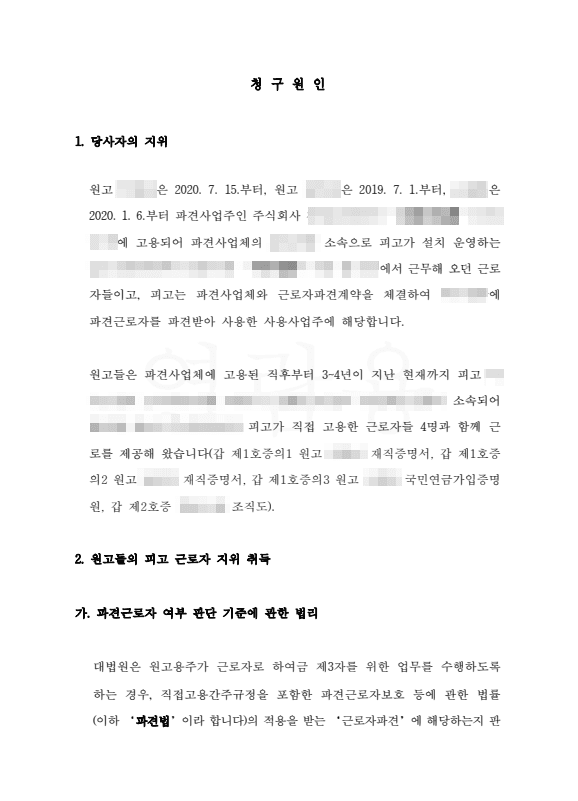
A lawsuit for confirmation of employee status is filed as a civil action with the court having jurisdiction.
Employers often deny employee status by relying on subcontracting agreements, business registration certificates, and the like, so the employee's side must prove the actual nature of the status through the evidentiary materials described above.
During the trial, the court comprehensively assesses the facts and the legal principles to determine whether a substantive employment relationship existed.
Where necessary, the actual conditions at the site may be verified through examination of the relevant persons.
Effects of Recognition and the Employer's Obligations
If the court recognizes employee status, the employer becomes subject to obligations under the Labor Standards Act to pay wages, severance pay, and annual leave allowances.
In addition, if an unfair dismissal is recognized, the invalidity of the dismissal, an order of reinstatement to the original position, and payment of unpaid wages also come into question.
Once employee status is confirmed, the obligation to enroll the employee in the four major insurance programs may also apply retroactively to the employer, which can substantially increase the employer's burden.
Key Issues That Determine the Outcome of the Litigation
The outcome of a lawsuit to confirm worker status varies greatly depending on the facts.
Because one must establish an actual relationship of subordination in the use of labor, rather than being bound by the wording of the contract, it is important to obtain advice from experts, such as a labor attorney or a labor law attorney, and to secure evidence from the early stage.
A lawsuit to confirm worker status goes beyond a dispute over an employment contract; it is a final safeguard for protecting the rights and interests of workers, who are socially vulnerable, and a strong legal means by which an employer can correct an unlawful employment structure.
However, if the employment relationship between the parties is clear or there is no significant dispute over the facts, it may also be possible to reach an amicable settlement with the employer through means such as monetary compensation or recontracting, leading to the withdrawal of the lawsuit.
If worker status is in question, rather than hesitating to file a lawsuit to confirm worker status, consulting a labor attorney or a labor law attorney on the matter and preparing a legal response can be a prompt first step in protecting one's rights.