
CONTENTS
- 1. Divorce by Conciliation | Concept

- - What Is the Principle of Conciliation First?
- - Confirming the Competent Court
- - Documents Required When Applying for Divorce by Conciliation
- 2. Divorce by Conciliation | Procedure
- - Fact-Finding by the Family Court
- - Conciliation at the Family Court
- - The Outcome of Conciliation
- - Reporting of the Divorce upon Successful Conciliation
- 3. Divorce by Conciliation | Legal Disputes
- - Assets Subject to Division and the Right to Claim Division of Marital Property
- - Designation of Parental Authority and Custody
- - Claim for Consolation Money (Solatium)
- 4. Divorce by Conciliation | Step-by-Step Response Strategy
- - Divorce Attorney Support System

1. Divorce by Conciliation | Concept

Conciliation divorce is a procedure by which the parties dissolve the marital relationship by agreeing to divorce through the court's conciliation procedure.
Through conciliation, disputes over consolation money, division of marital property, parental authority, custody, and the like may also be resolved together.
 What Is the Principle of Conciliation First?
To obtain a judicial divorce, the conciliation procedure of the family court must be undergone.
This is called the 'principle of prior conciliation,' and even where a lawsuit is filed without the conciliation procedure, the court will refer the case to conciliation ex officio. (Article 50 of the "Family Litigation Act")
However, in the following situations, the conciliation procedure may be omitted and a lawsuit may be filed directly.
▶ Where there is no possibility that conciliation will be established
Confirming the Competent Court
Divorce conciliation must be filed with the competent family court based on factors such as the parties’ addresses and last place of residence.
The court having jurisdiction over conciliation divorce is determined in the following order, in accordance with Articles 22 and 51 of the Family Litigation Act.
2. The jurisdiction of the address where they last resided together
3. The jurisdiction of the other party’s general venue
4. The family court agreed upon by the spouses
Documents Required When Applying for Divorce by Conciliation
The main documents required to apply for a divorce by conciliation are as follows.
2. One copy each of the marriage relationship certificate of each spouse
3. One copy each of the resident registration extract of each spouse
4. One copy each of the family relationship certificate of each spouse
5. Where there is a minor child, the basic certificate and family relationship certificate of each such child
(including an unborn child)
6. Other various supporting materials
2. Divorce by Conciliation | Procedure
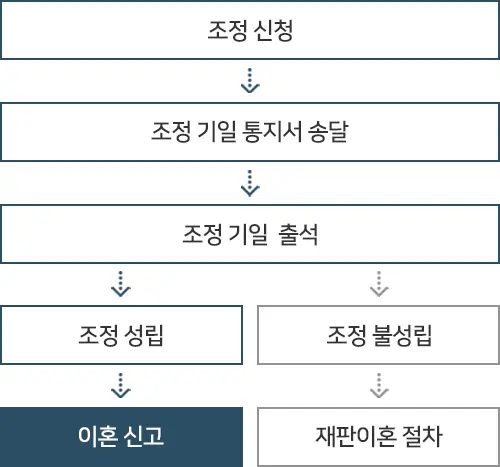
The procedure for divorce by conciliation proceeds in the following flow.
Fact investigation → Attendance and statements at the conciliation date → Establishment or non-establishment of conciliation (a divorce trial if not established) → Divorce report
Fact-Finding by the Family Court
The family court does not make its determination based solely on the statements of the two parties, but conducts an individual fact-finding investigation through a family investigator into matters such as living circumstances, financial status, and the child's upbringing situation.
In addition, where necessary, the court may verify facts, including property, income, and the child's education, through external institutions such as banks and schools.
Conciliation at the Family Court
On the conciliation date, the parties or their representatives attend and coordinate whether to reach an agreement under the mediation of the conciliation committee.
If the party who applied for conciliation fails to attend the first date, a new date, or any subsequent date, the application for conciliation is deemed to have been withdrawn.
In addition, where the other party to the conciliation fails to attend, the court may issue a compulsory conciliation decision ex officio.
The Outcome of Conciliation
If, in the conciliation procedure, an agreement is reached between the parties on the divorce and ancillary issues (division of marital property, consolation money, custody, and the like), its content is recorded in the conciliation protocol, and the conciliation is established.
This conciliation protocol has the same effect as a judicial settlement, and the divorce is legally finalized (“Family Litigation Act” Article 59).
However, in the following cases, the establishment of conciliation may be difficult, and the court may issue a decision in lieu of conciliation or a decision recommending settlement.
② Where no agreement is reached between the parties
③ Where the content of the agreement is judged to be inappropriate
If no objection is filed within 2 weeks from the date of service of such a decision, or if the objection is rejected or withdrawn, it takes effect in the same manner as conciliation.
If an objection is filed, the case proceeds to a divorce trial.
Reporting of the Divorce upon Successful Conciliation
Once conciliation is established, the conciliation applicant must file a divorce report with the competent authority (a city or district office, an eup or myeon office, and the like) within one month from the date the conciliation is established.
When filing the report, the following documents must also be submitted.
∙ A copy of the conciliation protocol
∙ A certificate of finality of the conciliation protocol
See More
Related News
3. Divorce by Conciliation | Legal Disputes

Because divorce by conciliation involves not only the divorce itself but also various ancillary legal matters such as consolation money, division of marital property, and child custody, an application for conciliation may be filed together with respect to the following matters.
Assets Subject to Division and the Right to Claim Division of Marital Property
The right to claim division of marital property is the right to receive a distribution of the joint property formed during the marriage according to the actual degree of contribution (Civil Act, Article 839-2).
During the conciliation process, it is important to clearly organize the following matters.
▷ Whether retirement allowances, pensions, loan debts, and the like are also included
▷ The claim may be made within two years after the divorce
▷ Where no agreement is reached, an adjudication on division of property may be sought from the family court
Designation of Parental Authority and Custody
Where there is a minor child, designation of the holder of parental authority and the custodian is required.
If no agreement is reached, the family court designates them ex officio, giving the highest priority to the child's welfare.
The custodian is the person responsible for the child's daily life, and the holder of parental authority is the person with the rights and duties to manage the child's legal acts and property.
Usually the same person is designated, but in some cases the roles may be separated.
The following matters may also be arranged together.
▷ Whether and how visitation rights are exercised
▷ Whether to change the child's surname and family origin
Claim for Consolation Money (Solatium)
Upon divorce, a claim for compensation for emotional harm may be made against the party responsible for the breakdown of the marriage, such as through a spouse's act of infidelity or violence, and this is referred to as the right to claim consolation money (Articles 806 and 843 of the Civil Act).
When claiming or defending against consolation money in the course of a conciliation divorce, the following points should be organized.
▷ The degree of emotional suffering and the specificity of supporting materials (KakaoTalk, recordings, medical certificates, and the like)
▷ Organizing the factors affecting the calculation of consolation money, such as the duration of the marriage, the presence of children, and the course of the conflict
▷ The need to prepare for the possibility of comparative fault offset (where the other party raises a counterargument)
▷ A claim may be made within three years after the divorce (extinctive prescription of the right to claim damages under Article 766(1) of the Civil Act)
See More

Standards for calculating property division in divorce proceedings and methods for securing evidence

Are you curious about the criteria for determining parental custody?
Divorce alimony claim method and calculation standards
Take a look at how to claim divorce property division and the negotiation process
What if you don’t pay divorce support as agreed upon?
4. Divorce by Conciliation | Step-by-Step Response Strategy
Divorce by conciliation may feel simpler than a trial, but in reality, legal issues such as consolation money, division of marital property, and parental authority and custody are intertwined, so the essence of the dispute is no different from that of judicial divorce.
In particular, because factors such as the degree of conflict between the parties, the possibility of agreement, the size and nature of the assets, and child custody issues operate in a complex manner, a strategic response is needed from the conciliation stage onward.
Response Strategy by Stage
Stage | Response Strategy |
Checking the Requirements for Filing for Conciliation | - Review of whether the case is one in which conciliation is necessarily required before judicial divorce |
- Need to include ancillary claims such as consolation money, division of marital property, and custody in the application | |
Designing a Favorable Conciliation Proposal and Negotiation Strategy | - Designing a favorable settlement proposal in advance before the conciliation date |
- Anticipating the other party's reaction and position and preparing a rebuttal strategy | |
Preparing for Disputes by Item Regarding Consolation Money and Division of Marital Property | - Organizing the consolation money argument in light of fault and the duration of the marriage |
- Need to organize the asset list, emphasize one's contribution, and check assets suspected of being concealed | |
Strategy for Securing Parental Authority and Custody | - Asserting parental authority and custody on the basis of the child's care situation, education plan, economic capacity, and the like |
- Visitation rights and the calculation of child support should also be designed together to be effective | |
Preparing for Failure of Conciliation and Follow-up Response | - Preparing to convert to judicial divorce where the other party fails to appear or no agreement is reached |
- Need to review in advance the legal effect of the conciliation protocol and the possibility of enforcement |
Divorce Attorney Support System
This firm has many specialist attorneys with an average of more than 10 years of experience, and it forms task forces of 1 to 20 members to take dedicated charge of cases.
Drawing on the experience accumulated through numerous divorce cases, it provides its utmost assistance so that the rights and interests of clients can be substantively protected.
It also provides comprehensive assistance through a system of collaboration with professionals such as evidence examination, accountants, and tax accountants.
If you need assistance regarding divorce by conciliation, please request a consultation with a divorce attorney.
See More


Watch related video content
for this case study.

Lawyer's Official No. 1 reason for divorce, check before marriage