CONTENTS
- 1. Judicial Divorce | Concept and Preparation

- - Definition and Requirements
- - Points to Consider Before Preparing for Divorce
- - Judicial Divorce Litigation Procedure and Expected Duration
- - Essential Documents to Prepare for a Judicial Divorce
- 2. Judicial Divorce | Claim for Consolation Money by the At-Fault Spouse
- - Criteria for Calculating the Amount of Consolation Money
- - Grounds That May Support a Claim for Consolation Money
- - Evidentiary Materials Required When Filing a Claim
- - Responding When the Other Party Refuses to Pay Consolation Money
- 3. Judicial Divorce | Property Division Strategy
- - Characteristics of Property Subject to Division
- - The Property Disclosure and Property Inquiry Systems
- 4. Judicial Divorce | Parental Authority and Custody of Children
- - Principles for Designating Parental Authority and Custody
- - Visitation Rights and the Obligations of the Non-Custodial Parent
- - Child Support Calculation Table
- - How to Respond to Non-Payment of Child Support
- - Procedure for Changing a Child's Surname and Origin
- 5. Judicial Divorce | How an Attorney Experienced in This Area Can Assist
- - Key Points of the Litigation

1. Judicial Divorce | Concept and Preparation

A judicial divorce means that, where a divorce by agreement is not possible under the current Civil Act, one of the spouses files a divorce action with the court and divorces by obtaining a judgment.
If it is determined that the spouses cannot maintain the marital relationship, the principle is to establish the divorce by agreement of the parties through a ‘divorce by agreement,’ but where agreement is not possible or cannot be reached, the marital relationship is dissolved by the court's determination through a ‘judicial divorce.’
A judicial divorce, beyond the simple dissolution of the marital relationship, tends to be accompanied by derivative disputes such as consolation money, division of property, and parental authority and custody.
 Definition and Requirements
Article 840 of the Civil Act sets out the grounds for judicial divorce on a limited basis.
The principal grounds are as follows.
• An act of infidelity by the spouse (such as adultery)
• Malicious desertion by the spouse
• Grossly unfair treatment by the spouse or a lineal ascendant
• Grossly unfair treatment of one's own lineal ascendant by the spouse
• The spouse's whereabouts being unknown (for three years or more)
• Any other serious cause making it difficult to continue the marriage (including violence, alcohol dependence, and mental illness)
If the court finds that one of the above grounds exists, it may render a divorce judgment after comprehensively considering the degree to which the marital relationship has broken down.
However, a claim for divorce based on infidelity may not be brought where there was prior consent or subsequent forgiveness, or where six months have passed from the day the act became known, or two years have passed from the day the act of infidelity occurred.


Points to Consider Before Preparing for Divorce
1) Organizing the Facts
Documenting the principal events that occurred during the marriage in chronological order is helpful in proving statutory grounds for divorce under the Civil Act (such as infidelity or violence).
2) Gathering Relevant Evidence
Please secure objective materials in advance, such as medical certificates, photographs evidencing infidelity, contracts, and loan certificates, so that they can be submitted to the court.
3) Assessing the Property Situation and Preparing Preservative Measures
It is necessary to ascertain the status of property held in the spouse's name, such as real estate, deposits, and insurance, and to consider the possibility of applying for a provisional attachment or provisional injunction to prevent arbitrary disposal.
4) Considering Personal Protection and Measures Relating to Children
If there is a risk of assault, a provisional injunction prohibiting approach may be advisable, and where a dispute over the custody or visitation of children is anticipated, an application for a preliminary disposition may also be appropriate.
5) Establishing a Procedural Response Strategy
To prepare necessary legal measures (such as preservative measures and the preservation of evidence) in a timely manner during the litigation, we recommend consulting an attorney experienced in divorce matters.
Judicial Divorce Litigation Procedure and Expected Duration
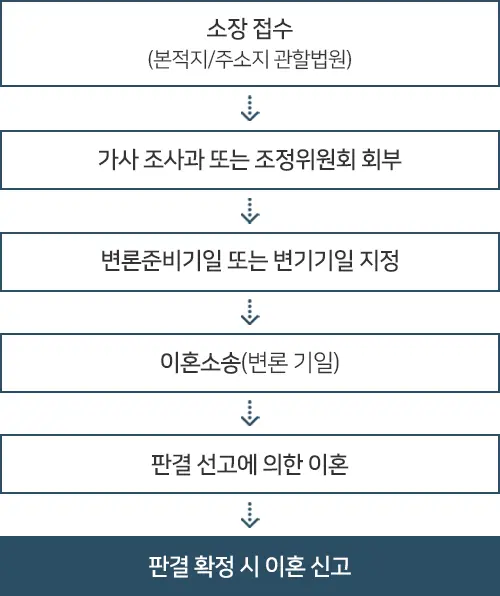
A judicial divorce begins with the filing of a complaint with the family court having jurisdiction over the relevant area.
The litigation procedure is similar to ordinary civil litigation but is governed by the Family Litigation Act and the Family Litigation Rules, and generally proceeds in the following order.
• In principle, conciliation is attempted first through the family conciliation procedure.
→ However, where one or both spouses cannot be summoned other than by service by public notice, the litigation proceeds directly.
• If no settlement is reached, the divorce litigation proceeds.
• An exchange of written submissions with the other party and the holding of pleading dates take place.
• Examination of evidence (such as examination of the parties and examination of witnesses) may be conducted.
• The court renders judgment on the outcome of the divorce litigation, and the judgment takes effect.
→ A party dissatisfied with the judgment may file an appeal or a final appeal within 14 days from the day the written judgment is served.
• A report of divorce is filed with the administrative authority within one month.
A judicial divorce generally takes about six months to one year, depending on the complexity of the matter and the scope of the issues, and may be prolonged over several years where there are many issues or the other party actively contests the case.
Essential Documents to Prepare for a Judicial Divorce
• Complaint for divorce (application for divorce mediation)
• Marriage relationship certificate for each spouse
• Resident registration abstract for each spouse
• Family relationship certificate for each spouse
• Basic certificate and family relationship certificate of any minor children
• Other supporting materials
2. Judicial Divorce | Claim for Consolation Money by the At-Fault Spouse

Even where a judicial divorce is granted, consolation money is not awarded automatically; a responsible ground attributable to one party must exist.
Consolation money for divorce generally ranges from about 10 million won to 30 million won.
Criteria for Calculating the Amount of Consolation Money
A claim for consolation money may be joined with the divorce claim or brought as a separate, independent claim for damages.
Consolation money may be claimed not only in a judicial divorce but also in cases of divorce by agreement, nullity of marriage, and annulment of marriage.
[ Key Considerations in Calculating the Amount of Consolation Money ]
• Proof of a responsible ground, such as an act of infidelity
• The degree of emotional harm
• The duration of the marriage
• Whether there are children
Grounds That May Support a Claim for Consolation Money
The most common ground for a claim for consolation money is an act of infidelity (adultery).
In the case of infidelity, in addition to the spouse who committed adultery, a claim for damages may also be brought against the affair partner, such as a lawsuit against the adulterous partner (male) or a lawsuit against the adulterous partner (female). The claim may also be brought against the affair partner.
In addition, consolation money may be claimed where emotional suffering can be proven, such as through domestic violence, serious verbal abuse or mistreatment, or the failure to provide living expenses.
In practice, it is common to join the claim for consolation money with the divorce litigation and pursue them together.
Evidentiary Materials Required When Filing a Claim
The following materials are required when claiming consolation money against a spouse.
Based on such evidence, the court calculates the amount of consolation money in light of the emotional suffering and its degree.
If you have difficulty gathering such evidence, it may be advisable to seek the assistance of an evidence-gathering professional.
Responding When the Other Party Refuses to Pay Consolation Money
The family court may order compliance and similar measures against a party who refuses to pay consolation money.
If the party fails to comply with such an order, the court may impose an administrative fine or order detention for up to 30 days until the consolation money is paid.
In addition, through compulsory execution, the court may proceed with a compulsory auction of the real estate of the person obligated to pay, in order to enforce payment of the consolation money.
3. Judicial Divorce | Property Division Strategy

In connection with a judicial divorce, it is also important to understand the property division lawsuit.
Property division is the procedure for liquidating and distributing the common property formed during the marriage according to each party's actual contribution (Article 839-2 of the Civil Act).
In principle, the property subject to division is the property accumulated through the joint cooperation of the spouses during the marriage, namely common property whose ownership as between the spouses is unclear.
Future income such as severance pay or pensions, as well as debts such as loans incurred while living together, are also subject to property division.
However, property that each spouse owned before the marriage, or property that one spouse acquired during the marriage through inheritance, gift, or testamentary gift, constitutes that spouse's 'separate property' and therefore cannot be subject to property division.
Characteristics of Property Subject to Division
• Gifted or inherited property: In principle this is separate property, but partial division may be possible where the other party's contribution to its maintenance, management, or increase is proven.
• Limitation period: The claim must be brought within two years after the divorce is finalized.
• Even an at-fault spouse may claim property division.
• Property received through division is not income, so no income tax is payable; however, if ownership of real estate is transferred, acquisition tax, local education tax, and the special tax for rural development must be paid.
• The person who transfers the property by way of division is likewise not subject to capital gains tax.
The Property Disclosure and Property Inquiry Systems
If you are concerned that the other party may conceal property, you may consider the property disclosure and property inquiry systems.
For a claim for division of marital property, where it is found necessary, the family court may order a party to submit a property list specifying that party's financial condition.
In such a case, the following property list must be submitted.
- Ownership of real estate, surface rights, and the like
- Ownership of automobiles and construction machinery subject to registration or recording, and the like
- Mining rights, fishing rights, and the like
- Money of 1 million won or more, and bills and checks totaling 1 million won or more
- Deposits totaling 1 million won or more, and insurance contracts with insurance proceeds of 1 million won or more
- Remuneration, support payments, income, and the like that may be received periodically
If property disclosure alone makes it difficult to resolve the case, an application for a property inquiry is also available.
4. Judicial Divorce | Parental Authority and Custody of Children
When pursuing a judicial divorce, you must also consider which parent your cherished child will live with.
If the child is a minor, the holder of parental authority and the custodian are determined by agreement; if no agreement is reached, the court designates them on its own authority.
Parental authority is the right and duty to protect and manage the person and property of a minor child, while the right of custody means the right and duty to directly raise and educate the child.
Principles for Designating Parental Authority and Custody
If no agreement is reached and a dispute arises, the family court designates the holder of parental authority and the custodian with the welfare of the child as its foremost consideration.
The family court determines the designation of the custodian, the allocation of childrearing expenses, and the matters of childrearing according to whether and how visitation rights are exercised, and in doing so considers the following factors.
• The parents' childrearing capacity, financial means, and childrearing environment
• The child's age and wishes
• The existing childrearing relationship, among others
Weighing these circumstances comprehensively, the court determines to which parent custody and parental authority will be granted.
The fact that matters of childrearing are settled through divorce does not change the blood relationship, the duty of support, or the right of inheritance between parent and child.
Visitation Rights and the Obligations of the Non-Custodial Parent
Visitation rights are the right of a parent who does not directly raise the child after divorce to interact with the child through meetings, telephone calls, letters, and the like.
If a parent has died or contact with the child is impossible, lineal ascendants such as grandparents may also apply for visitation.
If the other party obstructs this without justifiable reason, an application may be made to the family court for an order to comply and the imposition of an administrative fine, but confinement is not permitted.
However, where there is a risk of harm to the welfare of the child, the court may restrict or exclude visitation.
In addition, where a full adoption takes place after remarriage, the visitation rights of the biological parent are extinguished.
Child Support Calculation Table
A parent who does not raise the child must pay child support.
The method of payment is not restricted, whether by lump sum or in installments, and payment may also be received in kind, such as real estate, rather than in cash.
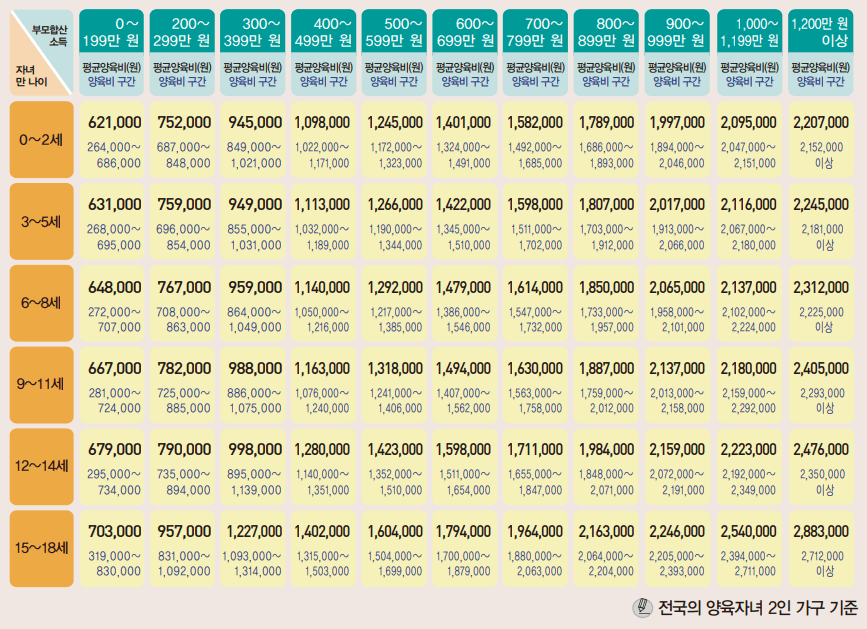
Generally, the period for bearing child support runs until the child reaches adulthood, and the specific amount of child support is determined in light of the parents' financial situation and other circumstances.
If circumstances change such that child support should be increased or reduced, a claim may be brought through a petition for adjudication to modify child support, among other means.
The child support calculation table is as follows. (Source: Seoul Family Court)
How to Respond to Non-Payment of Child Support
A child support claim is subject to compulsory execution, so in the event of non-payment it can be enforced through an application to the court for compulsory execution, an inquiry into property, the attachment of wages, and similar measures.
In addition, following the amendment of the Act on Securing and Supporting the Performance of Child Support, from July 1, 2025, unpaid child support may be paid in advance by the State until the minor child reaches adulthood (with the State subsequently recovering the amount from the debtor).
However, there are criteria for advance payment, such as minor children in households at or below 150% of the standard median income and the amount payable, so please confirm these in advance.
Sanctions may also be imposed on those who fail to perform child support obligations (such as suspension of a driver's license, a ban on departure from the country, and disclosure of the list of defaulters).
Procedure for Changing a Child's Surname and Origin
As a general rule, a child follows the father's surname and origin. However, where a change of surname and origin is necessary for the child's welfare following a judicial divorce, a petition for a ruling to change the surname and origin may be filed with the family court.
The application for the change of surname and origin is filed with the competent family court.
5. Judicial Divorce | How an Attorney Experienced in This Area Can Assist

A judicial divorce has a legally complex dispute structure. This is because it goes beyond the mere dissolution of the marital relationship and involves a range of derivative issues such as consolation money, property division, parental authority, custody, and child support.
Accordingly, the following step-by-step assistance is necessary.
- Preliminary consultation: Assessment of whether the grounds for judicial divorce are met, methods of gathering evidence, and analysis of anticipated issues
- Drafting the complaint and acting as litigation counsel: Conducting lawful proceedings in accordance with the Family Litigation Act and the Civil Procedure Act, and designing strategies for argument and proof
- Acting in conciliation and settlement: Seeking to reach an amicable settlement as far as possible at the pre-trial stage
- Execution after judgment: Compulsory execution of consolation money, property division, and child support, and acting in further litigation where the other party fails to comply
In particular, securing effective rights requires gathering sufficient evidence and making strategic arguments at an early stage, so for a judicial divorce we recommend obtaining the assistance of an attorney experienced in divorce matters.
A judicial divorce may appear to be a legal claim procedure aimed solely at 'divorce,' but within it numerous disputes are typically intertwined, including consolation money, property division, parental authority and custody, child support, and even points requiring criminal punishment where domestic violence has occurred.
If you wish to establish a lawful and fair set of rights through a court judgment and prepare for a new chapter in life, you should consult an attorney experienced in divorce matters thoroughly from the time you decide on divorce, and prepare evidence and a strategy carefully.
Key Points of the Litigation
Judicial Divorce Litigation Point | Key Content |
Existence and proof of statutory grounds for divorce | - Reviewing whether grounds for judicial divorce (such as infidelity, desertion, or violence) exist - Establishing a strategy to secure concrete evidence such as KakaoTalk messages, medical certificates, and witnesses |
Claim for consolation money and defense reasoning | - Structuring a strategy to claim or defend against consolation money depending on whether the party is at fault - Calculating the amount of consolation money in light of the duration of the marriage, the degree of fault, and the harm suffered |
Determining the subject and ratio of property division | - Distinguishing common property from separate property and structuring a strategy to increase the client's contribution - Tracing hidden assets and whether to include corporate assets are also key issues |
Parental authority and custody of children and child support | - As the holder of parental authority and the custodian are designated based on the welfare of the minor child, emphasizing the closeness between the client and the child - Preparation is needed in accordance with the family investigator's investigation, the childrearing plan, the child support standard table, and the like |
Litigation procedure strategy and the possibility of agreement | - Structuring a strategy that also keeps in mind the possibility of a prompt out-of-court settlement or conciliation - Pursuing firm response and coordination strategies in parallel, with the ordering of arguments and organization of evidence being important |
Daeryun, the ninth-largest law firm in Korea (based on 2025 value-added tax filings with the National Tax Service), forms a task force of one to twenty members depending on the scale and difficulty of the matter and does its utmost to assist so that the client's rights and interests are protected.
If you have any questions regarding judicial divorce, please book a legal consultation.