
CONTENTS
- 1. Divorce Consolation Money (Solatium) | The Concept of the Right to Claim Consolation Money

- - Claim for Consolation Money According to the Type of Divorce
- - Whether Transfer and Inheritance Are Possible
- - The Nature of the Right to Claim Consolation Money
- 2. Divorce Consolation Money (Solatium) | The Party Against Whom a Claim May Be Made
- - Can a Claim for Consolation Money Be Made Against a Third Party?
- - Is a Relationship Begun After the Breakdown of a Marriage Subject to a Claim for Consolation Money?
- - Defining the Scope of the Claim
- 3. Divorce Consolation Money (Solatium) | Calculation Criteria and Extinctive Prescription
- - Factors in Calculating the Amount of Consolation Money
- - The Extinctive Prescription of the Right to Claim Consolation Money
- 4. Divorce Consolation Money (Solatium) | Methods of Payment and Compulsory Execution
- - Methods of Paying Consolation Money
- - Methods of Enforcing Payment of Consolation Money
- 5. Divorce Consolation Money (Solatium) | Taxation and Tax Treatment
- - Taxation of the Person Receiving Consolation Money
- - Taxation of the Person Paying Consolation Money
- 6. Divorce Consolation Money (Solatium) | Strategic Response
- - Claims for Consolation Money Where Strategy Shapes the Outcome

1. Divorce Consolation Money (Solatium) | The Concept of the Right to Claim Consolation Money

Divorce is, beyond the mere dissolution of the marital relationship, a legal dispute in which compensation for emotional harm may be obtained depending on whether there is responsibility for the breakdown of the marriage.
Where the marriage has broken down due to a spouse's act of infidelity, violence, desertion, or the like, consolation money (solatium) may be claimed against the responsible spouse (Articles 806 and 843 of the "Civil Act (Civil Code)").
 Claim for Consolation Money According to the Type of Divorce
Consolation money may be claimed not only in a judicial divorce, but also in an uncontested divorce, or in the case of the invalidity or cancellation of a marriage.
However, where both spouses bear a similar degree of responsibility, a claim for consolation money may be dismissed.
Supreme Court Judgment of April 26, 1994, Docket No. 93Meu1273
Whether Transfer and Inheritance Are Possible
In principle, the right is a strictly personal right that cannot be transferred or succeeded to.
However, once a contract concerning the compensation has been formed between the parties, or once a lawsuit has been filed, transfer or succession becomes possible. (Article 806 (3) and Article 843 of the Civil Act.)
Supreme Court Decision 92Meu143, decided May 27, 1993
The Nature of the Right to Claim Consolation Money
Accordingly, the nature of the right to claim consolation money (solatium) may be summarized as follows.
▷ Possible in both divorce by agreement and judicial divorce
▷ After a lawsuit is filed, transfer and inheritance are also possible


2. Divorce Consolation Money (Solatium) | The Party Against Whom a Claim May Be Made
Consolation money for divorce is not something that can be claimed only against the spouse.
Consolation money may also be claimed against a third party who directly provided the cause of the breakdown of the marriage.
This is recognized as joint liability arising from the tort of a third party other than the spouse, and if the requirements for a claim for damages under the Civil Act are met, liability for consolation money may be imposed (Article 750 of the Civil Act).
Can a Claim for Consolation Money Be Made Against a Third Party?
The other party to the infidelity, parents-in-law, or a third party in a de facto marital relationship, that is, a person who has infringed upon married life, may be a target.
For example, where a person encouraged the affair, or broke down the relationship with the spouse through intimidation, verbal abuse, or assault, tort liability may be recognized.
A claim for consolation money is not recognized, however, merely on the ground that there was discord among family members.
There must be circumstances showing that the third party actively harmed the marital community life.
Is a Relationship Begun After the Breakdown of a Marriage Subject to a Claim for Consolation Money?
Because an affair or relationship that took place after the marital relationship had in fact broken down is difficult to regard as having infringed the marital community life, a claim for consolation money is not recognized.
In such a case, the court holds that if the marriage has already substantially ended, it is not a subject of the right to claim consolation money.
Defining the Scope of the Claim
▷ Where a third party directly caused the breakdown of the marriage
▷ An affair after the breakdown of the marriage is not subject to a claim for consolation money
3. Divorce Consolation Money (Solatium) | Calculation Criteria and Extinctive Prescription
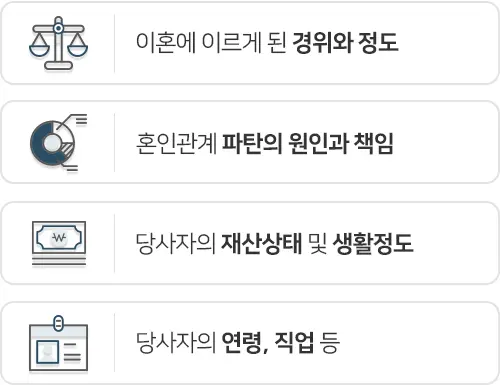
There is no fixed statutory standard for the amount of divorce consolation money, and it is determined by comprehensively considering various factors, such as the circumstances of and responsibility for the breakdown of the marriage, the economic situation of the parties, and their standard of living.
In addition, because the right to claim consolation money corresponds to the right to claim damages under the Civil Act, the short-term extinctive prescription of three years applies (Civil Act, Article 766, paragraph 1).
Factors in Calculating the Amount of Consolation Money
The court calculates the amount of consolation money by comprehensively considering the following factors.
▷ The duration of the marriage, the presence of children, and the spouse's age and occupation
▷ Economic and social status and standard of living
▷ The degree of mental suffering and the supporting evidence
▷ Whether there was an agreement between the parties, and any history of past litigation or conflict
Consolation money ranges from several million won to tens of millions of won, and it varies greatly depending on the content and degree of the culpable conduct.
For example, where clear infidelity is established, up to tens of millions of won may be recognized, but if the circumstances of the breakdown are open to dispute or if mutual responsibility is recognized, it may be reduced to several million won or less.
The Extinctive Prescription of the Right to Claim Consolation Money
A right to claim consolation money is extinguished when three years pass from the date on which the harm and the perpetrator became known (the date of divorce), or when ten years pass from the date on which the tort occurred (Article 766 of the Civil Act).
Method of divorce | Standard |
Divorce by agreement | Three years from the date of the divorce report |
Judicial divorce | Three years from the date the judgment becomes final |
Nullity or annulment of marriage |
Where a claim for consolation money is generally pursued together with the divorce lawsuit, prescription issues rarely arise.
The issue arises in the case of a divorce by agreement in which the divorce has taken place but no separate agreement was reached on consolation money. In that case, a lawsuit for consolation money must be filed within three years from the date of divorce.
4. Divorce Consolation Money (Solatium) | Methods of Payment and Compulsory Execution

Divorce consolation money is damages that the spouse at fault pays to the other party in an amount determined through agreement or trial.
However, if the other party does not pay voluntarily, the amount can be recovered through legal compulsory execution after going through certain procedures.
Methods of Paying Consolation Money
Consolation money may be paid in the following ways, and the method may vary according to the agreement of both parties or the decision of the court.
: payment of a fixed amount at one time
▷ Installment payment
: payment divided over a certain period
(for example: monthly payment)
▷ Payment by transfer of property other than cash, such as real estate or a vehicle
▷ In some cases, payment combined with child support or division of property
In this case, if consolation money is paid in the form of real estate or the like, tax issues arising from the transfer of ownership may occur.
Methods of Enforcing Payment of Consolation Money
If the other party does not perform the obligation to pay the consolation money, you may apply for compulsory enforcement through the following procedure.
① Application for an order to comply (Article 64 of the Family Litigation Act)
Where the consolation money is not paid pursuant to a title of execution such as a family court judgment or a protocol of conciliation, an order to comply may be obtained directing payment within a certain period.
▷ If payment is not made for three or more installments without justifiable grounds, confinement is possible (up to 30 days)
※ Confinement refers to a court order to take the obligated person into custody in a detention room, a detention center, or a similar facility.
② Application for compulsory execution (Article 28 of the Civil Execution Act and related provisions)
Based on a title of execution such as a judgment, a protocol of conciliation, or a protocol of settlement, you may apply for compulsory execution against the other party's property, such as real estate, wages, and deposits.
▷ Attachment of deposit claims or wages
▷ Attachment of movable property such as automobiles and precious metals
▷ Attachment available pursuant to a payment order decision
※ If there is a possibility that the other party will dispose of the property in advance, you should apply for a preservative measure such as provisional attachment or provisional injunction before filing the lawsuit.
Related News
5. Divorce Consolation Money (Solatium) | Taxation and Tax Treatment

Because divorce consolation money has the character of damages, it is generally not subject to taxation.
However, tax issues may arise depending on the method of payment, the amount, and the purpose of payment.
In particular, where consolation money is paid in the form of a specific asset such as real estate, capital gains tax, acquisition tax, and similar taxes must also be considered.
Taxation of the Person Receiving Consolation Money
Because consolation money is basically regarded as compensation for mental harm, in most cases no tax is imposed.
However, in exceptional cases it may become subject to taxation as follows.
: Non-taxable (excluded from application under Article 4 of the 「Income Tax Act」)
▷ Gift tax
: Generally non-taxable.
However, where the form is consolation money but it is in substance a 'sham divorce' for transferring assets, gift tax may be imposed
▷ Acquisition tax
: Taxable where real estate is transferred as consolation money (Article 7 of the 「Local Tax Act」, etc.)
※ Where high-value real estate is transferred under the name of consolation money, it may become subject to a gift tax investigation, so the grounds for payment and the basis for payment should be clearly documented in accordance with the facts.
Taxation of the Person Paying Consolation Money
Because the payment of consolation money is itself a form of damages, tax is generally not imposed, but where payment is made by transferring assets such as real estate, a capital gains tax issue may arise.
: No tax
▷ Transfer of real estate
: Subject to capital gains tax (treated as a transfer for value)
▷ Transfer of other assets
: Whether tax applies is determined by the nature of the asset concerned
6. Divorce Consolation Money (Solatium) | Strategic Response
Divorce consolation money (solatium) is not merely compensation for emotions but a legal procedure for proving responsibility for the breakdown of the marriage and obtaining monetary compensation.
Because the court determines the amount of consolation money (solatium) by comprehensively considering the degree of responsibility of the spouse at fault, the duration of the marriage, the emotional harm, and economic capacity, it can be difficult to obtain the desired outcome through mere assertion alone.
Accordingly, you should organize the following items yourself and approach the matter strategically.
Practical Preparation and Strategy for a Consolation Money (Solatium) Claim
Item | Specific content and strategy |
Organizing the grounds of fault | Organizing specific facts of infidelity, violence, desertion, and the like, and securing supporting evidence |
Organizing the married life | Organizing in writing the duration of the marriage, whether there are children, the time and course of the conflict, the circumstances of the emotional suffering, and other matters |
Review of the extinctive prescription | Confirming whether the claim is filed within 3 years from the date of divorce by agreement or the date the judgment becomes final, and analyzing the starting point in the case of a claim against a third party |
Calculating the amount of consolation money (solatium) | Setting a realistic claim amount by comprehensively considering the degree of fault, economic capacity, standard of living, and other factors |
Whether to claim against a third party | Determining whether a third party, such as an affair partner, was involved and whether the tort can be proven |
Method of payment and tax review | Reviewing in advance the tax risks, such as acquisition tax and capital gains tax, depending on the form of payment, including cash and real estate |
Preparing for compulsory execution | Confirming the other party's assets, reviewing the possibility of provisional attachment and compulsory execution, and preparing preemptive measures where necessary |
Claims for Consolation Money Where Strategy Shapes the Outcome
This law firm has many attorneys with an average of more than 10 years of experience, and depending on the scale and difficulty of the case, it forms a task force of 1 to 20 members to respond to the case.
It also collaborates with experts in each field, such as tax accountants, certified public accountants, and evidence investigation specialists, to respond comprehensively from the claim for consolation money through to recovery.
If you are in a situation requiring a claim for consolation money following a divorce, please entrust your case through the 🔗divorce attorney legal consultation reservation.
See More


Watch related video content
for this case study.

Lawyer's Official No. 1 reason for divorce, check before marriage