CONTENTS
- 1. Nullity of Marriage Lawsuit | Grounds for Filing

- - Grounds for Nullity of Marriage
- 2. Nullity of Marriage Lawsuit | How to File
- - Plaintiff and Defendant
- - The Litigation Procedure
- - Supporting Evidence
- 3. Nullity of Marriage Lawsuit | Effect of a Final Judgment
- - Deemed Never to Have Been Married
- - The Child Deemed 'Born Out of Wedlock'
- - Claim for Damages Available
- - Criminal Complaint Available
- 4. Nullity of Marriage Lawsuit | Possibility of Filing After Divorce
- 5. Nullity of Marriage Lawsuit | Items to Prepare
- - Support System of a Divorce Attorney

1. Nullity of Marriage Lawsuit | Grounds for Filing

A nullity of marriage lawsuit is an action filed to treat a marriage that is not legally valid as having never existed from the outset.
In other words, where the requirements for the formation of a marriage have not been met, a party may request the court to declare the marriage null and void.
 Grounds for Nullity of Marriage
In order to file a nullity of marriage lawsuit, the case must fall within the grounds for nullity of marriage.
Article 815 of the Civil Act provides that a marriage is, in principle, null and void in the following cases.
(2) If there is or was a lineal relationship by affinity between the parties
(3) If there was a lineal blood relationship through adoptive parents between the parties
In particular, where only a formal report of marriage was filed without any intention of actually living as a married couple, or where the marriage was between persons related by affinity or close kinship, it may fall within the grounds for nullity of marriage.
In addition, a marriage between blood relatives within the eighth degree was originally deemed null and void; however, pursuant to the Constitutional Court's decision of nonconformity to the Constitution (2019Heon-Ga15), that provision lost its effect as of December 31, 2024.
As no amending legislation has been enacted to date, as of 2025 the statutory provision deeming a marriage between blood relatives within the eighth degree null and void has no effect.


2. Nullity of Marriage Lawsuit | How to File

A nullity of marriage lawsuit may be filed where grounds for nullity of marriage exist.
Plaintiff and Defendant
If grounds for nullity of marriage exist, the following persons may file a nullity of marriage lawsuit with the family court (Family Litigation Act, Article 23).
Plaintiff (the person filing the lawsuit)
∙ A legal representative
∙ A relative within the fourth degree
If a party files the nullity of marriage lawsuit, the spouse becomes the opposing party.
By contrast, where a third party (a legal representative or a relative within the fourth degree) files the lawsuit, the married couple become the opposing parties.
If the person who would be the opposing party has died, the public prosecutor becomes the opposing party (Family Litigation Act, Article 24, Paragraphs 1, 2, and 3).
Plaintiff | Defendant |
A party (one of the spouses) | The other spouse |
The public prosecutor (where the person who would be the opposing party has died) | |
A third party (a legal representative or a relative within the fourth degree) | The married couple (or the survivor where one has died) |
The public prosecutor (where the person who would be the opposing party has died) |
The Litigation Procedure
To assert the nullity of a marriage, a complaint for a nullity of marriage lawsuit must be submitted to the family court having jurisdiction over the place of residence.
Contents of the Complaint
∙ The purpose of the claim for nullity of marriage
∙ The cause of the claim (stated in detail)
∙ Attachment of materials capable of proving the grounds for nullity)
At this point, evidence capable of proving that the marriage is null must be organized and attached.
A nullity of marriage lawsuit is classified under the Family Litigation Act as a case that is not referred to mediation, and in principle does not go through the mediation procedure (see Family Litigation Act, Article 2, Paragraph 1, Item 1(a)1, and Article 50, Paragraph 1).
Through the lawsuit, the court conducts its examination on the basis of both parties' assertions and evidence.
If the grounds for nullity are recognized on the basis of the submitted evidence and assertions, the court renders a judgment of nullity of marriage.
Supporting Evidence
Because a nullity of marriage lawsuit requires a stricter legal determination than an ordinary divorce lawsuit, materials capable of supporting the point that the marriage was never established from the outset must be prepared systematically.
: written statements, text or KakaoTalk conversations, testimony of family members and acquaintances, and the like
∙ Official supporting documents, such as a family relation register, that can confirm a relationship by affinity or blood
∙ Objective circumstances showing that only a formal report of marriage existed and there was no substantive marital relationship
∙ Materials proving a lineal blood relationship through adoptive parents (such as a certificate of adoptive relationship)
Because the key is to prove that there was no substance to the marriage, it is important to set out specifically the actual absence of married life or that the relationship was one prohibited by law.
3. Nullity of Marriage Lawsuit | Effect of a Final Judgment
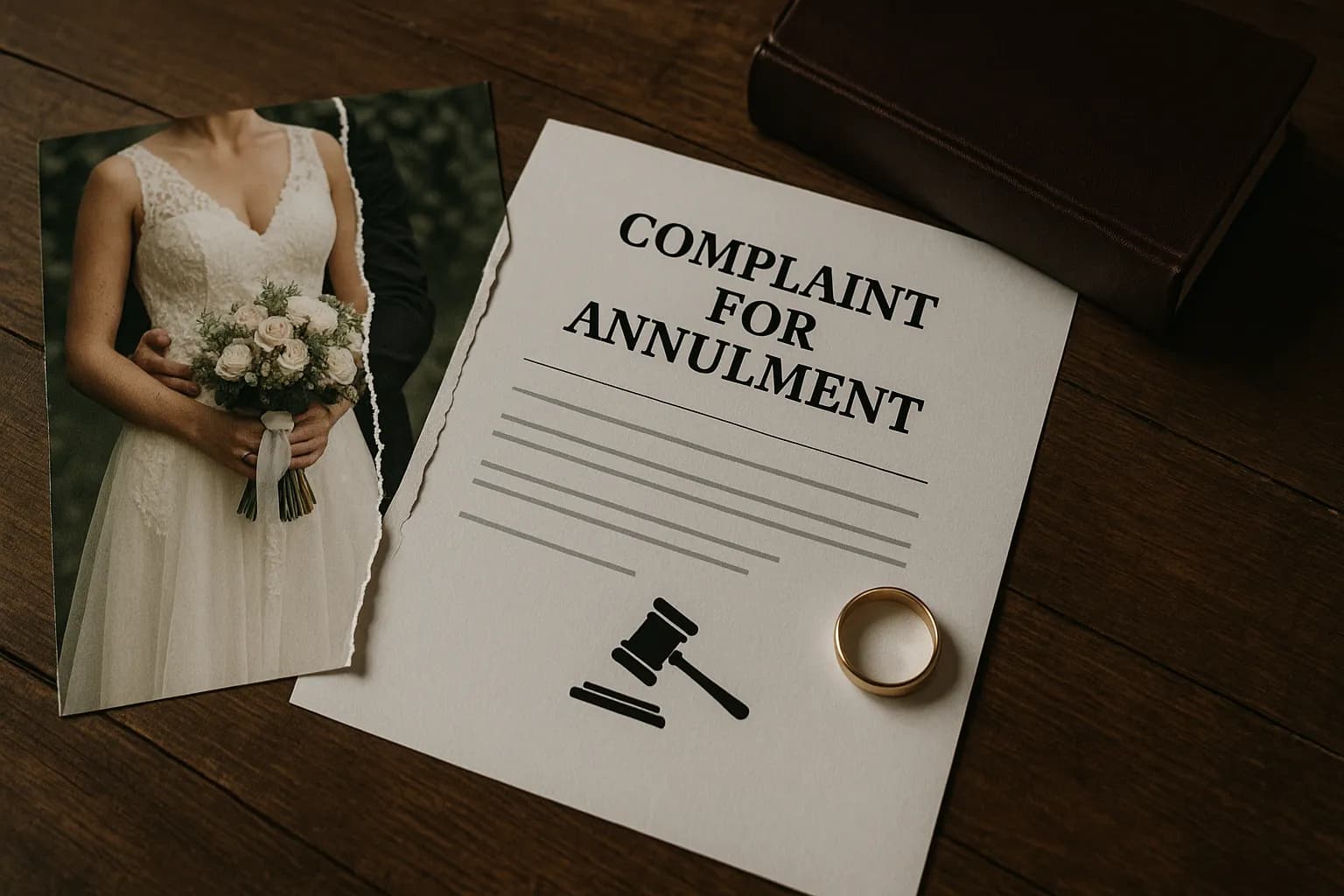
Once a judgment of nullity of marriage becomes final, the marriage is legally deemed never to have existed in the first place. This has an entirely different legal effect from divorce or marriage annulment, and the following consequences arise.
Deemed Never to Have Been Married
When a marriage becomes null, the parties are deemed never to have been married from the outset, and the marriage is treated as having had no effect from the beginning.
In addition, the record of the marriage is deleted from the family relation register.
The Child Deemed 'Born Out of Wedlock'
In the case of nullity of marriage, a child born of that marriage is treated as a child born out of wedlock, and accordingly the parent-child relationship must be established through the acknowledgment procedure (Civil Act, Article 855, Paragraph 1).
However, for the legal protection of the child, the father or mother may acknowledge the child, or the court may decide the matter on its own authority.
Claim for Damages Available
If the cause of the nullity of marriage results from the other party's gross negligence or intent, a claim for compensation for emotional and financial loss is available.
This is because, under Article 806 of the Civil Act (damages upon rescission of engagement) and Article 825 (provisions applied mutatis mutandis to annulment and nullity of marriage), compensation may be claimed where the other party bears serious fault.
In other words, if the other party concealed the fact of the marriage or hid a relationship that is not legally permitted, compensation may be claimed not only for financial loss but also for emotional distress.
Supporting Evidence for a Claim for Damages
Situation | Supporting Evidence |
Marriage through intent or gross negligence | Text messages, KakaoTalk messages, emails, recordings, written statements, and the like showing circumstances of concealment or deception of the facts |
False intent to marry or marriage by deception | The absence of photographs, the lack of any record of living expenses paid, statements of third parties, and the like showing that a marriage was outwardly entered into but there was no actual cohabitation or married life |
If a relationship not legally permitted was concealed | Official documents that can confirm a blood or affinity relationship, such as a family relation register and a certificate of adoptive relationship |
Supporting evidence of emotional distress | Counseling records, medical certificates, psychiatric treatment records, testimony of acquaintances, and the person's own written statement |
Supporting evidence of financial loss | Receipts for expenses incurred on the premise of the marriage, account transaction records, and the like |
Criminal Complaint Available
Once nullity of marriage is recognized, the marriage itself is deemed never to have existed.
Accordingly, the case is no longer subject to the rule on intra-family property offenses (Criminal Act, Article 328), so a criminal complaint becomes available for property crimes (such as fraud, embezzlement, and theft) that previously could not be criminally punished.
4. Nullity of Marriage Lawsuit | Possibility of Filing After Divorce

A nullity of marriage lawsuit originally could not be filed where the spouses had already divorced.
This was because the position of the precedents was that such a suit would be rejected for lack of a legal interest in the action.
In 2023, however, the Supreme Court en banc (Judgment 2020Meu15896) changed this prior position and held that a nullity of marriage lawsuit may be filed even after divorce.
The Supreme Court found that “correcting a family relations register that incorrectly records a history of marriage nullity requires objective documentary evidence, and a suit for confirmation of nullity of marriage may be filed as a procedure for obtaining such evidence.”
Accordingly, even where a marriage has already ended, if a legitimate interest exists in obtaining confirmation that the marriage never came into being in the first place, the position is that the court must determine whether it is void through a substantive examination.
As a result, a nullity of marriage lawsuit has become possible even after divorce, and a legal remedy for correcting an erroneous marriage history has been clearly opened.
5. Nullity of Marriage Lawsuit | Items to Prepare
To file a nullity of marriage lawsuit, the following items should be reviewed in advance and prepared thoroughly.
Category | Item to Prepare |
Confirming Grounds for Nullity | Review of applicability under Article 815 of the Civil Act |
Confirming the Competent Court | The family court with jurisdiction over the defendant's address or the place of marriage registration |
Securing Supporting Evidence | - Text messages, KakaoTalk, written statements, etc. (absence of agreement) |
- Family relations register, adoption relationship certificate (blood or in-law relationship) | |
- Living expense records, absence of photographs, third-party statements, etc. (absence of married life) | |
Drafting the Complaint | Organize the key arguments and supporting evidence, then reflect them in the complaint |
Reviewing the Possibility of Filing Suit | Review of the possibility of filing suit where the parties have divorced |
Whether a substantial legal interest exists, such as correction of the family relations register | |
Responding to Child-Related Matters | Confirmation of and response to the status of a child born out of wedlock |
Review of whether acknowledgment procedures are necessary and of measures to protect the child's rights |
If you prepare step by step based on the table above, a clearer and more systematic nullity of marriage lawsuit can proceed.
Support System of a Divorce Attorney
This law firm has many attorneys experienced in this area with an average of more than ten years of practice, and depending on the scale and difficulty of a case, it forms a task force of one to twenty members to handle the matter.
In addition, it can provide comprehensive assistance extending to related civil and criminal cases by collaborating with specialists in each field, such as accountants, tax accountants, and evidence investigation professionals.
If you need to pursue a claim for nullity of marriage, please request a consultation with a divorce attorney.
See More


Watch related video content
for this case study.

Lawyer's Official No. 1 reason for divorce, check before marriage