




CONTENTS
- 1. School Violence Reporting Procedure | A Process to Understand in Advance

- - Representative Types of School Violence That May Be Reported
- 2. School Violence Reporting Procedure | Reporting Methods and the Receipt Process
- - Formation of the Dedicated Body
- - Methods of Fact-Finding in Investigating a Matter
- - Emergency Measures for the Students Concerned
- - Resolution at the School Level or Convening of the School Violence Committee
- 3. School Violence Reporting Procedure | How to Report Outside the School
- - Methods of Online Reporting and Emergency Reporting
- 4. Procedure for Reporting School Violence | Tips and Points to Note in Preparing a Report
- - Items to Be Included in the Report
- - Checking on Progress After the Report
- 5. Procedure for Reporting School Violence | Protecting Rights After the Report

1. School Violence Reporting Procedure | A Process to Understand in Advance

The school violence reporting procedure is a process that students, parents, and teachers should all understand.
Since school violence not only seriously harms the victim student's right to learn and right to dignity but is also a grave problem that can leave long-term psychological and physical wounds, if the fact of harm is not uncovered or is not handled appropriately, the victim student may fail to adjust to school life and may even reach the point of an extreme choice.
Many 🔗School Violence victim students and their parents often hesitate to report or fail to respond actively because they are unaware of the procedure.
School violence is not a problem for the victim to bear alone.
External agencies such as the school, the office of education, and the police must become involved, and clear evidence must remain in order for appropriate measures to be taken against the offending student.
Guardians should report school violence promptly without hesitation, and should correctly understand and prepare for the procedure. This explains in detail, step by step, from the preparation stage before reporting to the receipt of the report and the points to note after reporting.
 Representative Types of School Violence That May Be Reported
Type of School Violence | Key Elements to Identify in Fact-Finding upon Reporting |
Physical violence | The seriousness of the bodily injury, whether there was confinement or physical restraint, and whether there was sexual violence |
Economic violence | The seriousness of the harm (amount, frequency, continuity), whether there was restitution, whether there was destruction of property, and the degree of intimidation/coercion |
Emotional violence | Whether it was continuous, the degree of intimidation/coercion, and whether there was sexual harassment |
Verbal violence | Profanity/vulgar language, falsity, and whether there was sexual harassment |
Cyber violence | Identity theft, the violent/obscene nature, the degree of dissemination, and whether there was cyber sexual violence |
2. School Violence Reporting Procedure | Reporting Methods and the Receipt Process
As for school violence, anyone who witnesses the scene or becomes aware of the facts must report it to the school or other relevant agencies.
If a report is received in accordance with the school violence reporting procedure, it must be reported to the (district) office of education within 48 hours of becoming aware of it.
- Receipt of report : reporting orally, via a report box, via survey (email, SNS, website, etc.), to the 112 police, the 117 School Violence Report Center, a school resource officer, and the like (sexual violence matters may be reported anonymously)
- Recording the receipt of the report : notifying the reporter of the fact of receipt, and confirming the status of the victim and the 🔗School Violence Offender
- Reporting of receipt : after reporting to the principal and notifying the homeroom teacher, the offending student is subjected to a prohibition on retaliatory measures, the offender and the victim are separated and safety measures are taken, the guardians are notified, and a report is made to the office of education
Formation of the Dedicated Body
The vice principal, the professional counseling teacher, the health teacher, parents, and others form a dedicated body in charge of school violence issues.
Parents must constitute at least one third of the members of the dedicated body.
The dedicated body investigates the school violence matters received and reviews whether the case may be resolved by the school principal, among other roles.
Methods of Fact-Finding in Investigating a Matter
Emergency Measures for the Students Concerned
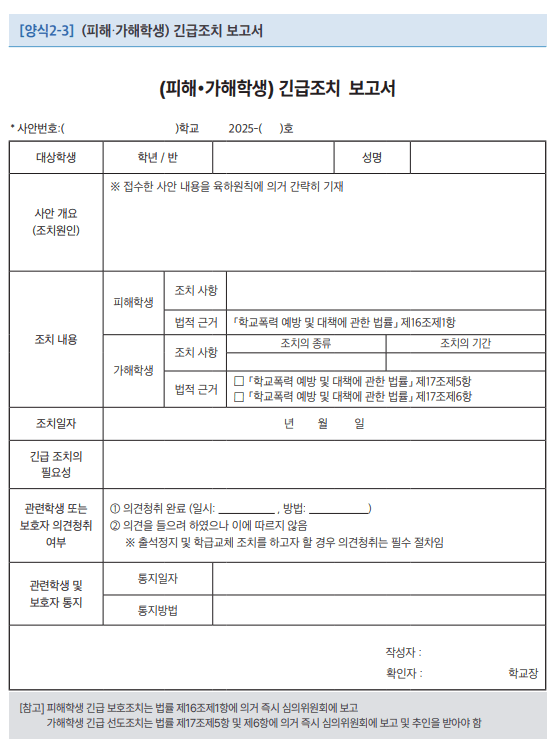
In the case of a 🔗school violence victim who has gone through the school violence reporting procedure, emergency measures for protection may be necessary.
The principal may take measures such as psychological counseling and advice by experts within or outside the school, temporary protection, and treatment and recuperation, and in such cases any absence necessary for the measure is recognized as attendance.
The following emergency measures may be imposed on an offending student.
- A written apology to the victimized student
- Service within the school
- Completion of special education or psychological treatment
- Suspension from attendance
- Transfer to another class
Resolution at the School Level or Convening of the School Violence Committee
The principal may resolve, at the school level, instances of school violence received through the school violence reporting procedure.
- Where no medical certificate requiring physical or psychological treatment of two weeks or more has been issued
- Where there is no property damage, or where any property damage is immediately remedied or a promise to remedy it has been made
- Where the school violence is not continuous
- Where it does not constitute an act of retaliation (including acts using an information and communications network) in response to a report, statement, or provision of materials regarding school violence
However, even where the requirements for resolution at the school level by the principal are met, if the victimized student and the student's guardian request that the school violence committee be convened, the convening of the 🔗School Violence Countermeasures Deliberation Committee must be requested.
See More


3. School Violence Reporting Procedure | How to Report Outside the School
Where internal school response alone is insufficient, or where the homeroom teacher or the school does not respond actively, external reporting must be pursued concurrently and without delay.
The representative external reporting channels are the district office of education, the police station, and the 117 School Violence Report Center.
Because the district office of education has the authority to manage and supervise the school violence matters of the schools under its jurisdiction, the victim may file a complaint directly with the district office of education where the school's response is inadequate.
The district office of education may require the school to conduct a re-investigation or to make an additional report, and, where necessary, may direct that the School Violence Review Committee be convened.
Reporting to the police is essential if the matter is a criminal one, such as physical violence, extortion of money or goods, or sexual harassment.
One may visit the nearest police station directly, or the 117 School Violence Report Center receives reports 24 hours a day by telephone, text message, KakaoTalk Plus Friend, and the like.
Once a report is received, direct investigation or protective measures may be carried out by the local police station.
Methods of Online Reporting and Emergency Reporting
Recently, reports can also be filed conveniently online through a school violence reporting app (the Eoullim app) or through the websites of each Metropolitan and Provincial Office of Education.
One may install the school violence reporting app on a smartphone or attach the facts of the harm and the evidence through the 'School Violence Report Center' on the Office of Education website.
A reporter may also report anonymously without disclosing their name; however, because anonymous reports may be of limited effectiveness, as it is difficult to verify the facts during the investigation, it is advisable to use them when the evidence is clear.
If the school violence situation is urgent and immediate separation is necessary, one may report directly to the police or request emergency measures from the Office of Education without going through the homeroom teacher and the dedicated body.
Where there is a threat to one's safety, it is helpful to request a place for emergency evacuation and to ask that a counseling teacher or expert accompany the student.
4. Procedure for Reporting School Violence | Tips and Points to Note in Preparing a Report

Once you have decided to report school violence, the first thing a victimized student should do is to record the facts of the harm as specifically as possible and secure evidence.
In school violence cases, objective materials, in addition to the victim's statement, play an important role.
Anything that can serve as evidence—the content of conversations with the offending student, SNS messages, texts, chat captures, photographs of injuries, and damaged belongings—should all be gathered and kept.
Recording without omission the time and place of the harm, the offender's name, whether it was repeated, and, if there were witnesses, who they were, is of great help to the person in charge or the investigating teacher in ascertaining the facts when the report is later received.
It is also advisable to note the dates and content of any discussions of the harm with the homeroom teacher or parents.
From the standpoint of an offending student who has been wrongly accused, such records can also be used as rebuttal material.
Items to Be Included in the Report
The report should set out the facts of the harm specifically, and if the facts are omitted or vague, processing may be delayed.
In particular, it is advisable to include the following without omission.
When submitting the report to the school, it is advantageous in any future dispute to request a receipt and to additionally confirm the fact of receipt by email, text message, or the like.
Checking on Progress After the Report
Having completed the report does not mean that every part of the procedure is then handled automatically.
The victim and the guardian should periodically check on the progress with the school, the District Office of Education, or the police.
In particular, to prevent the school's dedicated body from omitting or delaying the report, one should regularly check the processing deadlines and notifications of results and, if necessary, submit supplementary materials.
Even after the report, the offender's side may demand that the matter be smoothed over or settled; however, it is advisable for the victim not to settle hastily before taking legal measures.
An unnecessary settlement may make a subsequent disposition by the school violence committee or a police investigation difficult, and may lead to secondary harm.
5. Procedure for Reporting School Violence | Protecting Rights After the Report
Reporting school violence is not a one-off procedure but a process that the victim and family must manage continuously.
After the report, one should communicate closely with surrounding teachers and the school's person in charge so that no secondary harm comes to the victimized student, and, if necessary, support physical and psychological recovery by combining expert counseling with legal advisory.
In addition, the victim may exercise the rights guaranteed by law, such as the right to state an opinion and the right to confidentiality, during the investigation.
A school violence matter must not be arbitrarily closed or scaled down against the victim's wishes.
If you are dissatisfied with the outcome of the processing by the school or the District Office of Education, you may pursue administrative adjudication or 🔗school violence administrative litigation proceedings, and may thereafter pursue legal liability by combining civil and criminal procedures.
It is not too late even now, so if there is any suspicion of harm, you should gather evidence and report it simultaneously to the school and to outside agencies to protect the victim's rights.
If you need legal assistance while going through the school violence reporting procedure, you may then receive a 🔗referral to a school violence attorney and proceed with a consultation.










