
CONTENTS
- 1. School Violence Criminal Complaint | The Concept of a Criminal Complaint

- 2. Criminal Complaint over School Violence | Method of Filing a Criminal Complaint
- - Reporting to the School Violence Committee Alongside a Criminal Complaint
- - How to File a Criminal Complaint and Points to Note
- - Punishment of the Offending Student and Recovery for the Victim
- - Appeal under the Juvenile Act When the Disposition Is Unjust
- 3. Criminal Complaint over School Violence | How an Accused Offender Should Respond
- - Settlement with the Victim and Request for Leniency
- - Juvenile Protective Disposition Following Criminal Proceedings
- - Types of Juvenile Protective Disposition
- - Why Criminal Punishment Follows Referral to the Prosecutor
- - Internal School Discipline and the Civil Dimension
- 4. Criminal Complaint over School Violence | Checklist of Points to Note

1. School Violence Criminal Complaint | The Concept of a Criminal Complaint

A school violence criminal complaint is a procedure that a victimized student in a school violence case undertakes, in addition to the procedure of the School Violence Countermeasures Deliberation Committee, in order to hold the offending student's side criminally liable through a criminal complaint.
It is not limited to physical violence but appears in various forms, such as verbal violence, ostracism, cyberbullying, and stalking, and it leaves emotional wounds on the victimized student that are difficult to heal.
The victimized student and guardian may request disciplinary measures against the offending student internally within the school through the procedure of the School Violence Countermeasures Deliberation Committee (hereinafter the ‘School Violence Committee’), but where the criminal nature of the act of violence is clear, the offending student may also be directly punished through criminal procedure.
A school violence criminal complaint is significant in that it imposes a punishment by holding the offending student criminally liable and effectively secures the relief of the victimized student's rights.
However, because many of the offending students are minors, separate procedures such as referral to the juvenile court under the Juvenile Act are often carried out, and because the internal school procedure and the criminal procedure proceed in parallel, care is required in responding to the relevant matters.
The ages of an offending student against whom a school violence criminal complaint may be filed are as follows.
Age of Offending Student | Juvenile Protection Trial | Criminal Trial |
Under 10 years of age | X | X |
10 years of age or older to under 14 | 〇 | X |
14 years of age or older | 〇 (under 19) | 〇 |


2. Criminal Complaint over School Violence | Method of Filing a Criminal Complaint
If an incident arises that calls for a criminal complaint over school violence, the first thing to do is to confirm the facts and secure evidence.
Rather than the victimized student and guardian responding emotionally and raising their voices, it is important to set out concretely when, where, by whom, and what kind of violence occurred.
 Reporting to the School Violence Committee Alongside a Criminal Complaint
A school violence case becomes a formal matter when it is reported or accused to a teacher, the National Police Agency, or the 117 School Violence Center, among others.
Where the school principal finds it difficult to resolve the matter internally, a School Violence Committee (Hakpok-wi) is established, and proceedings to impose a school violence disciplinary disposition are conducted.
Depending on the matter, measures such as a written apology to the victim, a no-contact order, a change of class, or a transfer to another school may be imposed on the offending student.
However, as this amounts to no more than internal school discipline, if the facts of a crime such as assault, bodily injury, or a sexual offense are clear, a separate criminal complaint may be filed with the police.
The School Violence Committee process proceeds separately from the criminal complaint, and although there are cases in which the school discourages a criminal complaint, arguing that the committee's measures are sufficient, the victimized student's right to file a criminal complaint is guaranteed.
How to File a Criminal Complaint and Points to Note
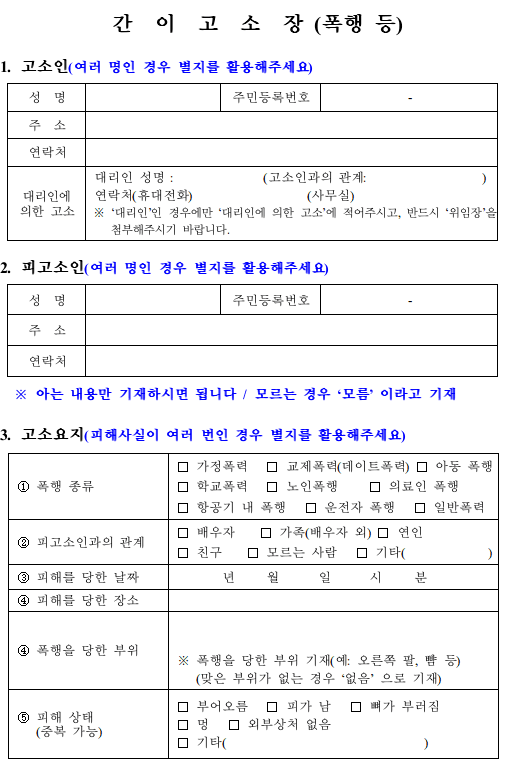
The victimized student, or the student's legal representative (guardian), must personally file the criminal complaint over school violence with the police.
In the complaint, the facts of the harm should be set out concretely in the order of date and time, place, and method, and the secured evidence should be attached.
Once the criminal complaint is received, the police investigate the offending student and the victimized student separately. A guardian may be present during the investigation, and the recording of statements is conducted as a rule.
Punishment of the Offending Student and Recovery for the Victim
If the offending student's offense is proven, the case proceeds to a juvenile protection trial before the juvenile court or to a criminal trial.
A person under 14 may receive only a protective disposition under the Juvenile Act, but a person aged 14 or older may, after referral to the juvenile court, receive a protective disposition or criminal punishment.
The offending student's side stands trial under the Criminal Act for assault, intimidation, bodily injury, rape, indecent act by compulsion, and the like.
Even though juvenile protective dispositions such as probation and a community service order are more common than an actual custodial sentence, if the victimized student's side wishes for severe punishment, it should not express any intention to settle.
Appeal under the Juvenile Act When the Disposition Is Unjust
Under Article 43 of the Juvenile Act, where, following a criminal complaint over school violence, a protective disposition or the like is manifestly unjust, or there is a violation of law or a serious misapprehension of fact bearing on that decision, an appeal may be filed.
- Period for filing an appeal : 7 days
- Submission of the notice of appeal : submitted to the original juvenile court
- Appellate proceedings : where the appeal is without merit, dismissal; or revocation of the original decision followed by remand to the original juvenile court, etc.
- Stay of execution : an appeal does not have the effect of staying the execution of the decision (Article 46 of the Juvenile Act)
- Re-appeal : against a decision dismissing an appeal, a re-appeal to the Supreme Court is possible in the case of a violation of law
3. Criminal Complaint over School Violence | How an Accused Offender Should Respond

If you have been notified by the school or the police that a criminal complaint over school violence has been filed, you should immediately ascertain the facts and consult with your parents.
Because whether the charges are acknowledged may turn on the content of the initial statements, care must be taken so that the letter of reflection written at the school does not conflict with the statements given to the police.
Accordingly, since distorting the facts and unreasonably denying them during the investigation may rather be disadvantageous, one must fully ascertain the facts and decide on a direction of response.
The offending student has the right to remain silent, and the right to have a parent or defense counsel present is guaranteed.
If a confession is coerced or excessive questioning is conducted, an objection may be raised immediately.
Settlement with the Victim and Request for Leniency
If the facts of the offense are clear, it is important to seek leniency through a settlement with the victim.
On the other hand, if the facts differ or the complaint is false, rebutting evidence must be prepared promptly.
Recordings of conversations with the victimized student and statements from witnesses may also be useful to the offending student in proving innocence, so securing them should not be neglected.
Juvenile Protective Disposition Following Criminal Proceedings
If a student who has committed school violence is 14 or older, the student is subject to the Juvenile Act and at the same time subject to the Criminal Act.
Accordingly, the student may receive a protective disposition or criminal punishment.
A judge of the juvenile division of the court may examine the juvenile protection case and impose a protective disposition; unlike criminal punishment, no criminal record or the like remains, so it does not adversely affect the juvenile's future.
Where the risk of reoffending is low and a settlement is reached, the matter may be concluded with a relatively light disposition; however, because it remains on record separately from the school's internal disciplinary record, a careful response is required.
Types of Juvenile Protective Disposition
After a criminal complaint over school violence has proceeded, following the hearing, the disposition the offending student may receive is one of: non-disposition (closure of the case), a protective disposition, or criminal punishment after referral to the prosecutor.
The types of protective disposition are as follows, and several protective dispositions may be combined and decided together.
No. | Type of protective disposition |
1 | Entrustment to protective custody of a guardian or a person who can protect the juvenile in place of the guardian |
2 | Attendance order |
3 | Community service order |
4 | Short-term probation by a probation officer |
5 | Long-term probation by a probation officer |
6 | Entrustment to protective custody of a welfare facility under the Child Welfare Act or another juvenile protection facility |
7 | Entrustment to a hospital, sanatorium, or other medical rehabilitation juvenile reformatory |
8 | Commitment to a juvenile reformatory for up to 1 month |
9 | Short-term commitment to a juvenile reformatory for up to 6 months |
10 | Long-term commitment to a juvenile reformatory for up to 2 years |
As a general rule, in a case in which an offender has received a protective disposition and the hearing thereof has been decided, a public prosecution may not again be instituted, nor may the case be referred to the juvenile court.
Why Criminal Punishment Follows Referral to the Prosecutor
This is a decision to refer the case to the prosecutor where, as a result of the investigation or hearing in the juvenile protection trial, facts constituting a crime punishable by imprisonment without labor or a heavier penalty are found, and, in light of the motive and nature of the offense, it is recognized that criminal punishment is necessary.
Where a minor aged 14 or older but under 19 commits a crime punishable by imprisonment for a definite term of two years or more at the maximum, in imposing imprisonment with labor the term may not exceed 10 years at the maximum and 5 years at the minimum.
In addition, a minor who was under 18 at the time of committing the crime may not be sentenced to death or life imprisonment, and in such a case shall be sentenced to 15 years of imprisonment for a definite term.
Internal School Discipline and the Civil Dimension
Apart from the procedures following a criminal complaint over school violence, not only does School Violence Committee discipline follow, but there is also a high likelihood that civil litigation will ensue.
In this case, through sincere reflection and efforts to recover the harm by means of a settlement payment, submission of a letter of reflection, and participation in counseling and treatment, the level of discipline may be lowered.
As a rule, contact with the victim's side should be conducted through defense counsel, and care must be taken because direct contact may be perceived as secondary harm.
See More
4. Criminal Complaint over School Violence | Checklist of Points to Note
School violence is not a trivial quarrel between children and adolescents.
It is a grave matter that leaves a lifelong wound on the victimized student, and the offending student, too, may become caught up in a juvenile crime and have their future affected by a disadvantageous criminal record or disciplinary record.
If you require representation in filing a complaint or a defense strategy in connection with a criminal complaint over school violence, we recommend that you seek a consultation.
Consultations and video consultations are available 24 hours a day, 365 days a year, and we operate branch offices nationwide to enhance the convenience of our clients.