
CONTENTS
- 1. Corporate Bankruptcy | Concept and Significance

- - Purpose of Corporate Bankruptcy
- 2. Corporate Bankruptcy | Filing Eligibility and Jurisdiction
- - Corporate Bankruptcy Procedures
- 3. Corporate Bankruptcy | Documents to Submit When Filing
- - Corporate Bankruptcy Procedure Costs
- 4. Corporate Bankruptcy | Key Legal Risks
- - Essential Checklist for Filing Corporate Bankruptcy

1. Corporate Bankruptcy | Concept and Significance

Corporate bankruptcy refers to the procedure in which, when an entity reaches a state where it cannot repay all of its debts with its own assets, the court declares bankruptcy, liquidates the entity's remaining assets into cash, and distributes them to creditors according to the priority set by law.
This is a legal system intended to organize entities that have no prospect of rehabilitation, to guarantee the realization of creditors' rights, and to maintain fairness among creditors and economic order.
Corporate bankruptcy may be filed not only by for-profit entities but also by non-profit entities, and it may be filed by a creditor or by the entity's representative, a director, a liquidator, or a similar person.
 Purpose of Corporate Bankruptcy
The purpose of corporate bankruptcy can be summarized in two points.
First, it lies in liquidating the corporation's assets so that creditors receive repayment fairly, and in maintaining order by preventing disorderly collection of claims.
Second, it is to wind up a corporation that can no longer be rehabilitated, thereby eliminating economic inefficiency and providing those responsible for the corporation, such as the representative director and directors, an opportunity to start anew through new economic activity.
2. Corporate Bankruptcy | Filing Eligibility and Jurisdiction
An entity in a state of excess liabilities or insolvency may file for corporate bankruptcy.
The applicant includes not only the entity's representative director but also a director, a liquidator, an unlimited liability partner, and a creditor.
Filing is made with the receiving section of the court of jurisdiction (the bankruptcy division, where one exists), and electronic litigation is also available.
Corporate Bankruptcy Procedures
A corporation seeking bankruptcy must review several matters, including its economic condition, the state of its debts, whether its creditors have been identified, and a financial investigation of the corporation.
Corporate bankruptcy proceeds in the following order, beginning with the filing of a bankruptcy petition with the court of jurisdiction.
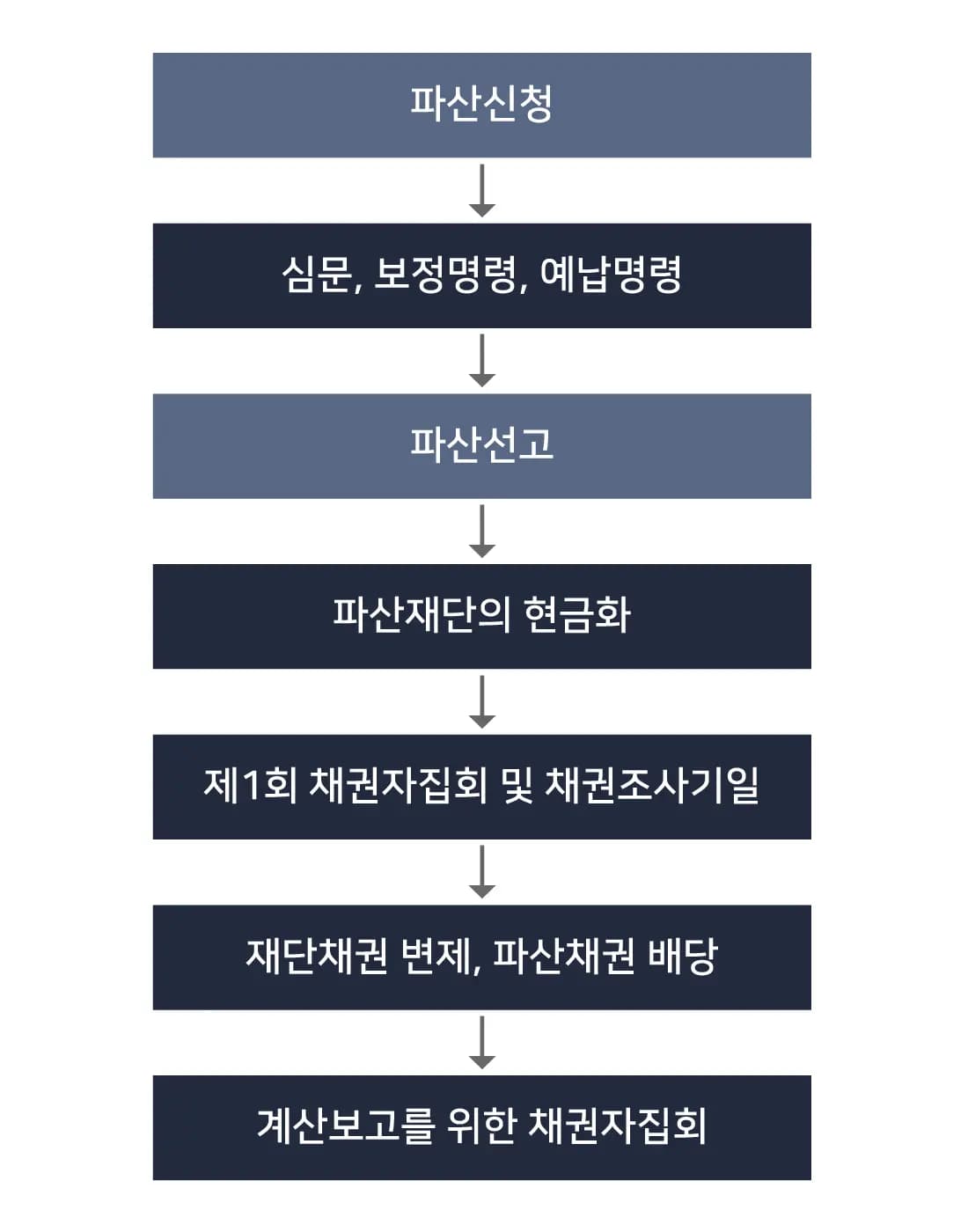
1. Filing of the bankruptcy petition
Corporate bankruptcy begins with the filing of the bankruptcy petition.
The debtor corporation itself or a creditor submits a bankruptcy petition to the court of jurisdiction to commence the proceedings.
The petition must set out in detail the corporation's assets and debt situation, the grounds for the petition, and the particulars of the creditors' claims, and it must be submitted together with attached documents, the stamp fee, and the service fee.
After receipt, the court confirms the formal requirements, assigns a case number, and formally docks the case.
2. Examination and order for correction (if necessary)
After reviewing the submitted petition, the court may, if it deems it necessary, set an examination date and require the attendance of the representative of the debtor corporation or the petitioner, as well as major creditors.
This examination confirms whether the corporation is in a state of insolvency or excess of liabilities and whether rehabilitation is possible.
In addition, if the submitted documents are deficient or require supplementation, the court may issue an order for correction requiring the documents to be supplemented within a set period.
This is very important, as failure to comply may result in dismissal of the bankruptcy petition.
3. Issuance of the order for advance payment and payment
After the examination, the court issues an order for advance payment so that the debtor pays the costs necessary for the proceedings in advance.
The advance payment is used for the remuneration of the bankruptcy trustee, the costs of the creditors' meeting, service costs, and the costs of managing and liquidating assets.
The court calculates the advance payment amount in consideration of the complexity of the case and the scale of the assets, and the petition is dismissed if this amount is not paid within the set period.
Generally, in addition to the basic advance payment, an additional amount is assessed according to the number of creditors.
4. Decision on the declaration of bankruptcy
Once the examination and payment of the advance payment are completed, the court decides whether to declare bankruptcy.
If a state of insolvency or excess of liabilities is recognized, the court issues a declaration of bankruptcy and serves official notice of it on the debtor, the creditors, and interested parties.
Once this decision is made, the corporation is deemed dissolved by operation of law, and the authority to manage the business and assets is transferred to the bankruptcy trustee.
5. Appointment of the bankruptcy trustee and public notice for the filing of claims
At the same time as the declaration of bankruptcy, the court appoints a bankruptcy trustee.
The trustee serves as the court's administrator, managing and liquidating the debtor's assets, investigating the creditors, and overseeing the distribution.
The court also gives public notice to the creditors of the period and place for filing claims and of the date of the first creditors' meeting.
To exercise distribution rights, a creditor must file within the period, stating the amount of the claim, whether it is secured, and whether there is a title for execution.
6. First creditors' meeting and investigation of claims
The first creditors' meeting is held on the appointed date.
At this meeting, the bankruptcy trustee reports on the list of assets, the liquidation plan, the status of claims, and the use of the advance payment, and the creditors may raise objections regarding the existence, amount, and priority of the filed claims.
Thereafter, through the claim investigation date, the court and the trustee review and confirm the filed claims and determine the order of repayment.
If there is an objection to a claim, it is decided through a separate objection procedure.
7. Liquidation of the bankruptcy estate and distribution to creditors
The debtor's assets are incorporated into the bankruptcy estate, and the bankruptcy trustee proceeds to liquidate them by sale or recovery.
8. Accounting report and termination of the bankruptcy proceedings
Once all liquidation of assets and distribution to creditors are completed, the bankruptcy trustee holds a creditors' meeting to present the accounting report, reporting on the performance of the trustee's duties, the status of the assets, and the results of repayment.
After reviewing this, and absent any particular objection, the court issues a decision terminating the bankruptcy proceedings and closes the case.
With this, the corporation is dissolved by operation of law, and the procedure for cancellation of its registration is carried out.


3. Corporate Bankruptcy | Documents to Submit When Filing
The documents that must be submitted when filing for corporate bankruptcy are as follows.
List of creditors
Certified copy of all corporate registration matters
Minutes of the board of directors
Articles of incorporation
Register of shareholders
Organizational chart
Settlement reports for three or more years
Balance sheet and income statement
List of real estate and movable property
Accounts receivable and status of debts
Status of ongoing litigation, provisional attachments, and auctions
Other documents required by the court
Where a creditor files the petition, supporting documents evidencing the existence of the claim and the fact of suspension of payment must also be submitted
Corporate Bankruptcy Procedure Costs
The costs incurred in conducting corporate bankruptcy proceedings are as follows.
►Stamp fee: KRW 1,000 for a petition by the debtor / KRW 30,000 for a petition by a creditor
►Service fee: KRW 204,000 base + (number of creditors × KRW 5,100 × 3)
►Advance payment: Varies by case upon the court's order for advance payment
4. Corporate Bankruptcy | Key Legal Risks

A point to be careful about in corporate bankruptcy proceedings is the issue of the representative's joint and several guarantee.
Where the representative director or an officer has provided a joint and several guarantee for the corporation's debts, the representative remains liable for the personal debt separately from the corporation's bankruptcy.
Accordingly, even after corporate bankruptcy, a creditor may separately pursue civil execution against the representative's personal assets, and if the representative has provided a joint and several guarantee for the corporation's debts, separate personal bankruptcy or individual rehabilitation proceedings should be considered.
In addition, the possibility of concurrent criminal proceedings, such as for embezzlement, breach of trust, or accounting fraud, is also important.
If misappropriation of funds, preparation of false financial statements, unpaid wages, or embezzlement of public funds comes to light during the corporate bankruptcy process, the corporation's management may be subject to criminal punishment.
In practice, where embezzlement of funds or breach of trust under laws governing public institutions or public fund support is detected, imprisonment and a fine may be imposed concurrently, and punishment may be carried out regardless of whether bankruptcy is declared.
In this way, corporate bankruptcy is not merely a procedure for winding up a corporation's debts; it is a complex procedure that proceeds together with the protection of creditors, relief for those owed unpaid wages, recovery of public claims, and the pursuit of management's legal liability.
Accordingly, the process requires specialized legal knowledge, and each interested party may need to respond actively to the various procedures, including the bankruptcy trustee's dispositions, the filing of claims, the distribution procedure, and criminal complaints, in order to protect their legal rights.
From the perspective of a company's management, before deciding whether to commence corporate bankruptcy proceedings, one should carefully review the possibility of rehabilitation, the burden of joint and several guarantees, and the risk of criminal liability; and even where bankruptcy is chosen, it is necessary to secure evidentiary materials, coordinate settlements with creditors, and prepare plans for resolving unpaid wages and public debts from before the proceedings commence.
Throughout this process, obtaining the assistance of a legal professional can be a practical way to minimize the risk of legal disputes and criminal liability.
Essential Checklist for Filing Corporate Bankruptcy
□ Confirm whether the corporation is in a state of insolvency or excess of liabilities
□ Secure the minutes of the board of directors and the resolution on bankruptcy
□ Secure the corporate registration matters, articles of incorporation, and register of shareholders
□ Organize the financial statements for the most recent three years and the list of real estate and movable property
□ Confirm the status of wages, severance pay, public debts, and tax arrears
□ Identify the status of legal disputes, such as litigation, auctions, and provisional attachments
□ Organize the list of creditors and the details of the claims
□ Prepare the bankruptcy petition and assemble the documents
□ Prepare the stamp fee and the service fee
□ Calculate the expected amount of the court's order for advance payment