
CONTENTS
- 1. Corporate Rehabilitation | Concept and Purpose of the System

- - Eligibility and Requirements for Filing Corporate Rehabilitation
- - Comparison of Corporate Rehabilitation and Corporate Bankruptcy
- 2. Corporate Rehabilitation | Detailed Overview of the Procedure
- - Petition to Commence Rehabilitation Proceedings
- - Preservative Measure and Comprehensive Prohibition Order
- - Decision to Commence Rehabilitation Proceedings
- - Appointment of an Examiner and Investigation of the Financial Situation
- - Filing of Claims and Investigation of Claims
- - Preparation and Submission of the Rehabilitation Plan
- - Meeting of Interested Parties and Approval of the Rehabilitation Plan
- - Approval Decision on the Rehabilitation Plan
- - Performance of the Rehabilitation Plan and Closing of Proceedings
- 3. Corporate Rehabilitation | How to Prepare a Rehabilitation Plan
- - Satisfaction of Legal Requirements
- - Building a Rationale to Persuade Interested Parties
- - Example of the Composition of a Rehabilitation Plan
- 4. Corporate Rehabilitation | Key Risks in the Proceedings
- - Failure to Manage Omitted Claim Filings and Objections
- - Collective Objection by Rehabilitation Creditors and Secured Creditors
- - Failure to Secure Funds to Perform the Rehabilitation Plan
- - Negative Assessment by the Investigator
- 5. Corporate Rehabilitation | Key Legal Response Points

1. Corporate Rehabilitation | Concept and Purpose of the System

Corporate rehabilitation is a legal procedure in which, for a corporation facing the risk of insolvency due to a deterioration in management finances, the court takes the lead in adjusting the rights of interested parties such as creditors, shareholders, and equity holders, and allows the debtor to continue its business so as to aid its rehabilitation and the repayment of debts.
Unlike bankruptcy, which disposes of a corporation's assets and distributes them to creditors, rehabilitation proceedings are distinguished in that they maintain the corporation's business and pursue the normalization of management.
The main purpose of the corporate rehabilitation system lies in preserving enterprise value through the continued existence of a corporation that has the potential for rehabilitation, and in minimizing harm to interested parties such as creditors, business partners, and employees.
In particular, the core is to provide legal protection so that the corporation can overcome a short-term financial crisis and carry out business reconstruction and restructuring at the same time.
 Eligibility and Requirements for Filing Corporate Rehabilitation
Corporate rehabilitation applies to the following corporations.
►Corporations in a state of excess of liabilities
►Corporations in a state of insolvency
►Available not only to for-profit corporations but also to non-profit corporations, such as public-interest corporations and foundations
A petition for corporate rehabilitation may be filed by the corporation itself, a creditor, or a shareholder or equity holder.
Comparison of Corporate Rehabilitation and Corporate Bankruptcy
Category | Corporate rehabilitation | Corporate bankruptcy |
|---|---|---|
Purpose | Normalizing the business and adjusting creditors' rights | Converting assets to cash and distributing to creditors |
Eligible petitioners | The corporation, creditors, shareholders | The corporation, creditors |
Disposal of assets | Partially restricted under the court's supervision | Conversion to cash by the bankruptcy trustee |
Repayment of claims | Repayment in accordance with the rehabilitation plan | Distribution according to priority |
Survival of the company | Possible | Dissolution of the corporation |
2. Corporate Rehabilitation | Detailed Overview of the Procedure
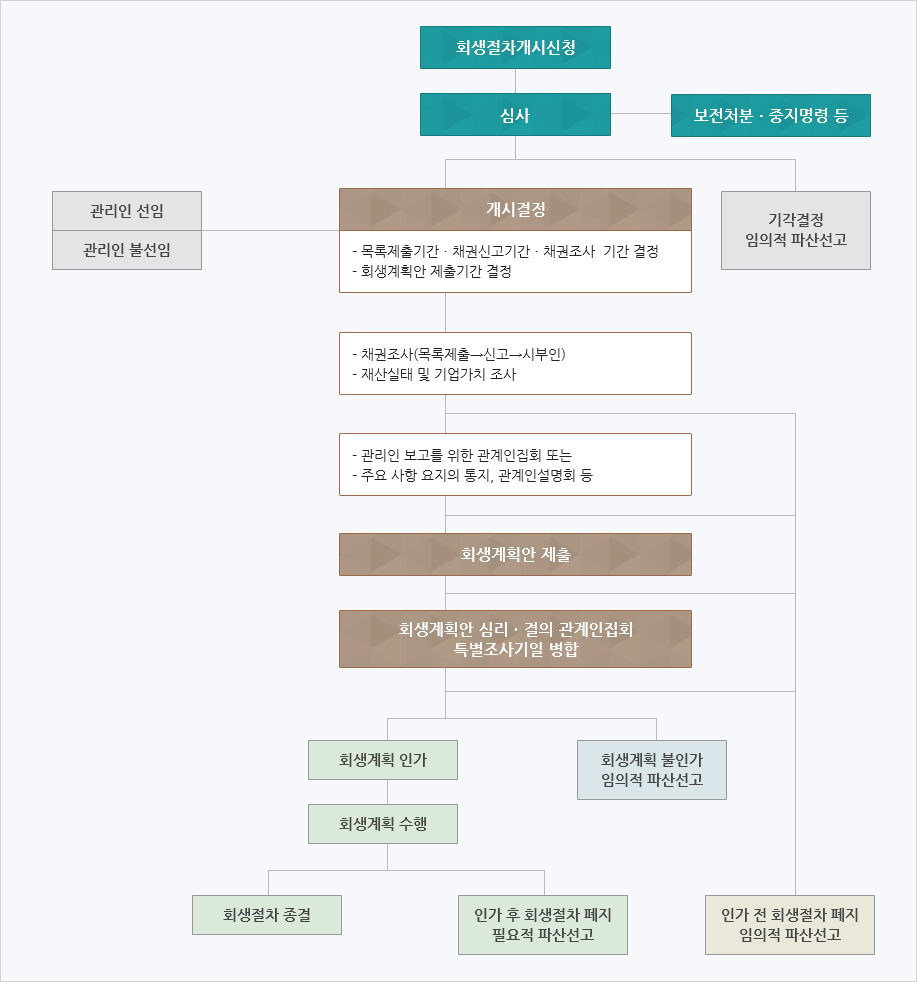
Corporate rehabilitation requires preliminary work, including a review of the corporation's debt situation, the grounds on which the debts arose, and the list of creditors.
To promptly halt creditors' demands for repayment and individual exercise of their rights, please review the corporate rehabilitation procedure.
Petition to Commence Rehabilitation Proceedings
Rehabilitation proceedings begin with the filing of a petition to commence rehabilitation with the court of jurisdiction by the debtor itself, a creditor holding claims amounting to 10% or more of the capital, or a shareholder or equity holder holding 10% or more of the capital.
When filing, various documents required by the court must be attached, including the rehabilitation petition, a certified copy of all corporate registration matters, the financial statements for the most recent three years, the list of creditors, and the list of assets; and the filing procedure is completed only when the service fee and the advance payment are paid pursuant to the order for advance payment.
Preservative Measure and Comprehensive Prohibition Order
After the petition is filed, the court issues a decision on a preservative measure and a comprehensive prohibition order to prevent the debtor from concealing assets, making repayments, or being subject to compulsory execution.
These measures are intended to protect the debtor's assets in a stable manner until the rehabilitation proceedings commence.
►Decision on a preservative measure : Prohibits the disposition or borrowing of certain assets, the hiring of officers and employees, and the like
►Comprehensive prohibition order : Prohibits creditors' individual compulsory execution, provisional attachment, provisional injunction, and the like


Decision to Commence Rehabilitation Proceedings
After document review and examination of the representative, the court issues a decision to commence or to dismiss.
When a decision to commence is issued, the authority to manage and dispose of the debtor's assets vests in a court-appointed administrator, and all collection of claims, such as compulsory execution, is suspended.
The debtor may only manage its assets and establish a plan for the repayment of claims.
Together with this decision, the period for filing claims, the creditors' meeting, and the claim investigation date are publicly announced.
Appointment of an Examiner and Investigation of the Financial Situation
At or immediately after the decision to commence, the court appoints an examiner to professionally investigate the following matters concerning the enterprise.
►The debtor's asset and liability situation
►The possibility of rehabilitation
►Liquidation value vs. going-concern value
►The feasibility of a rehabilitation plan
The examiner conducts an analysis of the financial statements, an asset valuation, and a management analysis, and submits an investigation report to the court.
Filing of Claims and Investigation of Claims
Within the period for filing claims set by the court, rehabilitation creditors, rehabilitation secured creditors, and shareholders or equity holders must file the type, amount, cause, and security status of their claims; and if they fail to file or are omitted, their distribution rights in the rehabilitation proceedings are forfeited.
In addition, the administrator decides whether to acknowledge or deny the filed claims and whether to raise an objection, and where there is an objection, proceeds with the claim confirmation procedure by petitioning for a claim assessment trial.
Preparation and Submission of the Rehabilitation Plan
After the decision to commence proceedings, the court sets and notifies the parties of the period for submitting the rehabilitation plan.
The rehabilitation plan includes the following:
▶The debtor's asset status
▶A repayment plan for each creditor
▶Measures for normalizing the business
▶Details of debt restructuring
▶A plan for raising new funds
The plan must also satisfy the following requirements. Although the debtor, creditors, or shareholders may all submit the plan, it is generally submitted by the debtor.
(1) No violation of the law
(2) The principle of fairness and equity
(3) The principle of equality
(4) Guarantee of liquidation value
(5) Feasibility of performance
Meeting of Interested Parties and Approval of the Rehabilitation Plan
The court holds a meeting of interested parties to explain the rehabilitation plan and to decide whether it is approved.
The requirements for approval are as follows:
▶Rehabilitation creditors: consent of at least two-thirds of the total voting rights by amount
▶Rehabilitation secured creditors: consent of at least three-fourths of the total voting rights by amount
▶Shareholders and equity holders: consent of at least one-half of the total number of voting rights
Approval Decision on the Rehabilitation Plan
The court examines the legality, fairness, and feasibility of the rehabilitation plan approved at the meeting of interested parties, and then issues a decision to approve or to deny approval.
Once the approval decision is issued, the repayment and normalization plan takes legal effect, and creditors receive repayment in accordance with the rehabilitation plan.
Performance of the Rehabilitation Plan and Closing of Proceedings
In accordance with the approved rehabilitation plan, the administrator carries out repayments, the sale of new assets, business restructuring, and the attraction of new investment.
Once the plan has been fully performed or the prospect of normal business operation is confirmed, the court issues a decision to close the rehabilitation proceedings, and the corporation returns to normal business operation.
3. Corporate Rehabilitation | How to Prepare a Rehabilitation Plan
The rehabilitation plan is the most important document determining the life or death of the corporation.
It must be designed not merely to meet formal requirements but to possess legal validity, economic feasibility, and acceptability to interested parties.
Satisfaction of Legal Requirements
▶The principle of guaranteeing liquidation value
All rehabilitation creditors and secured creditors have the right to receive repayment more favorable than what they would receive in liquidation, so the rehabilitation plan can obtain court approval only if it provides repayment of at least the liquidation value.
➝ A liquidation value appraisal report, an asset disposal plan, and a projected claim repayment plan must be attached.
▶The principle of fairness and equity
Creditors of the same nature must be repaid equally without differentiation, and the court cannot grant approval if a particular creditor is discriminated against.
➝ Classifications such as rehabilitation claims, rehabilitation secured claims, tax claims, and employee claims must be clearly defined.
Building a Rationale to Persuade Interested Parties
It is necessary to consult in advance with major creditors, secured creditors, and shareholders to secure agreement on the repayment rate, the scope of the exercise of security rights, and the performance deadline.
In particular, prior coordination with those holding a high proportion of rehabilitation creditor voting rights is an essential step.
It is important to clearly analyze the rehabilitation benefit (the gain upon survival and the loss upon liquidation) and to develop a rationale that persuades stakeholders of the need for rehabilitation.
Example of the Composition of a Rehabilitation Plan
An example of the composition of a corporate rehabilitation plan is as follows:
▶Overall repayment plan
▶Plan for repaying rehabilitation claims
▶Plan for repaying rehabilitation secured claims
▶Plan for raising operating funds and improving the financial structure
▶Plan for pursuing new business
▶Plan for asset disposal and cost reduction
▶Whether the existing management will be retained
▶Repayment rate and method for each interested party
4. Corporate Rehabilitation | Key Risks in the Proceedings

Corporate rehabilitation proceedings are a complex legal process that must achieve both the survival of the company and the repayment of its debts at the same time.
Accordingly, various legal and management risks exist at each stage, and if these are not recognized and managed in advance, the result may be a failed rehabilitation, the discontinuation of proceedings, or conversion to bankruptcy.
Failure to Manage Omitted Claim Filings and Objections
Creditors can receive repayment under the rehabilitation plan only if they file their claims within the designated claim-filing period.
Failure to file results in a critical loss, including forfeiture of the right to repayment and exclusion from the distribution of assets.
In addition, if the administrator does not appropriately acknowledge or dispute a claim filed by a creditor, a nonexistent claim may be included in the rehabilitation plan and increase the debt burden, so a system for reviewing claims and managing objections must be thoroughly established.
Collective Objection by Rehabilitation Creditors and Secured Creditors
To obtain approval of the rehabilitation plan, consent must be obtained from the required proportion of voting rights in each class, and if a class of rehabilitation creditors or secured creditors objects, the approval requirements may not be met and the proceedings may be discontinued.
Establishing a strategy for prior consultation and coordination of interests is important, and a strategic approach that designs the repayment rate, whether security rights survive, and the management plan differently for each creditor is needed to increase the likelihood of approval.
Failure to Secure Funds to Perform the Rehabilitation Plan
If the funding needed to perform the plan (operating revenue, asset sales, new investment, and DIP financing) is not raised smoothly, the plan itself becomes meaningless, and the inability to perform leads to discontinuation of the proceedings or bankruptcy.
When preparing the rehabilitation plan, a cash flow plan, a DIP financing agreement, and an appraisal of the expected value of asset sales should be prepared in practice in order to demonstrate feasibility.
Negative Assessment by the Investigator
The investigator's assessment in the investigation report of liquidation value versus going-concern value serves as a critical standard for the continuation or termination of the rehabilitation proceedings.
If the investigator finds that the liquidation value exceeds the going-concern value, the rehabilitation is likely to fail, so a business improvement plan and an asset valuation must be prepared precisely in advance to establish a strategy for actively responding to the investigator's opinion.
5. Corporate Rehabilitation | Key Legal Response Points

When filing for corporate rehabilitation, please be aware of and reliably address the following legal points.
✅Preparing the petition to commence rehabilitation and reviewing documents
✅Representation in applying for preservative measures and prohibition orders
✅Preparing the claim investigation schedule and responding to objections
✅Attending the creditors' meeting and submitting written opinions
✅Preparing the rehabilitation plan on the client's behalf and establishing an approval strategy
✅Managing the process of performing the rehabilitation plan and responding to court reports
✅Coordinating consultations and overseeing negotiations among interested parties
✅Applying for the closing of proceedings and the decision to terminate rehabilitation after approval


Watch related video content
for this case study.

Luxury platform 'Balan' rehabilitation process, will stores be able to get their money back?