
CONTENTS
- 1. Corporate Bankruptcy | Concept and Purpose

- - The Purpose of Corporate Bankruptcy
- 2. Corporate Bankruptcy | Eligibility to File
- - The Applicant and the Court of Jurisdiction
- 3. Corporate Bankruptcy | Procedure
- - Receipt and Examination of the Bankruptcy Application
- - Declaration of Bankruptcy and Notification
- - The Creditors' Meeting and the Examination Date
- - Distribution and Conclusion of the Procedure
- 4. Corporate Bankruptcy | Documents to Submit
- - The Bankruptcy Application
- - Attached Documents (Common)
- - Additional Documents to Submit Where a Creditor Files
- - Where an Agent Files
- 5. Corporate Bankruptcy (Business Bankruptcy) | Costs Involved
- - Stamp Fee
- - Service Fee
- - Advance Deposit (If Applicable)
- 6. Corporate Bankruptcy (Business Bankruptcy) | Developing a Strategy

1. Corporate Bankruptcy | Concept and Purpose

Corporate bankruptcy refers to the procedure in which, when a company can no longer cover all of its debts with the assets it holds, the court declares bankruptcy and liquidates the corporation's assets to distribute them fairly among the creditors.
 The Purpose of Corporate Bankruptcy
The corporate bankruptcy system is intended to ensure the equal recovery of claims among creditors and to prevent the spread of unnecessary loss by winding up corporations for which rehabilitation is difficult.
In addition, the representative or related persons of the corporation can seek a fresh start through legal resolution.


2. Corporate Bankruptcy | Eligibility to File
Any corporation in a state of insolvency or excess of liabilities may file for corporate bankruptcy.
This applies not only to for-profit corporations such as companies under the Commercial Act but also to non-profit corporations, and it is possible regardless of the type of debt (loans, card balances, wages, taxes, and the like) or the amount involved.
The Applicant and the Court of Jurisdiction
A director, an unlimited-liability partner, a liquidator, or a similar person of the corporation may file for bankruptcy even without being the representative.
A creditor may also file for bankruptcy if the corporation is in a state of insolvency or excess of liabilities.
For corporate bankruptcy, the application must be filed with the bankruptcy division (or the intake section) of the district court having jurisdiction over the location of the corporation's head office.
The application must be filed with the bankruptcy division (or the intake section) of the district court having jurisdiction over the location of the corporation's head office.
3. Corporate Bankruptcy | Procedure

Once an application for corporate bankruptcy is received, the court determines whether to declare bankruptcy in accordance with the following procedure, after which it carries out the liquidation of assets and the distribution to creditors.
Receipt and Examination of the Bankruptcy Application
▪ Review After Receipt of the Application
The court may declare bankruptcy on the basis of the submitted documents alone or, if necessary, may require the debtor and the creditors to appear before the court in person for an examination.
▪ Processing Period
If the debtor files the application directly, whether to declare bankruptcy is generally decided within 1 to 2 months, and the period may vary depending on the complexity of the case.
Declaration of Bankruptcy and Notification
When the court declares bankruptcy, it simultaneously determines the following matters as well and notifies interested persons, including the debtor and the creditors.
• Period and place for filing claims
• The first creditors' meeting and the date for the examination of claims
The Creditors' Meeting and the Examination Date
After the declaration of bankruptcy, the court designates the first creditors' meeting and the date for the examination of claims.
In this procedure, the bankruptcy trustee reports to the court and the creditors on the work performed so far and on future plans.
▪ Report on the Progress of Converting Assets to Cash
The bankruptcy trustee explains the results of investigating and disposing of the debtor's assets to convert them into cash.
▪ Sharing the Results of Reviewing the Claims
The trustee reports on the review of the existence, amount, and priority of the claims filed by the creditors.
▪ Guidance on the Distribution Outlook and Future Schedule
On the basis of the assets secured to date, the trustee explains the plan for paying priority claims, such as wages, severance pay, and taxes, and the possibility of distribution to general creditors.
Distribution and Conclusion of the Procedure
▪ Priority Payment of Estate Claims
Estate claims, such as wages, severance pay, taxes, and public insurance premiums, are paid with the highest priority.
▪ Distribution of Bankruptcy Claims
If any assets remain, they are distributed to general creditors in proportion to the amount of their claims.
▪ Accounting Report and Conclusion of the Procedure
After completing its work, the bankruptcy trustee presents an accounting report at a creditors' meeting, and once the court issues a decision to conclude the procedure, the bankruptcy proceedings come to an end.
4. Corporate Bankruptcy | Documents to Submit
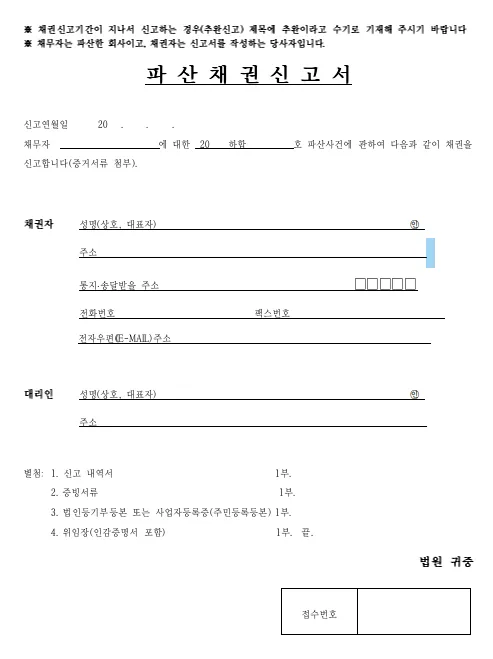
To file for corporate bankruptcy, the applicant must submit the application together with various supporting documents.
Because some documents may differ depending on the status of the applicant (debtor or creditor), it is important to prepare them carefully in advance.
The Bankruptcy Application
The bankruptcy application must state the following matters.
• The name of the representative
• The purport and grounds of the application
• The company's business objectives and current management status
• The total number of shares or equity interests, the capital, and the financial condition, including assets and liabilities
• Pending legal proceedings or dispositions (to the extent ascertained)
• If a creditor files the application, the amount of the claim and its grounds
• The case caption, the list of attached documents, the date of preparation, and the court of jurisdiction
• The name and seal of the applicant or the agent
(🔗You can download the corporate bankruptcy application here.)
Attached Documents (Common)
• Certified copy of all corporate registration matters
• Minutes of the board meeting concerning the bankruptcy application
• Articles of incorporation, company brochure, register of shareholders, and organizational chart
• Rules of employment, severance pay regulations, collective agreement, employee roster, and labor union materials
• Settlement reports for the past 3 years, and comparative balance sheets and income statements
• The most recently prepared financial statements (balance sheet, income statement, liquidation materials, and the like)
• List of real estate and movable property, certified copies of the registry, registration records, and the like
• Schedule of accounts receivable, private bonds, and collateral
• Materials concerning pending litigation, auctions, provisional attachments, and provisional injunctions
• Certified copies of all registration matters and settlement materials for subsidiaries and affiliated companies
Additional Documents to Submit Where a Creditor Files
• Materials proving the existence of the claim
-> Bills, checks, contracts, notarial deeds, accounts receivable ledgers, and the like
• Materials proving the state of insolvency
-> Dishonored bills and checks, bank transaction suspension certificates, and the like
Where an Agent Files
• Power of attorney and certificate of seal impression
※ However, even if an agent other than the representative files, the representative must appear in person on the date of the examination.
5. Corporate Bankruptcy (Business Bankruptcy) | Costs Involved

Filing for corporate bankruptcy involves a stamp fee, service fees, and an advance deposit.
The costs may vary depending on the status of the applicant (debtor or creditor), so please refer to the information below.
Stamp Fee
This is the cost of the government revenue stamp that must be affixed to the bankruptcy petition.
▪ If the debtor (corporation) files: 1,000 won
▪ If a creditor files: 30,000 won
Government revenue stamps are purchased at the bank within the court or at a post office and then glued onto the petition for submission.
Service Fee
This is the cost required for the court to serve the relevant documents on each creditor.
▪ Basic service fee: 204,000 won
▪ Additional service fee: number of creditors × 5,100 won × 3
The service fee must be paid to the bank within the court, and the ‘service fee payment receipt’ must be submitted together at the time of filing.
Advance Deposit (If Applicable)
If the court determines after its review that the bankruptcy proceedings need to move forward in earnest, it may require payment through an advance deposit order.
The advance deposit is used to cover the costs of the bankruptcy trustee's activities, such as the liquidation of assets and the exercise of avoidance rights.
If an advance deposit order is issued, please note that the filing may be dismissed if payment is not made within the set deadline.
The amount of the advance deposit is calculated differently depending on the nature of the case and the scale of the assets.
6. Corporate Bankruptcy (Business Bankruptcy) | Developing a Strategy

Corporate bankruptcy (business bankruptcy) goes beyond merely settling a corporation's debts, serving as an important system that helps a company prepare for a fresh start amid difficult financial circumstances.
However, because the procedure is complex and involves various legal and financial issues, professional legal assistance is important.
It is possible to proceed alone, but a systematic and strategic approach is needed, from investigating the corporation's assets to managing creditors, preparing complex documents, and responding to the court.
For this reason, step-by-step legal assistance such as the following is needed.
▷ Organizing the company's assets and details of claims
▷ Preparing the petition and attached documents
▷ Preparing for subsequent possibilities such as litigation and criminal liability
Drawing on years of accumulated experience in corporate bankruptcy, the firm provides careful support so that a company can conclude the procedure as swiftly and stably as possible.
In addition, attorneys handling corporate rehabilitation and bankruptcy, tax accountants, and certified public accountants work together cohesively to pursue both the improvement of the company's financial structure and the resolution of its legal issues at the same time.
The firm provides systematic support throughout the corporate bankruptcy procedure and works diligently to minimize legal risk and achieve the best possible outcome.
Related News


Watch related video content
for this case study.

5 things to keep in mind when hiring a lawyer|The lawyer will tell you directly.