
CONTENTS
- 1. Share Exchange/Share Transfer | Concept

- - Meaning of Stock Exchange
- - Meaning of Stock Transfer
- 2. Stock Exchange / Stock Transfer | Comparison
- - Transaction Structure of a Stock Exchange
- - Transaction Structure of a Stock Transfer
- 3. Stock Exchange / Stock Transfer | Procedure
- 4. Stock Exchange / Stock Transfer | Need for Legal Advice
- - Legal Issues and Risk Management
- - Protection of Shareholder Rights
- - Resolving Tax Issues
- - Drafting and Reviewing Contracts
- - M&A Strategy and Regulatory Response
- 5. Stock Exchange / Stock Transfer | Response Strategy
- - If You Need Professional Assistance?

1. Share Exchange/Share Transfer | Concept

The share exchange/share transfer method is regarded as the most advanced means of corporate restructuring compared with methods such as establishing a subsidiary, corporate division, triangular merger, corporate acquisition, and the issuance of new shares to a third party.
 Meaning of Stock Exchange
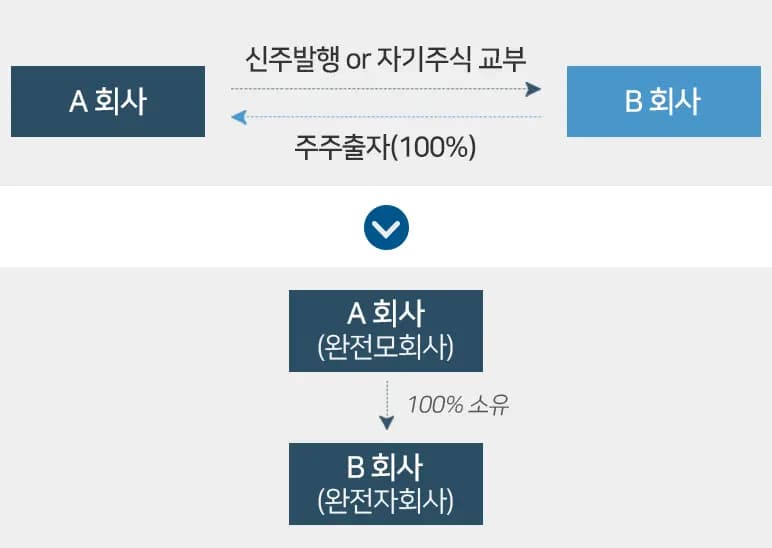
A stock exchange refers to a transaction in which an existing company receives a contribution of 100% of the shares of another company through a contract and, in return, delivers its own shares (newly issued shares or treasury shares) to the shareholders of that company.
Meaning of Stock Transfer
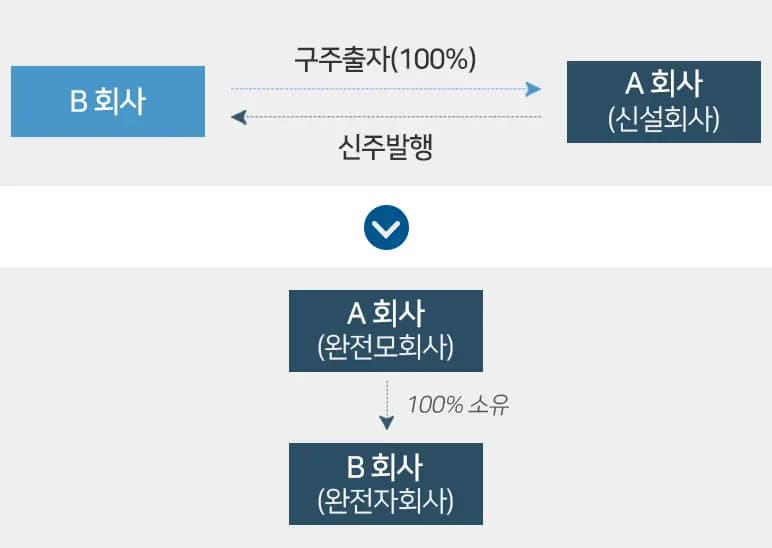
A stock transfer refers to a transaction in which an existing company establishes a new company, contributes 100% of its own shares to it, and the shareholders of the existing company receive shares of the newly established company in return.


2. Stock Exchange / Stock Transfer | Comparison
A stock exchange and a stock transfer are both means by which a parent company secures the shares of a subsidiary to establish a wholly owned subsidiary structure, but they differ fundamentally in their method and procedure.
Transaction Structure of a Stock Exchange
If Company A is the ‘acquiring company’ that will become the wholly owning parent company and Company B is the ‘target company’ that will become the wholly owned subsidiary, Company A may acquire all of the shares of Company B through a stock exchange.
In this case, Company A is a company that already exists.
For a stock exchange between the two companies, a stock exchange agreement must be concluded.
Company A acquires the shares of Company B by way of a share contribution and, in return, issues and delivers new shares to the shareholders of Company B.
New shares may be issued according to the stock exchange ratio, and in some cases treasury shares (existing shares) in circulation may be used in the exchange.
Transaction Structure of a Stock Transfer
The structure in which Company A becomes the wholly owning parent company and Company B becomes the wholly owned subsidiary is the same, but a stock transfer differs in that Company A is a newly established company.
The shareholders of Company B, the existing company, establish a new company, Company A, transfer the shares of Company B that they hold to Company A, and are allotted shares of Company A in return.
In this process, a stock transfer plan is prepared, and because the newly established company issues the shares, the shares delivered to the shareholders of Company B take the form of newly issued shares only.
3. Stock Exchange / Stock Transfer | Procedure
The procedure for a stock exchange or stock transfer is as follows.
▶ Stock Exchange Procedure
▶ Stock Transfer Procedure
4. Stock Exchange / Stock Transfer | Need for Legal Advice

A stock exchange or stock transfer procedure involves not only the Commercial Act but also multiple statutes acting in combination, such as the Monopoly Regulation and Fair Trade Act, the Financial Investment Services and Capital Markets Act, and tax laws.
Accurately interpreting the provisions of each statute and designing the procedure lawfully requires professional legal advice.
Legal Issues and Risk Management
The positions of interested parties may diverge due to matters such as minority shareholders’ appraisal rights and the exercise of rights by dissenting shareholders.
To prevent disputes arising from this, the key issues should be reviewed in advance at the stage before the transaction, and a legal strategy capable of responding to them is needed.
Protection of Shareholder Rights
Issues of fairness among shareholders may arise depending on the method of share valuation or the exchange or transfer ratio.
By establishing a procedure that is fair and lawful through legal advice on these sensitive factors, the trust of shareholders can be secured.
Resolving Tax Issues
A stock exchange or stock transfer may be subject to taxation under tax law, and unanticipated tax issues such as capital gains tax or gift tax may arise.
Because the tax risk may differ depending on the transaction structure, legal coordination that fully takes this into account is needed.
Drafting and Reviewing Contracts
Various documents accompanying a transaction, such as a stock transfer plan and a contract, have required items and a prescribed format.
Through review by a legal professional, it is important to prevent unclear expressions or omissions and to prepare documents that are legally consistent.
M&A Strategy and Regulatory Response
A stock exchange or stock transfer is often used strategically in the course of mergers and acquisitions, and in such cases a review by the regulatory authorities as to whether competition is restricted may follow.
Prior advice on issues under the Monopoly Regulation and Fair Trade Act plays an important role in steadily bringing the transaction to completion.
5. Stock Exchange / Stock Transfer | Response Strategy
A stock exchange or stock transfer has a complex procedure, and the outcome may vary depending on the interpretation of the relevant statutes, so it is important to closely review the legal risks in advance and to organize the structure.
In particular, because unexpected problems may arise, such as the protection of minority shareholders, issues under the Monopoly Regulation and Fair Trade Act, and tax burdens, it is effective to receive the assistance of professionals from the stage before the transaction.
If You Need Professional Assistance?
This firm has a number of attorneys experienced in this area who have backgrounds at large corporations and public institutions, and it provides practical interpretation together with response strategies.
In addition, through a system of collaboration with professionals in each field, including tax accountants, certified public accountants, and patent attorneys, it provides comprehensive legal solutions for the entire process, such as the structural design of stock exchanges and stock transfers, analysis of tax risks, review of disclosures and contracts, and coordination of interested parties.
If you are experiencing difficulty in establishing a structure for or carrying out the procedure of a stock exchange or stock transfer, please request assistance from our mergers and acquisitions team.
▷ Legal advice on general meetings of shareholders
▷ Advice on share valuation and the setting of exchange ratios
▷
▷ Establishment and support of M&A strategy
▷ Interpretation of relevant laws and litigation support


Watch related video content
for this case study.

✨Meet Daeryun Law Firm’s corporate legal and tax administration experts!