
CONTENTS
- 1. Land Expropriation and Compensation | Definition and Characteristics

- - Land Expropriation System
- - Characteristics
- 2. Land Expropriation and Compensation | Expropriation and Objection Ruling Procedures
- - Application for and Receipt of an Expropriation Ruling
- - Public Notice and Hearing of Opinions
- - Fact-Finding and Review of Opinions
- - Appraisal and Calculation of Compensation
- - Expropriation Ruling and Service
- - Objection and Litigation Against a Ruling
- 3. Land Expropriation and Compensation | Types of Compensation and Calculation Standards
- - Land Compensation
- - Compensation for Buildings and Other Obstructions
- - Compensation for Business Losses
- - Compensation for Loss of Residual Land and Purchase of Residual Land
- - Rights and Other Compensation
- - Compensation Outside the Project Area
- - Compensation for Loss of Farming
- 4. Land Expropriation and Compensation | Related Disputes and Resolution Methods
- - Main Causes of Disputes
- - Application for a Ruling and Land Expropriation
- - Objection and Ruling Procedures
- 5. Land Expropriation and Compensation | Checklist
- - Support System of Real Estate Attorneys

1. Land Expropriation and Compensation | Definition and Characteristics

The land expropriation and compensation system is a system for the compulsory acquisition of land and other property required to carry out public-interest projects such as public housing, roads, railways, and industrial complexes.
 Land Expropriation System
The State and public institutions carry out various public-interest projects, such as the construction of public housing, the expansion of transportation infrastructure including roads and railways, and the development of industrial complexes.
In this process, the land and objects required for a project must be secured, so a purchase contract is first concluded through consultation with the landowner.
However, in preparation for cases where consultation is not reached amicably, the legal system that allows the State or a public institution to compulsorily acquire the land needed for a public-interest project together with just compensation, while protecting citizens’ property rights, is the ‘land expropriation system.’
Characteristics
① Compulsory nature
Land expropriation is a compulsory act by which the State or a public institution can acquire land for a public-interest project even without the individual’s consent.
② Principle of just compensation
Because a compulsory acquisition takes place, just compensation corresponding to the market price must be paid to the person subject to expropriation.
④ Guarantee of procedural legitimacy
Land expropriation must go through transparent and fair procedures based on law, and the person subject to expropriation is guaranteed rights such as the right to raise objections and to request a trial.
⑤ Principle of priority of public interest
Land expropriation must always be for a public-interest purpose, and it is not permitted for the purpose of private interest.
⑥ Promptness and efficiency
A certain degree of promptness is maintained so that the public-interest project can proceed without disruption, and institutional mechanisms are in place to prevent unnecessary delay.


2. Land Expropriation and Compensation | Expropriation and Objection Ruling Procedures
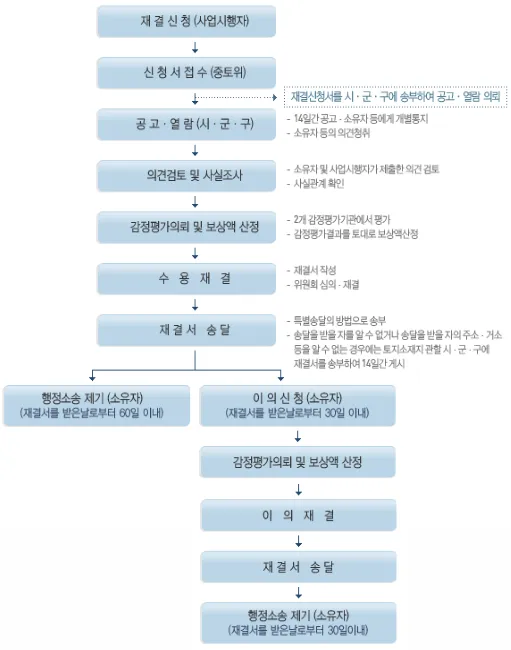
The land expropriation/compensation procedure is a process of systematically carrying out, step by step, the procedures legally guaranteed in order to secure the land needed for a public-interest project.
In particular, the expropriation adjudication procedure protects the rights of the project operator and the landowner in a balanced manner, and places emphasis on securing procedural legitimacy that sufficiently reflects the owner's opinion.
Application for and Receipt of an Expropriation Ruling
For land for which a negotiated purchase has not been reached, the project operator files an application for an adjudication of expropriation with the Land Expropriation Committee.
The received application for adjudication is then sent to the city, county, or district where the land is located, with a request that public notice and inspection be carried out.
Public Notice and Hearing of Opinions
The city, county, or district posts the relevant content on a notice board for 14 days and gives individual notice to landowners and others so that they may inspect the content of the expropriation application.
At this time, the owner may, during the public notice period, inspect the expropriation application documents and submit a written opinion.
The written opinion should specifically state the following wishes or requests concerning the expropriation.
∙ Claim for expropriation of the remaining land
∙ Whether any rights have been omitted
Fact-Finding and Review of Opinions
The Land Expropriation Committee reviews the opinions submitted by the owner and the project operator and verifies the facts through on-site investigation.
In this process, it reviews the matter in depth so that the owner's assertion of rights is sufficiently reflected.
Appraisal and Calculation of Compensation
An appraisal is commissioned from two independent appraisal institutions to calculate an appropriate amount of compensation for the land.
The appraisal results serve as the basis for fair payment of compensation.
Expropriation Ruling and Service
The land expropriation committee prepares the expropriation ruling on the basis of the appraisal results and the findings of the factual investigation, and finalizes it through the committee's deliberation.
The ruling is served on the owner by special service, and where service is not possible, it is posted and published for 14 days at the city, county, or district office having jurisdiction over the location of the land.
Objection and Litigation Against a Ruling
Objection
The owner may file an objection within 30 days from the date of receiving the adjudication document, and in the objection procedure, reappraisal and reexamination are carried out.
∙Filing of administrative litigation
After service of the adjudication document within 90 days (within 60 days where an objection has been filed), the legality of the adjudication and the appropriateness of the compensation amount may be contested before the court through administrative litigation.
3. Land Expropriation and Compensation | Types of Compensation and Calculation Standards

Land expropriation and compensation is a system that compensates, on reasonable and fair standards, for land and other property required for public-interest projects.
Compensation is divided into various items such as land, buildings and ground fixtures, and business losses, and specific assessment standards apply to each.
Land Compensation
Land compensation is based on the officially assessed land price published each year as of January 1.
A certified appraiser conducts the appraisal by comprehensively considering the rate of change in land prices, the rate of increase in producer prices, and the individual characteristics of the land subject to expropriation.
However, land price artificially raised by the relevant public works project (development gains) or speculative prices are not included in the appraisal.
In addition, compensation is in principle paid in cash, but it may be paid in bonds at the owner's request or under certain conditions.
Category | Details | |
Eligibility | - Where the person so wishes | |
- For land of an absentee landowner, where compensation exceeds 100 million won, the excess amount is compensated | ||
Repayment period | Within 5 years | |
Bond interest rate | Absentee real estate owner | - Bonds with a repayment period of 3 years or less : Interest rate on a 3-year term deposit |
- Bonds with a repayment period of more than 3 years and up to 5 years : Yield on 5-year government bonds | ||
Person who is not an absentee real estate owner | - Bonds with a repayment period of 3 years or less : 3-year term deposit | |
- Bonds with a repayment period of more than 3 years and up to 5 years : Yield on 5-year government bonds
| ||
Compensation for Buildings and Other Obstructions
For buildings and other obstructing structures, relocation costs (the costs of dismantling, transporting, and reinstalling) are compensated first.
If the relocation cost exceeds the acquisition price or relocation is not possible, compensation is based on the acquisition price of the building or other structure.
Compensation for Business Losses
Business suspension compensation is paid based on the operating profit for up to four months of the suspension period.
Business closure compensation covers two years of operating profit, and an eligible claimant for business closure compensation must meet one of the following requirements.
Requirements for Business Closure Compensation
▷ Where a business permit cannot be obtained at another location
▷ Where the head of the Si, Gun, or Gu recognizes that relocation to another location is markedly difficult because the business is an undesirable facility
Compensation for Loss of Residual Land and Purchase of Residual Land
Where the project operator expropriates or purchases part of the land and the value of the remaining land (the residual land) declines, or where construction of a passage, a ditch, a fence, or the like is required, the amount of the loss and the construction costs are compensated.
the owner may request the project operator to purchase the residual land
▷ Where no agreement is reached, an application for expropriation may be filed with the competent Land Expropriation Committee
Rights and Other Compensation
For specific rights such as mining rights and fishing rights, compensation for the extinction of the relevant right is paid separately in accordance with the relevant statutes.
Compensation Outside the Project Area
Where neighboring farmland not included in the project district becomes inaccessible because it is surrounded by mountains, rivers, or the like as a result of the project's implementation, the land may, upon the owner's request, be treated as land within the project district and compensated.
Compensation for Loss of Farming
For farmland incorporated into a project district, two years' worth of the average total agricultural income of farming households over the immediately preceding 3 years is compensated as the agricultural loss amount.
In this case, where the owner of the farmland and the actual cultivator differ, compensation is provided as follows.
Where the owner is a local farmer | Paid by mutual agreement |
If no agreement is reached, paid 50% to each | |
Where the owner is not a local farmer | Paid to the actual cultivator |
4. Land Expropriation and Compensation | Related Disputes and Resolution Methods

In the process of land expropriation and compensation, disputes may arise due to differences of opinion among interested parties.
To resolve such disputes amicably, legal and administrative procedures and various dispute mediation methods are available.
Main Causes of Disputes
∙ Issues regarding the legality and procedural propriety of the expropriation procedure
∙ Conflicts over compensation for losses to remaining land and the purchase of remaining land
∙ Disputes over the scope and standards of compensation for business losses
∙ Issues in calculating compensation amounts for rights compensation (mining rights, fishing rights, and the like)
Application for a Ruling and Land Expropriation
Where an agreement is not reached or an agreement is not possible, the project operator may apply to the competent land expropriation committee for a ruling.
Category | Details |
Application for ruling | The project operator or the landowner and interested parties may apply to the competent land expropriation committee for a ruling |
Purpose of ruling | Where an agreement fails, to acquire land for a public-interest project, carry out the compulsory expropriation procedure after payment or deposit of compensation |
Ruling procedure | ① Public notice and inspection of the expropriation ruling ② Appraisal by 2 appraisers ③ Calculation of the average of the appraised values ④ Examination and ruling |
Notification of result | Serve an authenticated copy of the ruling on the project operator, the landowner, and interested parties |
Transfer of ownership | After payment or deposit of compensation, the project operator transfers ownership of the land into the project operator's name |
Objection and Ruling Procedures
A person who objects to an adjudication of a land expropriation committee may within 30 days from the date of receiving the authentic copy of the written adjudicationfile an objection in writing (a prescribed written objection) with the Central Land Expropriation Committee.
Category | Details |
Period for filing an objection | Within 30 days after service of the authentic copy of the written adjudication |
Receiving authority | Central Land Expropriation Committee (for a local adjudication, via the local committee → the central committee) |
Examination and decision | After the central committee examines the objection, it renders an adjudication decision on the compensation amount |
Notice of the result | The authentic copy of the written objection adjudication is served on the project operator, the owner, and interested parties |
Payment of compensation | The project operator pays or deposits the increased portion of the compensation |
Confirmation of the adjudication | If no lawsuit is filed within 60 days after service of the written objection adjudication, it is deemed a final and conclusive judgment under the Civil Procedure Act → The compensation procedure is concluded |
5. Land Expropriation and Compensation | Checklist

This is a checklist for carefully confirming the main procedures and issues in the land expropriation/compensation process.
It can help the project operator, the landowner, and all parties concerned to clearly understand their rights and obligations.
Category | Items to confirm and points to note |
Consultation stage | An amicable consultation is most desirable, and the content of the consultation should be recorded in writing |
Application for adjudication | Confirm compliance with procedures such as submission of the application for adjudication, public notice, and hearing of opinions |
Compensation assessment | Check whether the appraisal results are reflected and whether artificial development gains are excluded |
Whether bond compensation applies | Confirm the owner’s wishes and whether the excess amount for absentee landowners applies |
Payment of compensation | Keep payment supporting documents and records of deposit |
Transfer of ownership | Confirm the registration transfer documents and the certified copy of the register |
Objection procedure | Check compliance with procedures such as receipt of the objection and the review by the Central Land Expropriation Committee |
Dispute response | Be familiar with the period and procedure for filing administrative litigation and respond in a timely manner |
Compensation for remaining land | Confirm consultation with the project operator and, if necessary, whether to apply for expropriation |
Compensation for rights | Check the assessment and payment procedures for compensation for rights |
Compensation for business losses | Confirm the suspension period and whether the requirements for business closure are met |
Support System of Real Estate Attorneys
This law firm has a substantial number of attorneys registered with the Korean Bar Association, including attorneys specializing in expropriation and compensation, attorneys specializing in real estate, and attorneys with an average of more than 10 years of experience.
Accordingly, professional and systematic legal support is available for various matters related to land expropriation and compensation, such as procedures, contracts, disputes, and permits and approvals.
If you need assistance in the course of land expropriation and compensation, you may request the support of a specialized attorney at any time.
See More


Watch related video content
for this case study.

How to respond to auction/encumbrance lawsuits