CONTENTS
- 1. Filing an Administrative Appeal | Definition

- - Functions of Administrative Appeal
- - Distinctive Features of Administrative Appeal
- 2. Filing an Administrative Appeal | Types of Administrative Appeals
- - Trial for Cancellation
- - Trial for Confirmation of Invalidity
- - Adjudication for Performance of an Obligation
- 3. Filing an Administrative Appeal | Administrative Appeal Procedures
- - Submission of the Adjudication Application
- - Submission of the Answer
- - Referral of the Case
- - Hearing
- - Ruling
- 4. Filing an Administrative Appeal | Methods for Self-Representation
- 5. Filing an Administrative Appeal | Points to Note
- 6. Filing an Administrative Appeal | Key Issues

1. Filing an Administrative Appeal | Definition

Filing for an administrative adjudication is a procedure for contesting a disposition of an administrative agency or requesting a reexamination.
An administrative adjudication is a remedy procedure in which a citizen whose rights or interests have been infringed by an unlawful or improper disposition of an administrative agency, or by the exercise or nonexercise of public authority, requests correction from an administrative agency.
In simple terms, it can be viewed as a procedure by which a citizen requests that the administrative agency itself reconsider an administrative disposition that the citizen feels is unfair or improper.
 Functions of Administrative Appeal
Let us review the functions of administrative adjudication.
1. Function of autonomous administrative control
Administrative adjudication is a system that has the administrative agency review its own disposition once more, thereby enhancing the autonomy and accountability of the administration.
The Supreme Court has ruled on this that "its purpose lies in giving the administrative authority an opportunity to correct the disposition on its own."
2. Role of supplementing the judicial function
Administrative adjudication can resolve disputes through a procedure that is simpler and faster than litigation.
In that it reduces the burden on the judiciary and helps the public receive relief of their rights quickly, it serves to supplement the judicial function.
3. Reduction of the burden on the public and the courts
If administrative adjudication is operated fairly and objectively, the public can reduce unnecessary time and cost, and the courts can be expected to function in filtering out minor matters or those that can be sufficiently resolved within the administration.
Distinctive Features of Administrative Appeal
Korea's administrative dispute system is divided into the 'administrative appeal,' which is decided by an administrative agency, and the 'administrative litigation,' which is decided by a court.
▶Principle: Optional administrative appeal
Under Article 18, paragraph 1 of the current Administrative Litigation Act, citizens may file an administrative litigation directly without going through an administrative appeal.
This is called the optional administrative appeal principle.
▶Exception: Mandatory administrative appeal
However, where an individual statute provides that an administrative appeal must be undertaken before a lawsuit can be filed, omitting that procedure may result in the lawsuit being rejected.
This is called the mandatory administrative appeal principle.
▶Exceptions to the mandatory administrative appeal principle
If any of the following grounds exists, an administrative litigation may be filed directly without going through an administrative appeal.
-Where there is a concern that significant harm may arise from the execution of the disposition or the progress of the procedure
-Where there is a ground that prevents the administrative appeal body from making a ruling
-Where there is another justifiable ground
In addition, an administrative litigation may also be filed directly without an administrative appeal in the following cases.
-Where an administrative appeal has already been undertaken on part of the related dispositions
-Where the administrative authority incorrectly advised that the administrative appeal procedure need not be undertaken
-Where the disposition has been changed and the new disposition is being contested
2. Filing an Administrative Appeal | Types of Administrative Appeals

An administrative appeal is a system that allows citizens to request the correction of an administrative agency’s erroneous disposition or failure to act.
The Administrative Appeals Act classifies such administrative appeals into three types.
These are the revocation appeal, the appeal for confirmation of invalidity and similar matters, and the appeal for performance of an obligation.
Because there are differences in the subject of the claim, the requirements, and the procedure for each type of appeal, they will be examined in detail.
Trial for Cancellation
A revocation adjudication is a procedure for requesting the revocation or modification of a disposition rendered by an administrative agency when the disposition is judged to be unlawful or unjust.
For example, contesting a restaurant business suspension disposition or a permit refusal disposition falls under this.
Item | Description |
Filing period | Within 90 days from the date the disposition became known, and within 180 days from the date of the disposition |
Stay of execution | In principle not stayed (a separate application is required) |
Circumstantial ruling possible | Where it would greatly contravene the public welfare, the claim may be dismissed even if it has merit |
Effect of the ruling | If upheld, the disposition loses effect as if it ‘had never existed from the beginning’ (formative effect recognized) |
▶Examples
-Request for revocation of a driver's license revocation disposition
-Request for revocation of a business suspension disposition for violation of the Food Sanitation Act, and the like


Trial for Confirmation of Invalidity
An adjudication to confirm invalidity or the like is a procedure for officially confirming, through administrative adjudication, the existence or non-existence of the effect of a disposition where the disposition is judged to be wholly invalid or non-existent.
This applies where the form of an administrative disposition is outwardly in place but the legal requirements are not met at all.
Item | Description |
Filing period | None (confirmation of invalidity is possible at any time) |
Circumstantial ruling | Not recognized |
Standard for recognizing invalidity | The defect must be serious and obvious, not merely unlawful |
Burden of proof | The claimant must prove the grounds for invalidity |
▶Examples
-A claim to confirm the invalidity of an administrative fine disposition imposed with no legal basis whatsoever
-A claim to confirm the non-existence of an order issued by a person without the authority to make the disposition, and the like
Adjudication for Performance of an Obligation
An adjudication on performance of obligation is a procedure for requesting that an administrative agency be ordered to issue a certain disposition when the agency refuses, or gives no response at all to, a permit or authorization applied for by a citizen.
It is a means of responding to inaction or passive administration.
Item | Description |
Filing period | None (available as long as the inaction continues) |
Stay of execution | Not applicable |
Circumstantial ruling | Possible |
Effect of the ruling | If granted, the administrative agency must issue the disposition pursuant to the ruling |
Compulsory disposition | If it is not performed, the commission may directly issue the relevant disposition |
▶Examples
-Failure to process an application for a private taxi license
-Responding to inaction on an application for disclosure of administrative information
-Requesting correction of a refusal disposition on an application for permission to change the form and quality of land
3. Filing an Administrative Appeal | Administrative Appeal Procedures
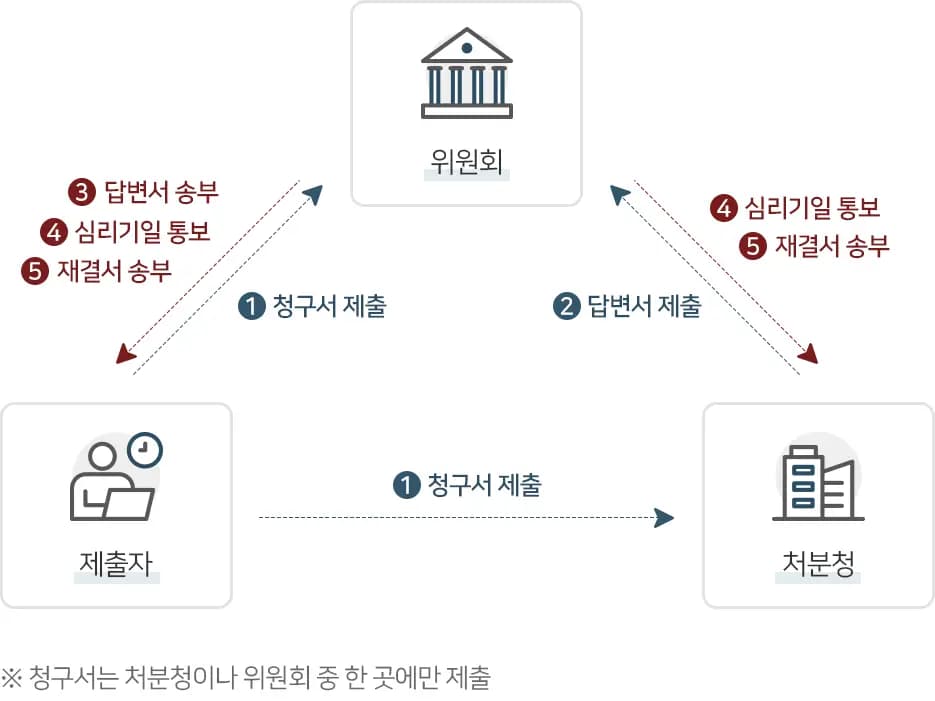
Let us examine the procedure for filing an administrative appeal.
Submission of the Adjudication Application
A person who wishes to file an administrative appeal must first prepare and submit a written appeal application.
The application may be submitted to the administrative authority that issued the disposition (the respondent) or to the administrative appeals commission with jurisdiction.
※ Note: Where there are two or more respondents, copies must also be submitted in a number equal to the number of respondents.
Submission of the Answer
When a claimant submits a written administrative appeal, the opposing disposition agency (the respondent) must submit a ‘written answer,’ which is rebuttal material to it, within 10 days.
The written answer is submitted to the Administrative Appeals Commission together with a copy of the written claim, and it contains the administrative agency's position and arguments.
The Administrative Appeals Commission serves this written answer on the claimant so that the claimant can know what arguments the disposition agency is making.
※ If the administrative appeal was conducted online, the written answer can be viewed electronically on the website of the Central Administrative Appeals Commission.
Referral of the Case
The disposition agency must, without delay, refer the request submitted by the claimant and the answer that it has prepared to the administrative appeals commission.
This is a procedure to enable the administrative appeals commission to examine the case promptly.
Hearing
After receiving a referred case, the Administrative Appeals Commission thoroughly reviews the arguments of the appellant and the respondent.
It then designates a hearing date for the review and determines in earnest whether the disposition was unlawful or unjust.
When the review is concluded, the result is sent in writing to the appellant and the respondent.
Ruling
An adjudication is a procedure in which the administrative appeals commission renders a final decision on the case in question and officially notifies the parties of it.
The administrative appeals commission serves the written adjudication on the claimant and the respondent, and the administrative appeal takes effect only once this written adjudication has been served.
In other words, a decision in an administrative appeal does not simply end with being "decided"; its contents must be formally notified through a written adjudication for it to have legal binding force.
4. Filing an Administrative Appeal | Methods for Self-Representation
The following reviews how to respond to an administrative appeal on your own.
1. Determine Whether It Is Subject to an Administrative Appeal
-Confirm whether the disposition in question is a disposition or omission by an administrative agency.
-Civil petition processing, private disputes, and the like are not subject to it.
2. Comply With the Filing Period
-Revocation appeal and invalidity confirmation appeal: within 90 days from the date on which the disposition became known
-Performance appeal: no time limit as long as the omission continues
※ However, all administrative appeals must be filed within 180 days from the date of the disposition
3. Prepare the Petition
-Avoid emotional expressions and clearly state the legal grounds and the facts.
-Citing the relevant statutory provisions specifically is effective.
4. Prepare Supporting Materials
-Secure and submit documents, photographs, written statements, and the like that can prove the impropriety or illegality of the disposition.
5. Use the Online Filing System
-You can file through the Administrative Appeals Portal after identity verification
-You can check the status of the proceedings in real time
5. Filing an Administrative Appeal | Points to Note
Let us look at points to note regarding the filing of an administrative appeal.
1. Whether the filing period has elapsed
One of the most common grounds for rejection is exceeding the filing period.
You must be sure to check that it is within 90 days from the date you became aware that the disposition existed (based on the date of notification).
2. Error in setting the respondent
An appeal claim must designate the administrative agency that issued the disposition as the respondent.
Designating an inappropriate respondent may result in rejection.
3. Subjective assertions alone are insufficient
Because an administrative appeal is a matter of legal judgment, appealing to a sense of injustice alone is insufficient.
A logical assertion combining the facts and the statutes is necessary.
6. Filing an Administrative Appeal | Key Issues
A filing for administrative adjudication is a system through which a citizen can request an administrative agency to correct an unlawful or unjust administrative disposition or inaction, but various legal issues arise in the actual filing process.
Review of requirements is conducted thoroughly, ranging from whether the subject of the filing constitutes an administrative disposition, whether the claimant is a person who has suffered a direct infringement of rights, and whether the filing period has been observed, and it must be legally proven that the disposition in question involved a serious illegality.
At the firm, administrative attorneys with experience in a variety of administrative cases work closely with experts from multiple fields within the firm, such as tax accountants, certified public accountants, and labor attorneys, to handle other procedures related to administrative dispositions on behalf of clients, and they also provide comprehensive legal services, including interpretation of statutes related to administrative regulation.