
CONTENTS
- 1. Administrative Litigation | Definition

- - Types
- - Appeal Litigation
- - Party Litigation
- - Citizen Suit
- 2. Administrative Litigation | Characteristics
- - Relationship with Administrative Appeal
- - Relationship with Civil Litigation
- 3. Administrative Litigation | Procedures
- - Submission of the Complaint
- - Submission of the Answer
- - Date for Preparation of Oral Argument
- - Date for Oral Argument
- - Conclusion of Oral Argument
- - Pronouncement of Judgment
- - Appeal
- 4. Administrative Litigation | Key Issues

1. Administrative Litigation | Definition

Administrative litigation is litigation that contests the legal validity of an administrative disposition imposed by an administrative agency.
It may be filed when an administrative agency’s decision or disposition is judged to be unreasonable or unjust, and it is a method of revoking that disposition or confirming its nullity.
Through this, it can be regarded as an important legal procedure that allows a court to judge legitimacy and revoke an erroneous disposition.
For example, when an application for a permit is refused without any reason, when an excessive tax is imposed, or when a business suspension disposition is unjustly issued, administrative litigation is precisely the act of a citizen filing a lawsuit with a court and requesting that the administrative measure be withdrawn or rendered void.
 Types
Types
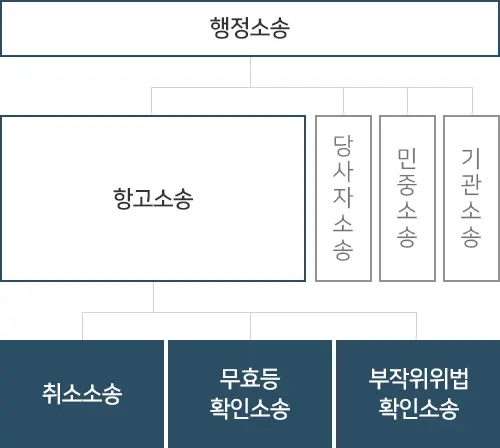
Administrative litigation is broadly divided into four kinds, distinguished between litigation for the protection of an individual citizen’s rights and interests and litigation for maintaining the public-interest legal order.
Appeal Litigation
An appeal litigation is the most representative type of administrative litigation, and it is litigation that raises an objection to an administrative agency's unlawful disposition or to its failure to take any disposition (an omission).
The Administrative Litigation Act divides appeal litigation into three types.
① Revocation lawsuit
This is litigation requesting the revocation or modification of an unlawful disposition or ruling issued by an administrative agency.
For example, it is the procedure for requesting that the court “remove that disposition” with respect to an unjust business suspension disposition, a taxation disposition, a permit revocation disposition, and the like.
-Within 90 days from the date of the disposition
-A person whose rights or interests have been infringed by the disposition
-Filed against the administrative agency that made the disposition
② Litigation to confirm invalidity or the like
This is litigation to confirm that an administrative agency's disposition was so unlawful that it had no effect from the outset.
It is litigation that goes one step beyond an ordinary revocation, and it is judged to be possible where the disposition itself is clearly invalid.
-No filing period, and administrative adjudication may also be omitted
-Anyone with a legal interest may file it
③ Litigation to confirm the unlawfulness of an omission
This is litigation requesting confirmation that, where an administrative agency takes no action despite having received a legitimate application, that is, where the very fact of remaining silent or neglecting the matter is itself unlawful.
-Where a considerable period (usually 60 days) has passed after the application with no disposition
-Applicable only where the administrative agency has a legal duty to make a disposition but does not do so
-Because there is no disposition, an ordinary revocation lawsuit is not possible
Party Litigation
A party litigation is a lawsuit filed when one seeks to resolve a dispute over a legal relationship under public law itself, rather than over an administrative agency's disposition.
Put simply, it is used when an administrative agency and a citizen directly contest a legal relationship from an ‘equal standing.’
Citizen Suit
A public-interest lawsuit is a lawsuit filed to request correction when the State or a public agency has violated a statute, regardless of an individual's legal interest.
Because it is a lawsuit aimed at correcting the public legal order rather than protecting an individual's rights, only persons designated by law may file it.


2. Administrative Litigation | Characteristics

Administrative litigation differs from ordinary civil litigation in several respects.
1. Adversarial principle plus ex officio principle
In civil litigation, judgment is based only on the facts asserted and proven by the parties, but in administrative litigation, the court may investigate and judge the facts directly.
Because the main purpose is to protect the rights of the people, a more active examination is permitted.
2. The circumstantial judgment system
Even if the plaintiff's assertion is legally correct, where revoking the disposition would cause great harm to the public interest, the court may dismiss the plaintiff's claim.
A circumstantial judgment, in which the plaintiff's claim is not granted because public-interest considerations are given priority even though the claim has merit, is the provision that most clearly demonstrates ‘public character.’
Relationship with Administrative Appeal
Administrative litigation and administrative adjudication are both means by which a citizen can raise an objection to an unlawful or unjust disposition of an administrative agency, but they have the following differences.
✅ What Is Administrative Adjudication?
Administrative adjudication is a procedure in which a disposition of an administrative agency is reviewed once again within the administrative agency. A higher agency of the administrative agency that made the disposition handles the adjudication, and it is a system processed within the administrative
branch rather than by a court.
-Purpose: A system established to secure the efficiency and self-control function of administration
-Characteristics: The procedure is relatively simple, the cost burden is low, and it has the advantage that a decision is rendered promptly
✅ What Is Administrative Litigation?
Administrative litigation is a procedure in which a citizen whose rights or interests have been infringed by an unlawful administrative disposition requests correction from a court.
-Purpose: The judiciary makes the final judgment on an unlawful act of an administrative agency and protects the rights of citizens
-Characteristics: Because an independent third party, the court, makes the judgment, it is more fair and has enforceability
✅ The Relationship Between the Two Procedures
-In principle, a choice is possible: Even where administrative adjudication is available under the statutes, administrative litigation can be filed directly.
-Exception: Where another law provides that administrative adjudication must be completed first, administrative adjudication cannot be omitted and a lawsuit cannot be filed directly.
Relationship with Civil Litigation
Administrative litigation and civil litigation are both litigation procedures judged by a court, but the subject and nature of the litigation differ.
✅ Basic Differences
Category | Administrative Litigation | Civil Litigation |
Nature | Public law relationship (State vs. individual) | Private law relationship (individual vs. individual) |
Subject | An unlawful disposition or omission of an administrative agency, and the like | Private rights (contract, damages, default, and the like) |
Purpose | Remedy of citizens' rights + administrative control | Realization of private rights |
In other words, administrative litigation concerns cases involving administrative agencies such as the State or local governments, while civil litigation concerns disputes between individuals.
3. Administrative Litigation | Procedures

Administrative litigation is a procedure of formally filing a lawsuit before the court to seek correction of an unlawful disposition or omission by an administrative agency.
The following explains the main procedures in order.
Submission of the Complaint
To begin an administrative litigation, you must first prepare a complaint and submit it to the court.
A sample complaint is available at the civil affairs office of each court for reference, and detailed information can be checked through the Electronic Civil Affairs Center of the Court of Korea.
The complaint must include the following matters.
-The personal details of the plaintiff and the defendant
-The content of the administrative disposition to be contested
-The reasons it is considered unlawful and the facts
-The purport of the claim (for example, a request to revoke the ○○ disposition)
Attached documents and service fees must also be submitted, and care should be taken because a correction order may be issued if anything is omitted.
Submission of the Answer
Once the complaint is filed, the court serves a copy of the complaint on the defendant.
The defendant (usually the State, a local government, and the like) must submit an ‘answer’ within 30 days from the date of receiving the copy of the complaint.
The answer contains a rebuttal of the plaintiff's claims, opinions on the facts, the legitimacy of the administrative disposition, and the like.
Usually a ‘procedural guide’ is enclosed along with the copy of the complaint, so when preparing the answer, one can be informed of the matters to be stated, documents to be submitted, and the like.
Date for Preparation of Oral Argument
When the defendant submits an answer, the court designates a date for preparation for pleadings in order to organize the "issues" before full hearing of the merits.
-Organizing the gist of the plaintiff's and defendant's arguments
-Distinguishing facts that are not disputed from facts that are disputed
-Establishing a plan for examination of evidence
-Reviewing and deciding whether to apply for evidence
In other words, it is a procedure for clarifying the issues to be substantively contested in the litigation and for organizing in advance the parts to be proven and the methods of proof.
Date for Oral Argument
Once the issues are organized, the court designates a "date for pleading" for the full-scale examination of evidence and statement of arguments.
This is also called the date for intensive examination of evidence.
The following take place on this date.
-Examination of witnesses
-Submission of documentary evidence
-Statement of the contents of arguments
Depending on the case, where the issues are simple or prompt handling is needed, the date for preparation of pleadings may be omitted and the date for pleading held immediately.
In a case that proceeds directly to the date for pleading without a date for preparation of pleadings, all arguments and evidence must be addressed at this session, so sufficient advance preparation is important.
Conclusion of Oral Argument
When all statements and examination of evidence are complete, the court declares ‘conclusion of oral argument’ and sets a date for the pronouncement of judgment.
After oral argument has been concluded, even if a brief or additional materials are submitted, they are not reflected in the content of the trial.
If one unavoidably wishes to submit additional materials, one must file an ‘application to reopen oral argument.’
Pronouncement of Judgment
On the designated date, the court pronounces judgment.
The judgment is delivered by the presiding judge reading out the text of the judgment, and a brief explanation of the reasons may be added if necessary.
The pronouncement may proceed even if the parties do not appear in court.
The effect of the judgment arises at the same time as the pronouncement.
The court then prepares the written judgment and serves it on each party.
Appeal
A party who is dissatisfied with the judgment must submit a “notice of appeal” to the court of first instance within two weeks from the date of being served with the written judgment.
The notice of appeal is submitted to the trial court of first instance, but the actual examination proceeds at the higher court (a high court or the Seoul High Administrative Court).
See More
4. Administrative Litigation | Key Issues
Administrative litigation is the last legal means by which citizens can recover their rights against the abuse of administrative power.
The procedures and requirements are somewhat demanding, but if you understand the basic structure of the litigation and thoroughly prepare the key points, such as the filing period, the defendant, and securing evidence, you can respond on your own.
However, where the difficulty of the litigation or the scale of the harm is large, or where specialized administrative law knowledge is required, obtaining the assistance of an administrative law attorney from the early stage is advisable.
An administrative law attorney at Daeryun LLC establishes a systematic response strategy across the entire process, from reviewing the unlawfulness of the disposition, to determining whether the filing period has been observed, identifying the appropriate defendant, and collecting and organizing evidentiary materials.
You may seek legal consultation from an 🔗administrative law attorney at Daeryun, ranked 9th among law firms in the Republic of Korea (based on 2025 National Tax Service value-added tax filings).


Watch related video content
for this case study.

✨Meet Daeryun Law Firm’s corporate legal and tax administration experts!