CONTENTS
- 1. International Trademark Applications | Measures to Secure Intellectual Property Rights Abroad

- 2. International Trademark Applications | Methods for Filing Trademarks and Designs Abroad
- - Madrid International Application Procedures
- - Points to Note When Using the Madrid System
- 3. International Trademark Applications | Methods for Filing Designs Abroad
- - Hague International Application Procedures
- 4. International Trademark Applications | Response Strategies When an Application Is Rejected
- 5. International Trademark Applications | Need for Patent Attorney and Attorney Assistance

1. International Trademark Applications | Measures to Secure Intellectual Property Rights Abroad
For international trademark applications and design applications, it is necessary to understand the principle of ‘territoriality’ in intellectual property rights.
A right acquired in a particular country basically has effect only in that country.
Even if a trademark or design has been registered with the Korean Intellectual Property Office, it has no effect abroad.
Accordingly, if you wish to secure a trademark right or design right abroad and exercise an exclusive right, you must go through a separate registration procedure under the relevant country or an international treaty.
For companies pursuing global expansion, sellers operating on online platforms, and manufacturers with original designs, securing overseas intellectual property rights is a matter directly connected to market entry strategy, beyond the dimension of rights protection.
Through international trademark applications and design applications, you may not only defend against the unauthorized use of intellectual property rights but also block similar trademarks and designs in advance and prevent future legal disputes.



2. International Trademark Applications | Methods for Filing Trademarks and Designs Abroad
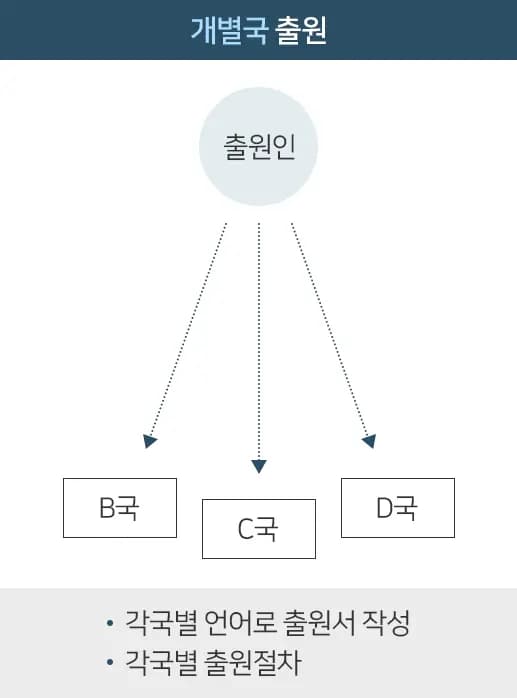
International trademark applications can be broadly divided into four methods.
- Direct trademark application in an individual country : Claim of priority under the Paris Convention
- Filing with the Benelux Office for Intellectual Property or the African Intellectual Property Organization : Filing with a trademark office jointly operated by certain countries under a multilateral treaty
- Filing with the European Union Intellectual Property Office or the African Regional Intellectual Property Organization : Use where a separate organization and trademark system covering a particular region exists
- The Madrid System : Use of the system encompassing the Madrid Agreement and the Madrid Protocol
 Madrid International Application Procedures
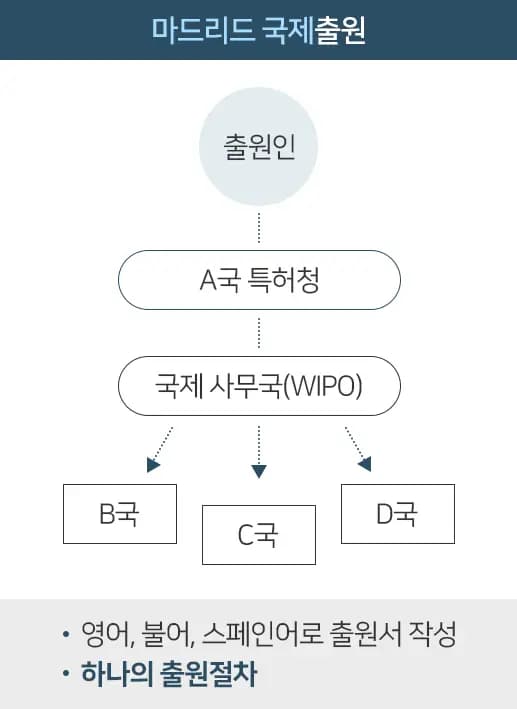
Among the methods of international trademark application, the most widely used is the Madrid System, to which 131 countries are party.
Operated under the Madrid Agreement and the Madrid Protocol, this system allows an applicant who has a basic application or registration in Korea to file in multiple countries simultaneously with a single international application through the International Bureau (WIPO) on that basis.
Because it is handled with a single language and a single fee, its cost efficiency and administrative efficiency are very high.
However, when the Madrid System is used, the application remains dependent on the status of the basic application or registration for 5 years from the date of filing.
This is called the ‘principle of dependency of international registration’ or the ‘risk of central attack,’ and caution is needed because if the domestic registration is invalidated or refused during this period, the international registration may also lapse to the same extent.
This principle applies even where a trademark right has been obtained in a designated country such as the United States or Japan.
Points to Note When Using the Madrid System
A point to note in electronic filing is that the applicant information in the international application must perfectly match the basic application.
In addition, because the international registration may be affected if the basic application is rejected or its registration is cancelled, it is advisable to proceed after securing the stability of the basic right.
3. International Trademark Applications | Methods for Filing Designs Abroad

The methods of filing a design application overseas are divided into two routes similar to those for international trademark filing.
The first is the Paris route method of filing directly with each individual country.
It is common to file while claiming priority within 6 months after the domestic design application.
Because this method is subject to the laws, registration requirements, and examination standards of the country of application as they are, it is very important to align the name, drawing format, classification code, and similar matters of the designed work with the standards of the relevant country.
The second is the international filing method using the Hague System.
This is a system that allows a single international application to be submitted to the International Bureau (WIPO) so that design rights can be secured simultaneously in several countries or regions.
Hague International Application Procedures
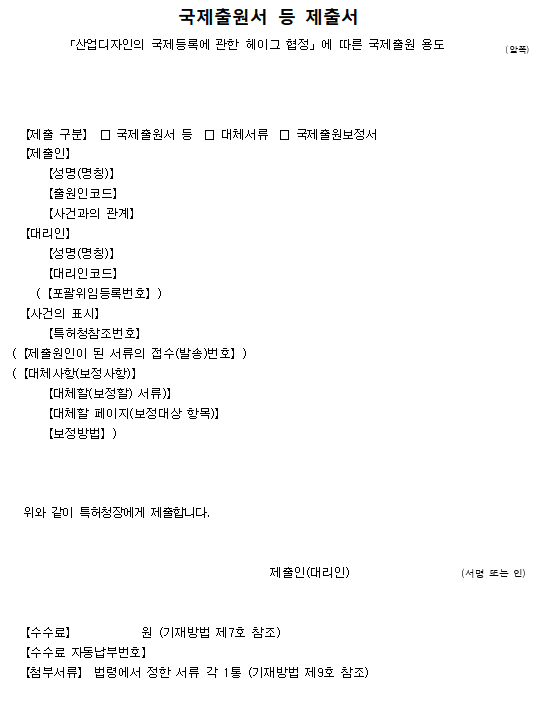
The greatest feature of the Hague System is that an international application is possible without a domestic prior application.
An international application is possible as long as the applicant's nationality, place of domicile, or actual place of business falls within a contracting party.
In addition, a single application may include up to 100 different designs, and the only point to note is that they must belong to a single class.
After the international registration, the designated office of each country conducts a substantive examination, and where a notice of refusal is issued, a response must be made in accordance with the domestic legal procedure of that country.
Even if a separate decision granting protection is not sent, if there is no notice of refusal within the designated period, the design is deemed registered and may be protected for the following 15 years.
4. International Trademark Applications | Response Strategies When an Application Is Rejected
An international trademark application undergoes substantive examination in accordance with the domestic statutes and examination standards of each designated country's office.
However, a trademark application may be rejected for various reasons, including a likelihood of confusion as to the source of goods, a trademark lacking distinctiveness, and rejection due to the existence of a prior-registered or similar trademark.
A notice of rejection may be issued within 1 year and 6 months from the international application date, in which case the applicant must directly undertake response procedures with the competent office of the relevant country, such as filing an objection, submitting a statement of opinion, and filing an appeal against the rejection.
Tips for responding to the rejection of an international trademark application or design application are as follows.
Strategy Item | Description |
1. Accurate analysis of the grounds for rejection | Closely review the basis for the decision and the legal provisions stated in the notice of rejection -Identify grounds such as a lack of distinctiveness, conflict with a similar trademark, and loss of novelty -Analyze whether there is room for rebuttal in each country |
2. Use of assistance from local experts in the designated country | Because responding to a rejection follows each country's domestic law, retaining a patent attorney or legal expert of the relevant country is effective -In major jurisdictions such as the United States, Japan, and Europe, particularly detailed responses are required |
3. Strategy for submitting statements of opinion and amendments | The grounds for rejection may be resolved by submitting a statement of opinion or making a partial amendment (narrowing the scope of goods, modifying the mark, and the like) |
4. Preparation of subsequent procedures such as an appeal or objection | Where a simple response is insufficient, the possibility of registration may be contested through an appeal and similar procedures -Logical arguments using precedents and prior cases are important -An objection by a third party also needs attention |
5. Consideration of refiling in individual countries | Consider refiling through individual country applications |
5. International Trademark Applications | Need for Patent Attorney and Attorney Assistance

If an international trademark application or design application is rejected, a single inadequate response leads directly to failure to obtain rights in that country.
Consistent process management, from strategy formulation before the application, through monitoring during the application, to a response system after the application, is very important.
An international trademark application is a strategic tool for substantively protecting a company's brand and product designs in the global market.
Various routes such as the Paris route, the Madrid System, and the Hague System should be selected according to the purpose and target countries, and the optimal method should be chosen by considering, according to the applicant's situation, whether a basic right has been secured, the cost, and management efficiency.
In particular, you should make active use of the electronic application system and accurately understand the examination and protection structures of the International Bureau and each designated office.
For this, you may need the help of experts such as intellectual property attorneys, patent attorneys, customs attorneys, and foreign attorneys advising on US law (United States).
The firm has entered into MOUs with local law firms abroad and, through close cooperation, provides support to clients seeking to file international trademark applications, so if you have any inquiries, please submit a request for a legal consultation.
See More