CONTENTS
- 1. Overseas Patent Application | The Concept and Importance of Overseas Patent Applications

- 2. Overseas Patent Application | The Concept of the PCT International Application
- - Subject Matter Protected by the PCT International Application
- - Advantages and Disadvantages of the PCT International Application
- 3. Overseas Patent Application | The PCT International Application Procedure
- - The National Phase of the PCT International Application
- - Overseas Patent Application Fees
- 4. Overseas Patent Application | Establishing an International Application Strategy Is Important
- - Points to Note in Overseas Patent Applications
- - The Priority Claim System
- - Assistance from Patent Specialists, Including Attorneys and Patent Attorneys

1. Overseas Patent Application | The Concept and Importance of Overseas Patent Applications

Any company that plans to sell its products and designs abroad, or that does most of its business in foreign markets, should understand how an overseas patent application works.
Because protecting a patent right requires following the proper legal procedure, a company that intends to export its products, designs, and similar goods abroad should review the overseas patent application procedure in each destination country.
To begin with, even where a patent right has already been obtained in the Republic of Korea, a party cannot exercise exclusive rights in another country over the same invention unless it secures a separate patent in that country.
This reflects the principle of patent independence, also known as the principle of territoriality, which is recognized worldwide and amounts to one patent per country.
To protect an invention in a foreign market, then, an applicant must file a separate application in that country and obtain a patent there. The overseas patent application system, known as the PCT international application, was created to carry out these foreign filings more efficiently.


2. Overseas Patent Application | The Concept of the PCT International Application
The traditional way to seek patent protection abroad is to file a separate patent application in each country where protection is sought.
When an application claims priority based on an earlier application, priority is recognized only if the application is filed in the country concerned within 12 months of the filing date of the earlier application.
A PCT patent application, by contrast, allows an applicant to first submit a PCT application to the patent office of the country of nationality or residence and then enter the national phase, within a set period, in each country where a patent is sought.
Under this procedure, the applicant prepares a single application, the PCT international application, designates the PCT contracting states in which protection is desired, and submits it to the applicant’s own patent office or to WIPO. The filing is then treated as having the same effect as a separate application in each designated country.
In short, a single patent application procedure among PCT member states can give the effect of filing in multiple countries at once.
As of July 2025, the PCT has 158 member states, including most of the world’s major economies.
 Subject Matter Protected by the PCT International Application
An overseas patent application made through a PCT international application protects only inventions.
Such inventions include each country’s patents and inventor’s certificates, utility models, utility certificates, patents of addition, certificates of addition, inventor’s certificates of addition, and utility certificates of addition, although Korea recognizes only patents and utility models.
For the international filing of trademarks and designs, a separate procedure should therefore be reviewed.
- Overseas trademark application : Madrid international trademark application
- Overseas design application : international design application under the Hague System
Advantages and Disadvantages of the PCT International Application
Advantages | ① Simple requirements for recognizing the filing date -a single PCT international application secures the effect of filing in multiple countries, which reduces the burden of separate filings in each one |
② Advance assessment of the likelihood of obtaining a patent -the prior art search by the International Searching Authority and the international preliminary examination help gauge the likelihood of obtaining a patent and provide an opportunity to make supplements | |
③ Ease of preparing the application -the application may be filed in Korean, English, or Japanese, which reduces the burden of translating it into each country’s language when several countries are designated | |
④ Protection against premature overseas filings -using the results of the international search and preliminary examination, the applicant can review marketability before deciding whether to enter the national phase, which keeps unnecessary spending to a minimum | |
⑤ Fee reductions upon entry into the national phase -major patent offices operate systems that reduce patent fees for PCT applicants who enter the national phase | |
Disadvantages | ① Added cost of the PCT international application |
② Possibility of duplicated examination |
See More
3. Overseas Patent Application | The PCT International Application Procedure

A PCT international application for an overseas patent moves through the following steps.
1) International application stage
The applicant submits the international application to its own patent office, the Korean Intellectual Property Office, or to the WIPO International Bureau.
Languages of submission : Korean, English, Japanese
Documents to be submitted : the request, description of the invention, claims, abstract, drawings, and similar materials
Formality examination : correction and supplementation of matters such as the applicant’s eligibility and the language of the international application documents
2) International search stage
At this stage, prior art is searched by one of the International Searching Authorities, drawn from the patent offices of Korea, Austria, Australia, Singapore, and Japan, and an International Search Report (ISR) and a Written Opinion are issued.
This allows the novelty, inventive step, and similar features of the invention to be assessed in advance, and it offers a chance to make supplements where necessary.
An applicant who wants a more in-depth review may request an international preliminary examination.
This step is optional, and its results may affect the examination after entry into the designated countries.
[Scope of the international search]
- Checking whether the subject matter is excluded from the international search
- Examination of unity of invention
- Prior art search
- Assessment of patentability (novelty, inventive step, industrial applicability)
International publication stage
Once 18 months have passed from the priority date, the application is published regardless of the stage it has reached, and a degree of protective effect arises.
The published materials include the description of the invention, the claims, the drawings, and the International Search Report.
The National Phase of the PCT International Application
To enter the national phase in a given designated country, the applicant must submit a translation to that country.
The translation must reach the designated country generally within 30 months of the international filing date, and up to 31 months in some countries. The applicant then follows that country’s own application procedure, and a determination is made on whether a patent right will be granted.
- The patent office of each country conducts substantive examination
- A translation prepared in the language required by the designated country is submitted, and fees are paid
Overseas Patent Application Fees
The international application fee must be paid to the patent office within one month of the date the application is received.
4. Overseas Patent Application | Establishing an International Application Strategy Is Important
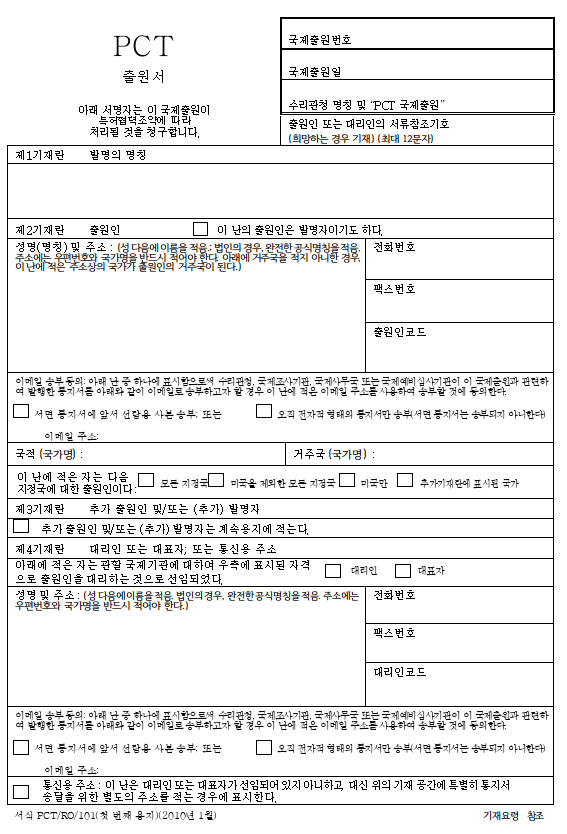
[Guidelines for Preparing Each PCT International Application Document]
Description of the invention
-the title of the invention in the description must match the ‘Title of the Invention’ field exactly
-set out matters such as the technical field, background art, disclosure of the invention, description of the drawings, best mode for carrying out the invention, industrial applicability, and sequence listing
Claims
-the claims must not refer to the description or the drawings, and the claim numbers must run in sequence
Abstract
-set out matters such as the technical field of the invention stated in the claims, the technical problem the invention seeks to address, the gist of the means for solving that problem, and the principal use of the invention
-state it concisely and summarize it within 150 words in English
-avoid stating uncertain effects or uses of the invention
Points to Note in Overseas Patent Applications
A few points deserve attention before starting the PCT procedure for an overseas patent application.
First, a PCT international application does not produce a worldwide patent from a single filing.
After the international filing date is recognized and the verification stage, the international search or the international preliminary examination, is complete, examination for patentability in each country begins only once a translation is submitted to that designated country.
In other words, a single PCT international application does not by itself yield patents in multiple foreign countries.
The PCT also sets strict periods for each stage, such as the fee payment period and the national phase entry period, so the applicant should take care not to miss these deadlines and lose rights as a result.
The Priority Claim System
A PCT international application may claim priority based on an earlier patent application.
If the PCT international application is filed within 12 months of a patent application in the Republic of Korea, it is treated as having been filed abroad on the original filing date, which can work in the applicant’s favor in assessments such as novelty.
Assistance from Patent Specialists, Including Attorneys and Patent Attorneys

The PCT international application is a powerful and efficient route to international patent protection.
Even so, an applicant must understand the requirements and deadlines at each stage and take a strategic approach that weighs factors such as translation costs and the differences among national laws.
For these reasons, it is advisable to seek advice from an experienced patent attorney or a specialized institution.
At this firm, customs attorneys advise on the resolution of cross-border patent disputes, and attorneys who hold patent attorney qualifications work alongside patent attorneys who have handled many corporate patent applications and patent disputes, forming a task force to manage overseas patent application matters.
Because careful translation helps prevent problems of dual interpretation when documents are prepared and reviewed, the firm’s in-house foreign attorney advising on U.S. law also collaborates on these matters.
The firm assists not only Korean companies filing patents abroad but also foreign companies seeking to file patents in Korea, a point worth keeping in mind.
If you are preparing an overseas patent application, please visit a nearby branch office of Daeryun LLC Law Firm.