
CONTENTS
- 1. Establishment of a Foreign-Invested Company | Overview of Local Subsidiary Establishment

- - Methods of Entering Into Domestic Business
- - Effects of Establishing a Company
- 2. Establishment of a Foreign-Invested Company | Requirements for Local Subsidiary Establishment
- - Differences From a Domestic Branch of a Foreign Company
- 3. Establishment of a Foreign-Invested Company | Procedure for Local Subsidiary Establishment
- - Business Registration and Foreign-Invested Company Registration
- - Procedure for Setting Up a Domestic Branch
- 4. Establishing a Foreign-Invested Corporation | Checklist Before Incorporation

1. Establishment of a Foreign-Invested Company | Overview of Local Subsidiary Establishment

The section below outlines the procedure for forming a foreign-invested company.
Foreign investors and foreign companies entering the Korean market may find it useful to lay the groundwork by establishing a local subsidiary in Korea.
As the global market expands, more foreign companies continue to enter Korea, and demand among foreigners who want to set up a company here is rising steadily.
The discussion that follows covers the procedure, the available legal methods, and the points to keep in mind when establishing a domestic local subsidiary for a foreign-invested company.
 Methods of Entering Into Domestic Business
A local subsidiary refers to a method by which a foreigner or a foreign corporation establishes a base in Korea, either by directly incorporating a company in the Republic of Korea or by acquiring shares in an existing company.
Beyond forming a foreign-invested company, other options are available, such as investing in a company that is already established, entering the market as a sole proprietorship, setting up a branch under the procedures of the Foreign Exchange Transactions Act, and opening a liaison office that does not generate domestic income.
A foreign corporation, however, cannot register a domestic sole proprietorship.
Under the Foreign Exchange Transactions Act, the party is classified as a ‘foreign exchange transactor,’ and if certain requirements are met, it may be registered as a ‘foreign-invested company’ under the Foreign Investment Promotion Act.


Effects of Establishing a Company
A foreign-invested company carries the following legal effects.
1) The Same Status as a Domestic Corporation
A local subsidiary established by a foreigner holds the same legal status as a domestic corporation within Korea
It is treated identically under all domestic laws, including the tax law, the Commercial Act, and the civil law
Where no special provisions apply, foreign investment activities within Korea are liberalized
2) Application of the Tax System
All taxes, including income tax, corporate tax, and value-added tax, are applied in the same manner as for a general corporation
Where the entity is not in the form of a branch, it is classified as a permanent establishment
3) Status as a Foreign-Invested Company
Once registration under the Foreign Investment Promotion Act is complete, the recovery of the investment and the remittance of dividends face relatively few restrictions
Various administrative benefits may also apply, such as long-term residence status (the D-8 visa)
2. Establishment of a Foreign-Invested Company | Requirements for Local Subsidiary Establishment

For a foreigner to invest in Korea through a local subsidiary, the following requirements generally apply.
Investment Amount Criteria
- To qualify as a foreign-invested company under the Foreign Investment Promotion Act and the Commercial Act, capital of at least 100 million won is required
- For an investment in an existing domestic company, the investment must acquire 10% or more of the total voting shares
- If the acquisition is below 100 million won or under 10%, the Foreign Exchange Transactions Act applies instead
Method of Contribution
- Contributions may take the form of a cash contribution or an in-kind contribution
- The foreign currency must be documented, whether it is brought in by overseas remittance or through customs entry
Form of the Company
- The company forms permitted under the Korean Commercial Act include the stock company, the limited company, the general partnership company, the limited partnership company, and the limited liability company
Differences From a Domestic Branch of a Foreign Company
Foreign-Invested Company | -Treated as a domestic corporation -The foreign investor and the foreign-invested company are separate legal persons -Minimum investment of 100 million won per case -Taxed on all domestic and foreign income (9 to 21%) |
Domestic Branch of a Foreign Company | -Treated as a foreign corporation -The head office and the branch are the same legal person -No limit on the investment amount -Taxed on domestic-source income (10 to 22%) |
3. Establishment of a Foreign-Invested Company | Procedure for Local Subsidiary Establishment
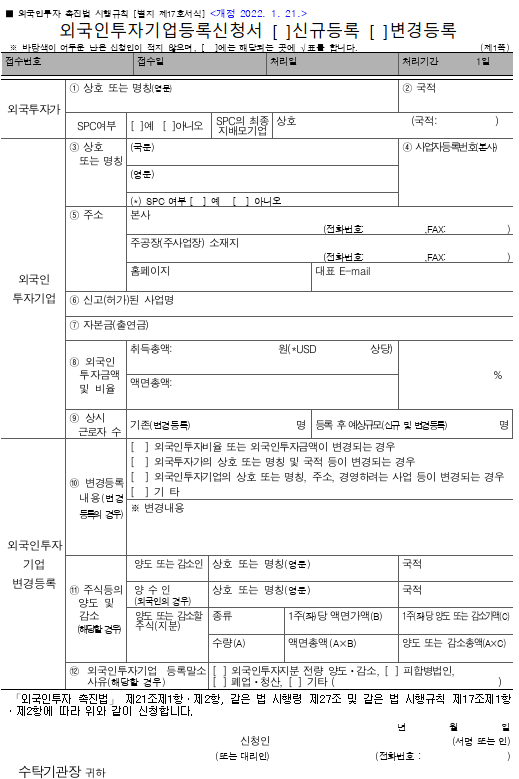
The procedure for establishing a local subsidiary can be summarized as follows.
1) Foreign Investment Notification
The foreign investor or its agent files the foreign investment notification with KOTRA, a domestic foreign exchange bank, or a trade office.
2) Remittance and Deposit of Funds
The foreign investor must remit the funds to the foreign currency account at the designated foreign exchange bank, or bring the funds in personally and obtain a foreign exchange declaration certificate through a customs declaration.
The funds must then be deposited into a share-payment custody account, and a deposit confirmation must be issued.
3) Company Incorporation Registration
A stock company may be formed either by incorporation through promotion or by incorporation through subscription, and there must be at least one promoter.
Documents to Be Prepared by the Foreign Investor
Documents issued by a foreign administrative agency require an apostille or consular confirmation.
- Written acceptance of office
- Passport or other issued identification document
- Power of attorney for the registration application
- Seal registration report
- Corporate certificate
Business Registration and Foreign-Invested Company Registration
Once the incorporation registration is complete through the establishment of a foreign-invested company, business registration is the next required step.
A corporate registration number is obtained from the competent tax office, and an application is then filed for a business registration certificate.
The documents to be submitted include the certified copy of the corporate register, the articles of incorporation, the shareholder register, and the lease agreement.
After that, within 60 days from the date the investment payment is completed, a registration application must be filed with the agency that received the foreign investment notification.
Following registration, a foreign-invested company registration certificate is issued, which may be used for the remittance of dividends or the issuance of a D-8 visa.
Procedure for Setting Up a Domestic Branch
Branches fall into the following types.
- Branch : Carries on business activities that generate domestic income
- Office : Handles non-business functions such as business liaison, market research, and research and development, without carrying on business activities
To set up a domestic branch in Korea, a foreign company must notify a foreign exchange bank and the Ministry of Economy and Finance, and the relevant agencies must conduct a review.
Once the branch establishment notification is complete, the registration of operations and the business registration are carried out.
To close a branch, a closure notification may be filed with the head of the designated foreign exchange bank for transactions.
After that, when the proceeds from the disposal of domestically held assets are remitted abroad, the following documents are required.
[Documents to Attach for Recovery of Liquidation Proceeds]
- Notification of closure of the foreign company's domestic branch
- Liquidation report audited by a certified public accountant
- Tax payment certificate
- Amount of operating funds introduced, retained earnings, and similar items
- Certificate of deposit balance
4. Establishing a Foreign-Invested Corporation | Checklist Before Incorporation

The law guarantees overseas remittance of the proceeds from a foreign investor's acquired shares, the proceeds from the sale of shares and similar assets, and the principal, interest, and fees under a loan agreement
Because notarization, an apostille, or consular confirmation may be required depending on the country, the translation and verification steps can become complicated.
The representative who establishes a foreign-invested corporation may apply for domestic residence status (D-8), which supports stable management of the company.
Because the documents to be submitted vary with the nationality of the founder and the method of document authentication, it can help to consult with the Korea Trade-Investment Promotion Agency (KOTRA) or a foreign exchange bank before establishment.
The registration and recording processes involved in establishing a foreign-invested corporation are complex, and the document requirements are extensive. Setting up such a corporation involves more than opening a place of business in Korea. It also touches on closely interconnected matters, such as foreign exchange remittance, visa issuance, tax filing, and recovery of the invested funds.
To help the procedures proceed lawfully, with an understanding of the Foreign Investment Promotion Act and the Commercial Act, careful fulfillment of the investment and procedural requirements, and support from legal professionals, specialists including attorneys, certified public accountants affiliated with the firm, tax accountants, and judicial scriveners can assist throughout the process.