
CONTENTS
- 1. Certification of Origin | Significance of Origin and Tariff Classification

- 2. Certification of Origin | Concept of Origin and Criteria for Determination
- - Supplementary Criteria for Certification of Origin
- 3. Certification of Origin | Procedures for Applying for a Certificate of Origin
- - Procedures for Issuing a Certificate of Origin
- - Institutional Issuance Procedures
- 4. Certification of Origin | Procedures for Determining Tariff Classification
- - Application for Advance Ruling on Tariff Classification
- 5. Certification of Origin | Origin Marking and Response to Marking Violations
- - Sanctions for Violation of Certification of Origin
- 6. Certification of Origin | Appeals and Dispute Response Measures
- - Assistance from Experts Including Attorneys and Customs Specialists

1. Certification of Origin | Significance of Origin and Tariff Classification
Certificates of origin and item classification are the main subjects of review during a customs investigation.
Origin is a concept referring to the country in which an imported or exported item was produced and manufactured, and in the global trade environment it carries an importance beyond that of the "country of manufacture."
This is because it affects various purposes, such as trade regulation, tariff benefits, anti-dumping responses, and securing consumer trust.
In particular, with the expansion of free trade agreements (FTAs), the certificate of origin (C/O, Certificate of Origin) has become an important factor directly connected to the tariff strategy of importing and exporting companies.
The item classification (HS Code) of imported and exported items is also an important standard in the certification of origin, determination, and application of preferential tariffs.


2. Certification of Origin | Concept of Origin and Criteria for Determination
The country of origin refers to the country or region where imported or exported goods are substantially manufactured, processed, or produced.
A defining feature is that it is based on the place where the physical transformation occurs, not the country where the trademark or company headquarters is located.
1. Wholly obtained criterion
- Goods entirely extracted or produced within a single country
- Examples: agricultural products, mineral products, naturally caught fish, and the like
2. Substantial transformation criterion
- The origin is determined based on whether processing above a certain threshold has occurred in a production process involving two or more countries
- The general rule of origin in the United States is the substantial transformation criterion, which means that the finished product and the non-originating materials are compared and the product is transformed into a new article with a new name, use, or characteristics
Criterion | Description |
Change in tariff classification (CTC) | Verifying whether the item number has changed by a certain level or more, based on the HS 6-digit code -2 digits (chapter), 4 digits (heading), 6 digits (subheading) |
Value-added criterion (VA) | The value added within the country of origin in the final product must be at or above a certain percentage |
Specific process criterion (SP) | Determined based on whether a specific manufacturing process specified in the agreement (cutting, sewing, printing, dyeing, and the like) has been undergone |
 Supplementary Criteria for Certification of Origin
As criteria for determining origin, supplementary criteria such as the de minimis standard (minimum allowance standard), the accumulation standard, and intermediate materials are provided.
Simple processing, such as simple packaging, washing, and reclassification, is not recognized as conferring origin.
3. Certification of Origin | Procedures for Applying for a Certificate of Origin
A certificate of origin, a document that officially proves the country of origin of an exported product, is required for the rules of origin under each agreement to be met.
Certificates of origin are used for purposes such as the application of FTA preferential tariffs, requirements of overseas buyers, and responding to trade disputes.
Type of Certificate of Origin | Description |
Preferential certificate of origin | A certificate to receive preferences such as tariff concessions under agreements such as the FTA and GSP Issuing authority : customs, chamber of commerce and industry |
Non-preferential certificate of origin | A certificate for origin marking of general export goods or for requesting an investigation into unfair trade practices (dumping) Issuing authority : chamber of commerce and industry |
Procedures for Issuing a Certificate of Origin
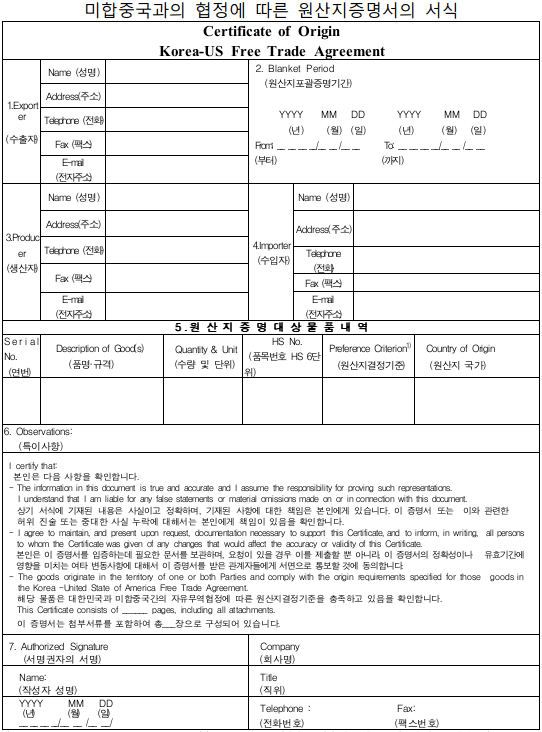
This is a method whereby, under an FTA, the exporter determines the origin on its own and prepares the certificate.
Summary of the self-issuance stages
Stage 1 - Keep a signature card on file |
Stage 2 - Designate the authorized signatory : record the signature, department name, position, name, date of designation, and reason for designation |
Stage 3 - Issue and sign the certificate : include the name of the agreement, the origin and determination criteria, and the exporter's information |
Stage 4 - Record and manage the certificate register : export declaration number, date of acceptance, origin, counterparty, and the like |
[Agreement countries where self-issuance is possible]
- Chile and Peru
- EFTA (Switzerland, Norway, Iceland, Liechtenstein, and others) FTA
- EU FTA
- RCEP (Regional Comprehensive Economic Partnership)
- The United States, Central America, Türkiye, Colombia, Central America, the United Kingdom, and others
Institutional Issuance Procedures
This is a procedure for obtaining a certificate of origin through the Korea Customs Service or a chamber of commerce, according to the requirements of a given agreement or the exporting country.
The certificate of origin must be issued before the loading of the export goods is completed, and even after loading is completed, it may be issued within 1 year where there is negligence or error.
List of required documents (based on a general certificate of origin)
Examples of agreements with institutional issuance
China, Vietnam, Singapore, ASEAN, India, RCEP, Israel, Cambodia, Indonesia, the Philippines, and others
4. Certification of Origin | Procedures for Determining Tariff Classification

Tariff classification is the classification of items according to classification rules based on function, form, use, and material.
It is the procedure for classifying import and export goods under the Harmonized Commodity Description and Coding System (HS), and although the number of digits used differs by country, the first 6 digits are assigned the same number worldwide.
Depending on the tariff classification, the determination of the tariff rate applicable to the item, the customs clearance requirements, the linkage with the criteria for determining origin, and whether a certificate of origin can be prepared accurately all vary.
Application for Advance Ruling on Tariff Classification
The Customs Valuation and Classification Institute has established an advance ruling system for importers and exporters who find it difficult to classify items on their own before filing an import or export declaration.
Where goods declared for import or export are identical to those for which an advance ruling has been issued, the item classification according to the content of the notice is applied.
Blocking customs clearance risks in advance through an advance ruling is advisable.
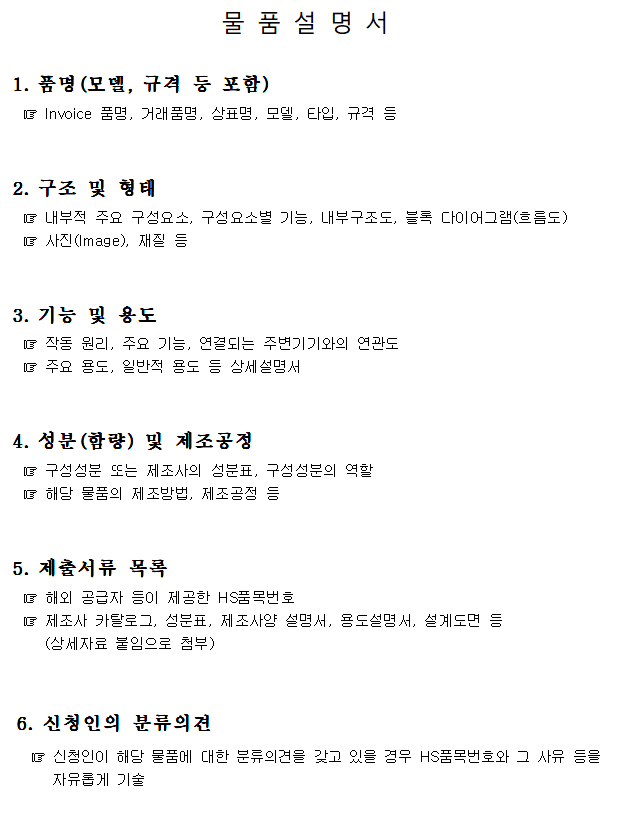
Required entries and supporting documents for advance ruling by item
See More
5. Certification of Origin | Origin Marking and Response to Marking Violations
For imported goods, the items subject to country-of-origin labeling and the labeling methods are as follows.
Category | Details |
Items subject to labeling | 674 items out of a total of 1,224 based on the HS 4-digit item classification (55% of all imported items) |
Labeling method | “Country of origin: country name,” “Made in country name,” and the like |
Labeling location | A location easily recognizable by the purchaser, by methods such as printing, branding, or etching |
Sanctions for Violation of Certification of Origin
Falsely indicating the country of origin or indicating it in a way that misleads the final consumer is a type of violation of country-of-origin labeling.
Damaging or altering the labeling after a certificate of origin has been issued, not providing the country-of-origin labeling at all, or selling goods that are not properly labeled with the country of origin within the country also constitute violations.
The authority to inspect at the distribution stage rests not only with the Korea Customs Service but also with local administrative agencies such as Mayors/Do Governors and the National Agricultural Products Quality Management Service.
If a person commits the prohibited acts described above through gross negligence, they are also subject to a fine of up to KRW 20 million.
6. Certification of Origin | Appeals and Dispute Response Measures
Where there is an objection regarding country-of-origin certification, verification, or labeling matters, an importing or exporting business should respond using the following procedures.
- Receive a written notice of investigation results from the customs office or the Korea Customs Service
- Within 30 days, organize and file the goods information (product name, specifications, use, and the like) and the gist of the objection
If an administrative disposition such as taxation is made due to non-recognition of the country of origin, you may pursue the following appeal procedures.
Category | Filing period | Adjudicating authority |
Pre-assessment review | Within 30 days from the date of receiving the pre-assessment notice | The head of the customs office or the Commissioner of the Korea Customs Service (5 hundred million won or more) |
Request for review | Within 90 days from the date of receiving notice of the disposition | The Commissioner of the Korea Customs Service |
Filing for administrative adjudication | Within 90 days from the date of receiving notice of the disposition | The President of the Tax Tribunal |
Request for review by the Board of Audit and Inspection | Within 90 days from the date of receiving notice of the disposition | The Chairman of the Board of Audit and Inspection |
Assistance from Experts Including Attorneys and Customs Specialists
For export and import companies, an accurate understanding and application of the systems for certificate of origin and tariff classification is critical as the complexity of trade transactions and the surge in FTA utilization increase.
As the responsibility for certification is shifting to the exporter, with the expansion of self-issuance of certificates of origin and the like, establishing internal and external management systems (an internal origin management system, dedicated HS code personnel, etc.) can help prevent long-term legal risks and reduce costs.
At the firm, customs attorneys and customs experts promptly provide overall advice on customs clearance for export and import, including certification and marking of origin and tariff classification.
▶Review of certificate of origin requirements
▶Review of the appropriateness of the procedure for applying conventional tariffs
▶Responding to customs self-inspection of origin
▶Attending on-site origin verification in the counterpart importing country
See More