
CONTENTS
- 1. Corporate Tax Act | Tax Liability and Items Subject to Taxation

- - Taxpayer
- - Items Subject to Taxation
- 2. Corporate Tax Act | Tax Rate Structure
- - Tax Rates on Income for Each Business Year
- - Separate Tax Rates on Gains from the Transfer of Land, etc.
- - Taxation of Non-Returned Income
- 3. Corporate Tax Act | Filing Deadlines and Documents
- - Filing and Payment Deadlines
- - Documents to Be Submitted
- 4. Corporate Tax Act | Corporate Tax Filing Procedure
- - Concept of Tax Adjustment
- - Adjustment Items
- - Classification of Tax Adjustments
- - External Adjustment Filing System
- - Electronic Filing of Corporate Tax
- 5. Corporate Tax Act | Major Deduction and Reduction or Exemption Systems
- - Deductions and Reductions Available to Small and Medium Enterprises
- - Deductions and Reductions Available to All Companies
- 6. Corporate Tax Act | Checklist
- - Support System of Tax Specialist Attorneys

1. Corporate Tax Act | Tax Liability and Items Subject to Taxation

Under the Corporate Tax Act, a corporation that conducts business in Korea bears a corporate tax liability on certain income, whether the income is domestic or foreign.
 Taxpayer
Under the Corporate Tax Act, corporations that fall under the following bear a corporate tax liability.
Type of corporation | Scope of corporate tax liability |
Domestic corporation | All income from domestic and foreign sources |
Foreign corporation | Domestic-source income only |
Here, a domestic corporation is a corporation whose head office, principal office, or place of effective management is located in Korea.
A foreign corporation, by contrast, is a corporation whose head office or principal office is located abroad and that falls under any one of the following (Article 2(2) of the Enforcement Decree of the Corporate Tax Act).
2. An entity composed solely of limited-liability members
3. Deleted
4. In addition, a foreign entity where a domestic entity of the same kind as, or most similar to, the foreign entity is a corporation under domestic law such as the 「Commercial Act」
→ Applicable from business years beginning on or after January 1, 2013
* A list by type of foreign corporation under the above classification criteria may be published by the Commissioner of the National Tax Service (Article 2(3) of the Enforcement Decree of the Corporate Tax Act), and no such notice has been issued to date.
Items Subject to Taxation
: Income arising from ordinary business activities, the disposal of assets, and the like
∙ Liquidation income
: Income from residual assets arising when a corporation is dissolved or liquidated
∙ Gains from the transfer of land, etc.
: Separate taxation where housing, appurtenant land, non-business land, and the like are disposed of
∙ Non-returned income
: Income not returned by a corporation with a certain asset scale or more (equity capital exceeding 50 billion won)


2. Corporate Tax Act | Tax Rate Structure

Under the Corporate Tax Act, corporate tax is subject to differential rates by tax base bracket.
In particular, the applicable rate varies depending on the nature of the corporation (for-profit, non-profit, cooperative corporation, etc.) and the type of income (income for each business year, liquidation income, etc.).
Tax Rates on Income for Each Business Year
For-profit corporations
All ordinary for-profit domestic and foreign corporations follow the tax rate structure below.
Tax base bracket | Rate | Progressive deduction |
2 hundred million won or less | 9% | - |
Over 2 hundred million ~ 20 billion won or less | 19% | 20 million won |
Over 20 billion ~ 300 billion won or less | 21% | 420 million won |
Over 300 billion won | 24% | 9.42 billion won |
In addition, for a for-profit corporation, liquidation income is also subject to taxation.
Non-profit corporations
For a non-profit corporation as well, the same tax rates apply to income arising from profit-making activities.
Unlike a for-profit corporation, however, the liquidation income of a non-profit corporation is not subject to taxation.
Tax base bracket | Rate | Progressive deduction |
2 hundred million won or less | 9% | - |
Over 2 hundred million ~ 20 billion won or less | 19% | 20 million won |
Over 20 billion ~ 300 billion won or less | 21% | 420 million won |
Over 300 billion won | 24% | 9.42 billion won |
Cooperative corporations
Under Article 72 of the 「Restriction of Special Taxation Act」, cooperative corporations are subject to special rates.
The liquidation income of a cooperative corporation is likewise not subject to taxation.
Tax base bracket | Rate | Progressive deduction |
2 billion won or less | 9% | None |
Over 2 billion won | 12% | 60 million won |
Separate Tax Rates on Gains from the Transfer of Land, etc.
Unlike ordinary income, gains arising from the transfer of land, housing, occupancy rights, and the like are taxed separately, and a heavier tax rate applies depending on whether the property is registered.
Category | Registered | Unregistered |
Where housing (including appurtenant land) prescribed by Presidential Decree is transferred | 20% | 40% |
Association member occupancy rights and preemptive sale rights | 20% | |
Where non-business land is transferred | 10% | 40% |
Taxation of Non-Returned Income
When a company with equity capital exceeding 50 billion won keeps a certain amount of profit or more internally instead of returning it, a separate tax applies to that income.
Category | Rate |
〔Corporate income × base rate (70%) - (investment + wage increase + mutual cooperation expenditure)〕 | 20% |
〔Corporate income × base rate (15%) - (wage increase + mutual cooperation expenditure)〕 | 20% |
See More
3. Corporate Tax Act | Filing Deadlines and Documents

Under the Corporate Tax Act, corporate tax must be filed and paid by determining the tax base and the tax amount within 3 months after the end of the business year.
The filing deadline varies depending on the accounting settlement date (settlement period), and where the filing deadline falls on a public holiday or a Saturday, the next business day becomes the filing deadline.
Filing and Payment Deadlines
Category | Statutory filing deadline |
Corporation with a December settlement | March 31 |
Corporation with a March settlement | June 30 |
Corporation with a June settlement | September 30 |
Corporation with a September settlement | December 31 |
Where a corporation fails to file within the prescribed deadline or files falsely, disadvantages such as a non-filing penalty, an underreporting penalty, or a penalty for failure to pay in good faith may arise, so meeting the deadline is very important.
Documents to Be Submitted
When filing corporate tax, a company must submit several documents together, including not only the tax base return but also the financial statements, the details of the tax adjustments, and similar materials.
2. Statement of financial position
3. Statement of comprehensive income
4. Statement of appropriation of retained earnings (statement of disposition of deficit)
5. Statement of tax adjustment
6. Supporting documents to the statement of tax adjustment and the statement of cash flows
Related News
4. Corporate Tax Act | Corporate Tax Filing Procedure
Under the Corporate Tax Act, a company must accurately reconcile the differences between corporate accounting and the tax law and submit the relevant materials without omission.
The key element in this work is the tax adjustment.
Concept of Tax Adjustment
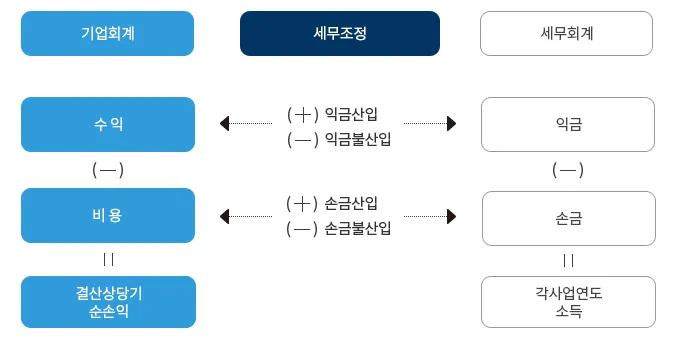
A tax adjustment is the procedure of adjusting the gross income and deductible expenses, based on the net profit or loss for the period shown in the financial statements that a company prepares under generally accepted accounting standards (such as the Korean Generally Accepted Accounting Principles or the Korean International Financial Reporting Standards), in order to calculate the taxable income recognized under the tax law.
This work closes the gap between accounting and the tax law, which arises because corporate accounting focuses on ‘accounting reasonableness’ such as profitability and financial soundness, while tax accounting is grounded in ‘tax equity’ and ‘the accuracy of taxation.’
Adjustment Items
The main items adjusted in a tax adjustment are as follows.
Adjustment item | Description |
Inclusion in gross income | Items that are not revenue for accounting purposes but are treated as income under the tax law |
Exclusion from gross income | Items that are revenue for accounting purposes but are not treated as taxable income under the tax law |
Inclusion in deductible expenses | Items that are not expenses for accounting purposes but are recognized as expenses under the tax law |
Exclusion from deductible expenses | Items that are expenses for accounting purposes but are not recognized under the tax law |
Classification of Tax Adjustments
Tax adjustments fall into the following two categories.
Settlement adjustment items
These are adjustment items recognized under the tax law only when they are reflected in profit or loss at the time of accounting settlement. The following are representative examples.
- Reserve for proper purpose business
- Allowance for severance benefits
- Allowance for bad debts and bad debt expenses
- Valuation losses on tangible assets/inventory, etc.
Filing adjustment items
These are items recognized under the tax law as long as they are reflected only in the statement of tax adjustment, and they need not be recorded in profit or loss in the settlement statement.
∙ Inclusion in deductible expenses of retirement insurance premiums
∙ Inclusion in deductible expenses of assets related to government subsidies
∙ Exclusion from deductible expenses of depreciation recorded in excess, etc.
External Adjustment Filing System
A corporation that meets certain requirements must have its tax adjustment performed by an outside expert such as a tax accountant (Article 97-2(1) of the Enforcement Decree of the Corporate Tax Act).
This system aims to secure the reliability of tax filings and to improve the accuracy of taxable income calculation.
- A corporation with revenue of 300 million won or more that is subject to various reserves, allowances, or tax reductions or exemptions
- A corporation established within the last 2 years with revenue of 300 million won or more
- A corporation that holds an overseas place of business or a foreign subsidiary, etc.
Electronic Filing of Corporate Tax
Corporate tax may be filed electronically over the Internet through the National Tax Service's Hometax.
In particular, corporations subject to an external audit and corporations whose assets or scale meet or exceed a certain standard must submit electronically or by mail.
When filing electronically, keep the following in mind.
▷ Some supporting documents are exempt from submission, but the obligation to retain them remains
▷ When filing electronically, the electronic filing tax credit under the Restriction of Special Taxation Act may apply
(it cannot be claimed together with a tax agent)
5. Corporate Tax Act | Major Deduction and Reduction or Exemption Systems

The Corporate Tax Act and the Restriction of Special Taxation Act provide various deduction and reduction or exemption programs centered on small and medium-sized enterprises, and some of these programs may also apply to general enterprises.
Deductions and Reductions Available to Small and Medium Enterprises
The deduction and reduction programs available to small and medium enterprises and mid-sized enterprises are as follows.
Program Name | Support Details and Statutory Basis |
Tax Reduction for Start-up SMEs | 50 to 100% tax reduction for four years from the first taxable year in which income arises |
| (Restriction of Special Taxation Act, Article 6) | |
Special Tax Reduction for SMEs | 5 to 30% tax reduction depending on the business type and region |
| (Restriction of Special Taxation Act, Article 7) | |
Tax Reduction for Technology Transfer and Lending | Special taxation for technology transfer, lending, and similar activities |
| (Restriction of Special Taxation Act, Article 12) | |
Win-Win Payment Tax Credit | 0.15 to 0.5% credit when payment is made through the win-win payment method |
| (Restriction of Special Taxation Act, Article 7-4) | |
Tax Credit for Companies Increasing Earned Income | 10% credit on the wage increase (20% for SMEs) |
| (Restriction of Special Taxation Act, Article 29-4) | |
Tax Credit for Performance-Based Pay | 15% credit on performance-based pay for full-time workers (10% from 2025) |
| (Restriction of Special Taxation Act, Article 19) | |
Tax Credit for Companies Maintaining Employment | Up to 15% credit on the amount of wage support |
| (Restriction of Special Taxation Act, Article 30-3) | |
Social Insurance Premium Tax Credit | 50 to 100% credit on the premiums for additional hires from increased employment |
| (Restriction of Special Taxation Act, Article 30-4) | |
Preferential Minimum Tax | A 3 to 10% preferential rate applies compared with general corporations |
Deductions and Reductions Available to All Companies
Program Name | Support Details and Statutory Basis |
Win-Win Cooperation Tax Credit | 10% credit on contributions, 3% credit on free leasing |
(Restriction of Special Taxation Act, Article 8-3) | |
Tax Credit for Research and Human Resource Development Expenses | Up to 25% general credit, up to 40 to 50% credit for strategic technologies |
(Restriction of Special Taxation Act, Article 10) | |
Exclusion of R&D-Related Contributions from Gross Income | Deferral of taxation on R&D contributions |
(Restriction of Special Taxation Act, Article 10-2) | |
Reduction for Tenants in R&D Special Zones | 100% reduction for 3 years, then 50% for the next 2 years |
(Restriction of Special Taxation Act, Article 12-2) | |
M&A Technology Value Tax Credit | 10% credit on the acquisition value of the technology |
(Restriction of Special Taxation Act, Articles 12-3 and 12-4) | |
Facility Investment Tax Credit | 1 to 10% base credit plus 3% credit on the excess investment amount |
(Restriction of Special Taxation Act, Article 24) | |
Tax Reduction for Relocation to Local Areas | 100% reduction for the first period, then 50% reduction for the following years |
(Restriction of Special Taxation Act, Article 63) | |
Reduction for Farming Association Corporations | 100% reduction on agricultural income, with a reduction limit of KRW 12 million per person for other income |
(Restriction of Special Taxation Act, Articles 63 through 68) | |
Reduction for Tenants in Agro-Industrial Complexes | 50% reduction for four years from the first taxable year in which income arises |
(Restriction of Special Taxation Act, Article 64) | |
Reduction for Social Enterprises | 100% reduction for 3 years, then 50% for the next 2 years (excluded from the minimum tax) |
(Restriction of Special Taxation Act, Article 85-6) | |
Reduction for the Jeju Region | 100% reduction for 3 years and 50% for 2 years for companies in the Jeju High-Tech Science and Technology Complex and similar locations |
(Restriction of Special Taxation Act, Articles 121-8 and 121-9) | |
Reduction for Start-ups in Enterprise Cities | 100% (50%) reduction for 3 years, then 50% (25%) reduction for the next 2 years |
(Restriction of Special Taxation Act, Article 121-17) | |
Electronic Filing Tax Credit | KRW 20,000 tax credit for electronic filing |
(Restriction of Special Taxation Act, Article 104-8) | |
Third-Party Logistics Cost Tax Credit | 3% credit on the increase in outsourced logistics costs (5% for SMEs) |
(Restriction of Special Taxation Act, Article 104-14) | |
Disaster Loss Tax Credit | When 20% or more of assets are lost, a credit is granted in proportion to the loss ratio |
(Corporate Tax Act, Article 58) | |
Foreign Tax Credit | A credit intended to prevent double taxation of foreign corporate tax |
(Corporate Tax Act, Article 57) | |
Tax Credit for Reducing Commercial Building Rent | 70% (50%) credit on the amount of the reduction (until December 31, 2025) |
(Restriction of Special Taxation Act, Article 96-3) | |
Reduction for Start-ups in Crisis Regions | 100% reduction for 5 years after start-up, then 50% for the next 2 years |
| (Restriction of Special Taxation Act, Article 99-9) |
6. Corporate Tax Act | Checklist
The following summarizes the key items that practitioners should review when filing corporate tax under the Corporate Tax Act and related laws.
To avoid disadvantages caused by omissions or errors, please use the checklist below for an advance review.
Review Item | Key Points to Confirm |
Fiscal Year-End and Filing Deadline | Confirm the corporate tax filing deadline (within 3 months) |
Competent Tax Office and Electronic Filing Status | Confirm the tax office and whether filing through Hometax is available |
Corporate Tax Return and Financial Statements | Submit the return, the statement of financial position, and the income statement |
Tax Adjustment Statement and Supporting Documents | Confirm whether they have been prepared and submitted in full |
Reflection of Settlement and Filing Adjustments | Whether depreciation, reserves, and similar items have been properly adjusted |
Inclusion and Exclusion of Gross Income and Deductible Expenses | Confirm accurate classification and reflection |
Special Tax Reduction for SMEs and R&D Expense Credit | Check eligibility and the credit limit |
Reduction for Start-up SMEs and Electronic Filing Credit | Confirm the reduction period and whether the credit applies |
Foreign Tax Credit | Whether the credit to prevent double taxation applies |
Revenue Amount and Subject to External Audit | Check whether the thresholds are exceeded and review the documents to be submitted |
New Establishment or Merger Status | Confirm whether it is subject to external adjustment |
Use of Carried-Forward Losses | Whether they are properly applied within the deduction limit |
Application of the Minimum Tax | Check whether the minimum tax is calculated after the reduction |
Possibility of Extending the Filing Deadline | Confirm whether to apply for an extension if necessary |
Support System of Tax Specialist Attorneys
This law firm includes a number of specialist attorneys with an average of more than 10 years of experience, including tax specialist attorneys registered with the Korean Bar Association.
As a result, practical and professional support is available across the entire process, from the calculation of corporate tax to the payment procedures, tax credits and reductions, and the use of tax support programs.
We can also handle accurate tax filing and develop tax-saving strategies by collaborating with experts such as tax accountants and certified public accountants.
If you need assistance with any matter related to corporate tax, please request support from a tax specialist attorney.
See More


Watch related video content
for this case study.

Meet Daeryun Law Firm’s corporate legal and tax administration experts!