
CONTENTS
- 1. Insurance | Definition

- - Insurance Companies
- - Individuals
- 2. Insurance | Points to Note When Concluding a Contract
- - Duty of Disclosure
- - Termination of the Contract in Case of Violation
- - Notice of the Violation and Payment of the Insurance Proceeds
- 3. Insurance | How to Respond When Payment Is Refused
- - Dispute Mediation Through the Financial Supervisory Service
- - Dispute Mediation Through the Korea Consumer Agency and Other Bodies
- - Dispute Mediation for Postal Savings and Insurance
- - Relief of Rights Through Litigation
- 4. Insurance | The Importance of a Proper Response

1. Insurance | Definition

Insurance is an important economic system that relieves the financial burden that can arise from unexpected accidents or situations.
The basic structure of insurance is that one party pays the agreed premium, and later, when an accident occurs to life, body, or property, the other party pays the agreed insurance proceeds and the like.
The types of insurance are very diverse, including life insurance, non-life insurance, and third-sector insurance, and the related laws and regulations are complex and vast, so understanding them accurately is difficult.
 Insurance Companies
Companies and institutions engaged in the insurance business may need legal review of insurance policy terms, insurance products, insurance contracts, and similar documents.
Insurance companies in particular may face a range of legal issues, such as unfair insurance policy terms, in the course of developing insurance products and offering them to consumers.
To prevent such issues, it is advisable to draft policy terms that meet legal requirements and to establish a strategy for the marketing and sales process.
In this way, an insurance company can operate its business while minimizing legal disputes and complying with regulations.
Individuals
Insurance plays an important role in protecting an individual's life, body, and property.
When an individual enters into an insurance contract, it is important to understand the insurance policy terms accurately and to select an insurance product that fits one's own circumstances.
In doing so, one should carefully review the scope of coverage and the conditions of each insurance product, and should assess one's own needs and risks well in order to make an appropriate choice.
Because the benefits and coverage may differ depending on the insurance product, it is important to choose the product that best fits one's own situation.


2. Insurance | Points to Note When Concluding a Contract

Insurance is an important mechanism for preparing for unexpected accidents or illnesses, but coverage cannot be obtained simply by enrolling.
Insurance is a contractual relationship, and the procedures and obligations that must be observed when concluding a contract are clearly defined.
Before entering into an insurance contract, the enrollee has a legal responsibility to truthfully inform the insurer of their health condition, past medical history, the state of their property, and the like.
This is called the ‘duty of disclosure (duty to inform),’ and it has a significant effect on the formation and validity of the insurance contract.
Duty of Disclosure
When entering into an insurance contract, the policyholder (or the insured) must disclose important matters to the insurance company.
This is called the duty of disclosure.
Here, an important matter is a matter that serves as the basis on which the insurance company, in assessing the likelihood that an insured event will occur and the likelihood that it will bear liability as a result, decides whether to enter into the insurance contract or sets the premium, exclusion clauses, and similar terms.
Termination of the Contract in Case of Violation
When entering into an insurance contract, if the policyholder or the insured conceals or misrepresents an important fact intentionally or through gross negligence, the insurance company may terminate the contract within one month from the date it became aware of the fact and within three years from the date the contract was entered into.
If the insurance company already knew of the fact at the time of the contract, however, or could have known it but failed to do so through gross negligence, the insurance company may not terminate the contract.
Notice of the Violation and Payment of the Insurance Proceeds
For an insurance company to terminate a contract or limit coverage, it must give notice of the following in writing or by electronic document.
• The reason it qualifies as an important matter
• The result of the contract handling
• Inclusion of the statement, “You may raise an objection if you have evidence to the contrary.”
Once the contract is terminated, the insurance company pays the surrender value to the policyholder.
3. Insurance | How to Respond When Payment Is Refused
When an insurer refuses to pay insurance proceeds, it is easy to feel helpless and aggrieved.
However, insurance proceeds disputes are a surprisingly frequent problem, and if you are familiar with certain procedures and response strategies, even an individual can respond effectively.
Dispute Mediation Through the Financial Supervisory Service
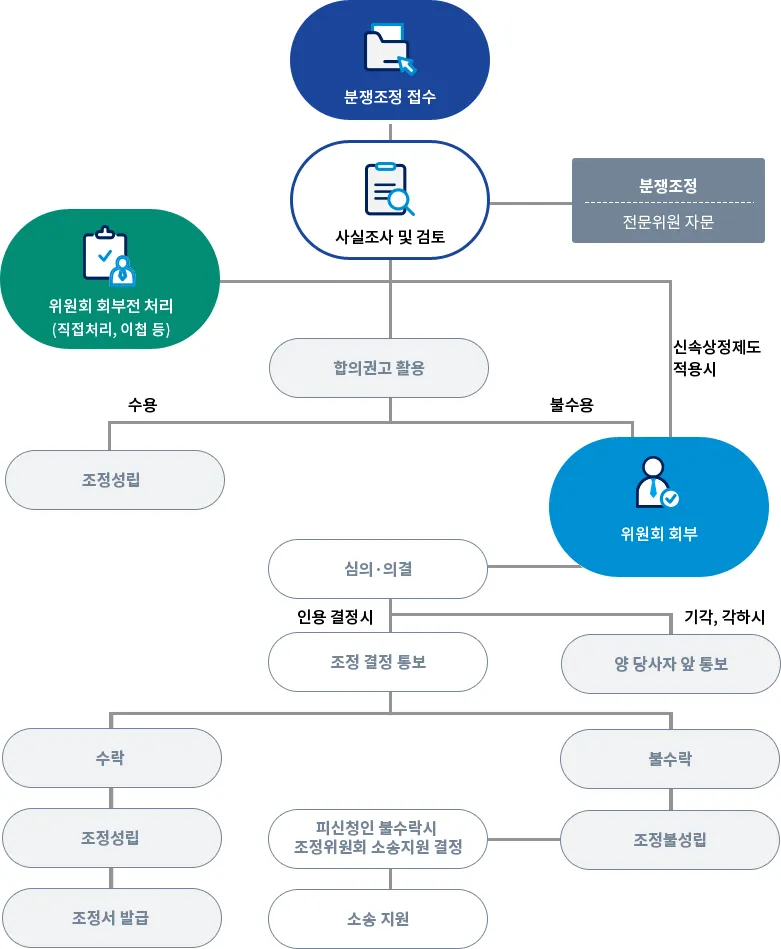
If an insurance claim has been denied, the matter can often be resolved fairly simply through the dispute mediation system of the Financial Supervisory Service.
Under this system, the Financial Supervisory Service attempts mediation from a neutral position when a dispute arises between a financial consumer, such as a policyholder, and an insurance company.
▶ How to Apply and the Procedure
1. Filing a Complaint
When filing, the applicant must submit an application form that includes the applicant's personal information, the name of the insurance company, and a specific statement of the request set out according to the Five Ws and One H.
2. Investigation and Recommendation of Settlement
3. Referral to the Mediation Committee
As a rule, the matter is referred within 30 days from the date of application, and the mediation committee prepares a mediation proposal within 60 days from the date of referral.
4. Acceptance of the Mediation Proposal and Its Effect
If it is not accepted, however, it has no effect, and the matter may be converted into civil litigation proceedings.
▶ Points to Note
For a small-amount dispute (20 million won or less), the dispute mediation procedure takes priority, and if certain requirements are met, filing a lawsuit is restricted until a mediation proposal is received.
Dispute Mediation Through the Korea Consumer Agency and Other Bodies
If a dispute arises, such as over the payment of insurance proceeds, it can be resolved promptly and fairly through the Consumer Dispute Mediation Committee of the Korea Consumer Agency.
In this procedure, a committee set up to mediate disputes between consumers and businesses conducts the mediation neutrally.
▶ Application Procedure
1. Filing a Complaint
2. Recommendation of Settlement
3. Application for Dispute Mediation and Extension of the Processing Period
4. Mediation Period
In that case, the parties must be informed of the reason for and the period of the extension.
5. Acceptance of the Mediation Proposal and Its Effect
If no intent is indicated, the proposal is deemed accepted, and an accepted mediation proposal has the same legal effect as a settlement in court.
Dispute Mediation for Postal Savings and Insurance
If a dispute arises in connection with postal savings or insurance, the Postal Savings and Insurance Dispute Mediation Committee established under the Ministry of Science and ICT supports the resolution of the dispute neutrally.
This committee mediates disputes concerning postal savings and insurance operations as a whole, including deposit contracts, insurance solicitation and contracts, and the payment of insurance proceeds.
▶ Dispute Mediation Procedure
1. Application for Mediation and Referral
The chairperson may decline to refer it to a meeting, however, where a lawsuit has been filed, where there is no practical benefit to mediation in light of statutes, precedents, and the like, or where the matter is not suitable as a subject of the dispute.
2. Request to Supplement Materials
3. Mediation Deliberation and Decision
Meetings are held in private, and the parties and others may observe where necessary.
4. Notice of the Mediation Result
Relief of Rights Through Litigation
If a dispute is not resolved through mediation procedures, such as those of the Financial Supervisory Service or the Korea Consumer Agency, a party may seek relief through civil litigation in court.
▶ Overview of the Civil Litigation Procedure
1. Filing the Lawsuit
2. Decision Recommending Settlement
3. Civil Conciliation Procedure
Conciliation may be applied for by a party or referred by the court on its own authority, and if an agreement is reached, a conciliation protocol is prepared and the conciliation is established.
※ Measures When Conciliation Is Not Established
If an agreement is not reached, the terms of the conciliation are inappropriate, or the respondent does not appear on the conciliation date, the court issues a decision in lieu of conciliation on its own authority.
4. Insurance | The Importance of a Proper Response

There are many different types of insurance, and because the amount of insurance proceeds paid and the scope of coverage differ depending on the terms of the contract, the help of an attorney with a deep understanding of each insurance product is needed.
In particular, insurance policy terms consist of complex and detailed provisions, so there is considerable room for various disputes to arise over their interpretation.
Because an insurance company bears legal liability according to the policy terms and conditions in the contract it has entered into with the customer, a prompt and accurate legal response is required when a dispute arises.
When an insurance-related dispute arises, then, it is very important to promptly seek the help of an attorney with both specialized knowledge and practical experience in the insurance field.
Our firm has many attorneys who specialize in the finance, civil, and insurance fields, and it provides comprehensive legal advisory services that cover not only the resolution of disputes between insurance companies and insureds but also the overall operations of insurance companies.
If you need legal help related to insurance, we encourage you at any time to obtain professional assistance by 🔗booking a legal consultation with a finance attorney.
See More