
CONTENTS
- 1. The Yellow Envelope Act | Definition

- - Origin of the Name
- - Purpose of the Act
- 2. The Yellow Envelope Act | Key Provisions
- - Expansion of the Scope of the Employer
- - Expansion of the Scope of Labor Disputes
- - Limitation of Claims for Damages
- 3. The Yellow Envelope Act | Legislative Timeline
- - Passage at the National Assembly Plenary Session
- - Scheduled Implementation
- 4. The Yellow Envelope Act | How Workers Can Respond
- - Joining a Union and Strengthening Its Organization
- - Demanding Participation in Management Decisions
- - Preparing Reasonable Industrial Action
- 5. Yellow Envelope Act | How Companies Can Respond
- - Expansion of the Prime Contractor's Bargaining Duty and How to Respond
- - Constraints on Management Decisions and How to Respond
- - Limits on Damages Claims and How to Respond
- 6. Yellow Envelope Act | Checklist
- - If You Need Legal Advice

1. The Yellow Envelope Act | Definition

The Yellow Envelope Act is a legislative amendment whose core lies in guaranteeing workers' rights and limiting companies' claims for damages.
It amends Articles 2 and 3 of the existing Trade Union and Labor Relations Adjustment Act (Trade Union Act), with the aim of substantively guaranteeing workers' right to collective action and limiting companies' excessive claims.
 Origin of the Name
The name Yellow Envelope Act originated in the 2014 SsangYong Motor strike.
At the time, after the court ordered the striking workers to pay approximately 4.7 billion won in damages, about 47,000 citizens each placed 47,000 won in a yellow envelope and delivered it, expressing their solidarity.
This yellow envelope borrowed the symbolism of the pay envelopes of the past, and it carried the hope that “workers would once again recover the foundation of their lives.”
This social solidarity soon led to calls for amending the Trade Union Act, and the amendment naturally came to be called the ‘Yellow Envelope Act.’
Purpose of the Act
The principal purpose of the Yellow Envelope Act is to ease the liability for damages that had been excessively imposed on workers who took part in strikes, and to substantively guarantee the right to collective action among the three labor rights.
Under the existing system, the losses a company incurred due to a strike were often passed on to workers in full, which in effect discouraged the right to strike.
The amendment aims to correct this imbalance by limiting claims for damages in the case of legitimate industrial action and by ensuring that the rights and obligations of labor and management are adjusted in a more balanced manner.
2. The Yellow Envelope Act | Key Provisions
The key issues of the Yellow Envelope Act fall broadly into three categories: expansion of the scope of the employer, limitation of claims for damages, and expansion of the scope of labor disputes.
This amendment has given rise to social controversy in that it strengthens the guarantee of workers' rights while it may also impose new legal burdens on corporate management.
Expansion of the Scope of the Employer
The Yellow Envelope Act changed the definition of ‘employer’ in Article 2 of the Trade Union Act for the first time in 72 years.
Category | Definition of the Employer |
Existing | Only a party that directly concluded an employment contract is recognized as an employer |
Amended | Even a party that is not a party to the employment contract may be included as an employer if it can substantively and specifically control or determine working conditions |
In addition, the provision stating that “an organization that admits persons who are not workers is not regarded as a trade union” was deleted, so that non-standard workers, such as platform workers, can also be guaranteed a stable trade union status.
Through this amendment, if a prime contractor in effect controls the working conditions of subcontractor workers, it may become a counterpart in bargaining, which reduces structures for avoiding responsibility between prime contractors and subcontractors and makes substantive dialogue and bargaining possible.
As a result, a prime contractor company may find itself in a situation where it must bargain directly with multiple subcontractor unions, and legal confusion may arise due to the absence of provisions for unifying bargaining channels.
Expansion of the Scope of Labor Disputes
The Yellow Envelope Act amended the definition of a labor dispute.
Category | Scope of a Labor Dispute |
Existing | Determination of working conditions, such as wages, working hours, welfare, dismissal, and other treatment |
Amended | Determination of working conditions and management decisions that affect working conditions |
As a result, restructuring, layoffs, plant relocation, and business consolidation may also be included as subjects of industrial action.
This takes into account the substantive effect that management decisions have on workers' lives and broadens the avenues through which workers can respond through industrial action.
As a result, the risk of conflict and strikes with unions may increase during a company's strategic management decision-making, such as restructuring and mergers and acquisitions.
Limitation of Claims for Damages
The Yellow Envelope Act newly established several provisions in Article 3 of the Trade Union Act, reasonably limiting the liability for damages that had been imposed on workers who took part in strikes.
If damage is unavoidably caused in the course of responding to an employer's unlawful act (where it is recognized as a justifiable act), the liability of the union and the workers is limited.
∙ Provision prohibiting abuse
An employer is prohibited from claiming damages for the purpose of threatening a union's existence or obstructing its activities.
∙ Provision for mitigation of liability
The liability ratio of an individual worker is calculated in consideration of factors such as the worker's position and role in the union, the circumstances of participation, the degree of involvement in the occurrence of the damage, and wage level, and the court may permit a reduction or exemption of the amount of damages.
∙ Exemption of guarantors
Guarantors of a worker, such as family members and relatives, are not to be held liable for damages.
In addition, “other trade union activities” was added to the existing Article 3 prohibition on “claims for damages arising from collective bargaining or industrial action,” so that the indiscriminate filing of damages claims by companies can be controlled.
This is intended to substantively guarantee workers' right to collective action and to reduce the excessive economic burden arising from strikes, thereby balancing labor-management relations.
As a result, companies may find it more difficult to recover losses caused by strikes through claims for damages, which may increase management risk and the likelihood of prolonged strikes.


3. The Yellow Envelope Act | Legislative Timeline
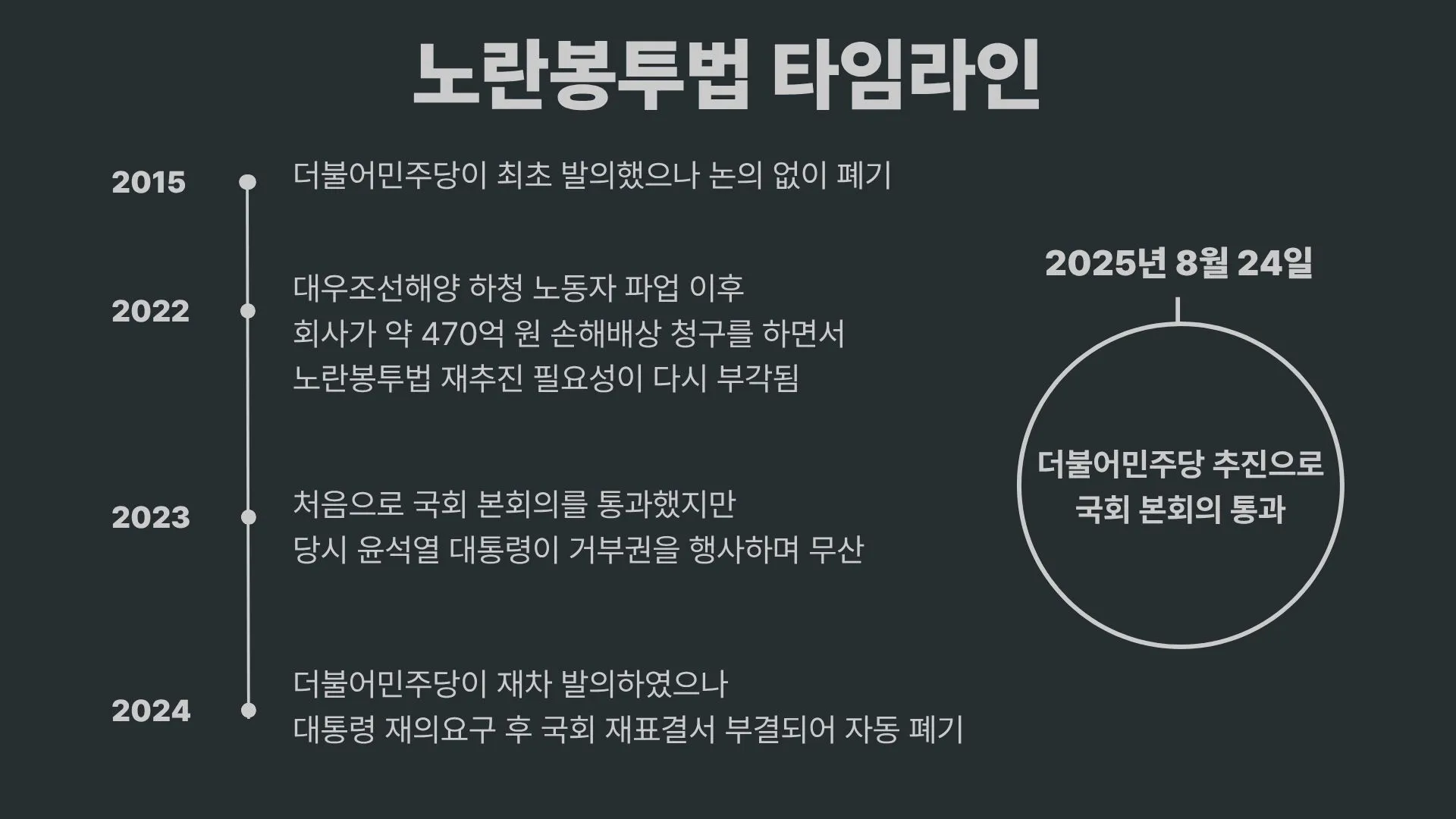
After it was first proposed, the Yellow Envelope Act went through repeated failures and renewed efforts, and it finally passed the plenary session of the National Assembly in 2025.
Passage at the National Assembly Plenary Session
On August 24, 2025, the Yellow Envelope Act was put to a vote at the plenary session of the National Assembly immediately after the People Power Party's filibuster ended, and it passed with 183 votes in favor and 3 against out of 186 members present.
Members of the People Power Party did not take part in the vote, expressing their opposition, but the bill effectively passed through the overwhelming support of the Democratic Party of Korea and members of non-negotiating blocs.
Scheduled Implementation
This Act takes effect six months after its promulgation, and during that period the government plans to form a task force (TF) involving labor, management, and experts to prepare for its implementation.
The task force is expected to prepare detailed guidelines on how the amended law will actually apply in the field and to present concrete standards that reflect Labor Relations Commission decisions and court precedents.
4. The Yellow Envelope Act | How Workers Can Respond
The implementation of the Yellow Envelope Act may become an occasion to expand workers' rights and ease the burden of damages.
However, for the purpose of the law to be substantively realized, workers themselves must also prepare to respond in the field.
Joining a Union and Strengthening Its Organization
Now that the Yellow Envelope Act has provided a legal basis for collective bargaining between prime contractors and subcontractors, it is important to secure bargaining power at the level of the trade union rather than the individual worker.
In addition, now that non-standard workers, such as platform workers and workers in special types of employment, can also be recognized as having a stable trade union status, they should effectively protect their rights and interests by expanding their organization and strengthening solidarity.
Demanding Participation in Management Decisions
Under the amended law, management decisions that affect working conditions, such as restructuring, layoffs, and business consolidation, are included as subjects of industrial action.
Accordingly, workers can actively demand the right to prior consultation and the right to participate in bargaining during the employer's major management decision-making, and through this they can establish a structure for resolution through ‘consultation and bargaining’ rather than ‘unilateral notification.’
Preparing Reasonable Industrial Action
Even though provisions limiting claims for damages have been introduced, exemption from liability for unlawful acts is not guaranteed.
Therefore, a trade union must secure the legitimacy and procedural soundness of its industrial action, and individual workers must also become familiar with the legal basis and regulations in order to avoid unnecessary legal risks.
5. Yellow Envelope Act | How Companies Can Respond

The Yellow Envelope Act may expand workers' rights, but it can also place new legal and operational burdens on companies.
Companies should therefore identify the anticipated risks accurately and pursue response strategies suited to them.
Expansion of the Prime Contractor's Bargaining Duty and How to Respond
Under the Yellow Envelope Act, a prime contractor may receive direct bargaining demands from the unions of many subcontractors, and because the procedure for unifying the bargaining channel is unclear, the burden of responding can increase.
In response, companies should prepare a bargaining and dispute-response manual in advanceand establish procedures for handling multiple unions and response guidelines for each bargaining topic.
This can minimize unnecessary conflict and secure bargaining efficiency.
Constraints on Management Decisions and How to Respond
As matters originally within management prerogative, such as restructuring, layoffs, relocation of a workplace, and mergers and acquisitions, may become subjects of bargaining and strikes, a company's prompt decision-making can be constrained and may lead to reduced investment.
When making management decisions, companies should therefore strengthen their labor risk management system to review in advance the disputes that may arise in labor-management relationsand incorporate a labor-law review process into the decision-making process.
Limits on Damages Claims and How to Respond
Claims for damages arising from losses caused by unlawful strikes remain possible, but as the burden of proof and the recognized scope of liability are limited, companies may find it difficult to obtain meaningful recovery.
To prepare for this, companies should establish a litigation risk management strategy and systematically accumulate materials that can satisfy the burden of proof.
It is also advisable to prepare in advance the costs and procedures for responding when a dispute arises.
6. Yellow Envelope Act | Checklist
The Yellow Envelope Act offers new opportunities to both labor and management while also presenting considerable challenges.
Before and after the law takes effect, workers and companies would do well to review and prepare for the following matters.
Worker Checklist
▷ Become familiar with the legal requirements for bargaining and industrial action procedures
▷ Prepare to participate in management decision-making processes such as restructuring and layoffs
▷ Review internal rules that can secure the legitimacy and lawfulness of a strike
▷ For non-regular and platform workers, develop a response strategy following recognition of union status
Company Checklist
▷ Review whether labor-management consultation procedures are reflected in management decision-making
▷ Accumulate evidence of losses if an unlawful strike occurs and build a litigation response system
▷ Develop measures to manage conflict between in-house and subcontractor unions and operate communication channels
▷ Build a system of regular legal and labor advisory services and conduct in-house training
If You Need Legal Advice
Legislation that brings major changes to labor-management relations as a whole, such as the Yellow Envelope Act, calls for a comprehensive review that goes beyond legal interpretation to cover business operations, labor strategy, and overall risk management before a stable response is possible.
At our firm, experts from various fields work together in a collaborative structure, including attorneys experienced in labor law and labor practice as well as labor consultants, accountants, and human-resources and labor consultants.
Through this, we can provide practical and effective solutions to a range of issues, including the development of bargaining strategies, the preparation of industrial-action response manuals, and the presentation of approaches to litigation and dispute response.
🔗an attorney experienced in labor lawcan help you develop a systematic response.


Watch related video content
for this case study.

How companies respond to the implementation of the Yellow Envelope Act