
CONTENTS
- 1. Act on the Protection of Children and Youth against Sexual Abuse | Case Details

- 2. Act on the Protection of Children and Youth against Sexual Abuse | Assistance Provided by the Attorney Specializing in Sexual Offense Cases
- - Verification of Inconsistencies and Credibility in the Victim's Statements
- - Rebuttal of the Implausibility of the Behavioral Pattern
- - Securing Evidence of Normal Interaction After the Incident
- - Emphasis on the Timing of the Report and the Variability of the Statements
- - Presentation of the Supreme Court Decision as a Basis
- 3. Act on the Protection of Children and Youth against Sexual Abuse | Case Outcome
- - Major Offenses and Levels of Punishment under the Act on the Protection of Children and Youth against Sexual Abuse
- 4. Act on the Protection of Children and Youth against Sexual Abuse | Response Points for a Wrongful Charge
- - The Need for Assistance from an Attorney Specializing in Sexual Offense Cases

1. Act on the Protection of Children and Youth against Sexual Abuse | Case Details
This is the account of a client who expressed that he had been wrongly detained on charges of violating the Act on the Protection of Children and Youth against Sexual Abuse.
The client in this case was a 20-year-old young man about to enter university, and he had a drinking gathering, together with other friends, at the home of the 15-year-old middle school student who is the victim in this case and whom he had known for some time.
Everyone ended the gathering in a highly intoxicated state, but the next day, the victim claimed, "The client had intercourse with me while I was asleep," and filed a criminal complaint for violation of the Act on the Protection of Children and Youth against Sexual Abuse.
Although the client maintained that no sexual intercourse had taken place at all, the victim's statement alone was adopted as the principal evidence during the investigation and trial, and the court of first instance imposed an actual sentence of two years' imprisonment.
The aggrieved client decided to appeal and, with the assistance of an attorney specializing in sexual offense cases, came to contest the case again.

2. Act on the Protection of Children and Youth against Sexual Abuse | Assistance Provided by the Attorney Specializing in Sexual Offense Cases
In this case involving a violation of the Act on the Protection of Children and Youth against Sexual Abuse, the attorney specializing in sexual offense cases filed an appeal on the following grounds.
 Verification of Inconsistencies and Credibility in the Victim's Statements
In the first police interview, the victim stated, "My friends and I were drinking, and then the client arrived," but in the second interview, she changed her statement to say, "When the client arrived, my friends had already gone home."
By contrast, the client consistently stated from the outset that 'other friends were also present,' and so we pointed out that the victim's statements were not consistent and challenged their credibility.
Rebuttal of the Implausibility of the Behavioral Pattern
If a quasi-rape had occurred as the victim claimed, it would be likely that the client left before the victim woke up.
However, in reality, CCTV footage was secured showing the two having lunch together and going home together the next day, which proved that this did not match the victim's claim at all.
Securing Evidence of Normal Interaction After the Incident
The attorney specializing in sexual offense cases presented the point that, after the alleged incident, the victim and the client exchanged messages on several occasions and continued ordinary interactions, such as going to the cinema together.
This was a circumstance inconsistent with the victim's claim that she had "suffered serious psychological shock."
Emphasis on the Timing of the Report and the Variability of the Statements
The victim reported the matter one year after the incident occurred, and while claiming that she had been highly intoxicated at the time, she stated that she "remembered the detailed scenes of the harm specifically."
In addition, her statements differed across both of the two police interviews and the prosecutorial interview.
This variability was presented as a factor that raised the possibility of memory distortion and of a false report.
Presentation of the Supreme Court Decision as a Basis
Relying on Supreme Court Decision 2023Do13081, which held that "where the defendant has consistently denied the offense itself, there is no direct evidence, and, considering as a whole the reasonableness, validity, and objective circumstances of the victim's statement, a reasonable doubt is not excluded, the defendant must be found not guilty," we constructed the argument that guilt could not be established on the victim's statement alone.


3. Act on the Protection of Children and Youth against Sexual Abuse | Case Outcome
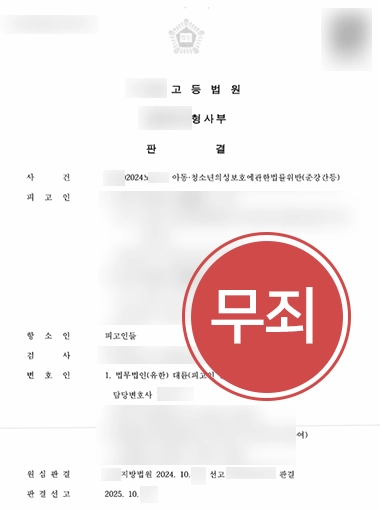
The appellate court, on the grounds that the victim's statements had been reversed several times and did not accord with the objective evidence (the footage, the call records, and the circumstances of interaction), reversed the judgment of the first instance and acquitted the client.
The client, who did not give up even after receiving an actual sentence from another law firm and came to Daeryun, was acquitted in full on appeal with the assistance of Daeryun's attorney specializing in sexual offense cases and was able to clear the wrongful charge.
Major Offenses and Levels of Punishment under the Act on the Protection of Children and Youth against Sexual Abuse
The Act on the Protection of Children and Youth against Sexual Abuse is a law intended to protect children and youth under 19 years of age from sexual exploitation, abuse, and enticement.
It provides for punishment more severe than the Criminal Act for all acts committed against minors whose right to sexual self-determination has not been fully formed.
Type of Offense | Level of Punishment |
Rape of a child or youth by assault or intimidation | Life imprisonment or imprisonment for 5 years or more |
Act of inserting a sexual organ into the inside of the body, such as the mouth or anus | Imprisonment for a definite term of 5 years or more |
Indecent act by compulsion against a child or youth by assault or intimidation | Imprisonment for a definite term of 2 years or more, or a fine of 10 million to 30 million won |
A person aged 19 or older having sexual intercourse with a child or youth aged 13 or older but under 16 by taking advantage of a state of distress | Imprisonment for a definite term of 3 years or more
|
A person aged 19 or older committing an indecent act against a child or youth aged 13 or older but under 16 by taking advantage of a state of distress | Imprisonment for not more than 10 years, or a fine of not more than 50 million won |
4. Act on the Protection of Children and Youth against Sexual Abuse | Response Points for a Wrongful Charge

If you are facing charges of violating the Act on the Protection of Children and Youth against Sexual Abuse, you should respond as follows.
1. Review of the credibility of the statements is key.
If the victim's statements are not consistent, or if there are circumstances suggesting that the memory has been distorted, these should be rebutted specifically and without delay.
2. Objective circumstantial evidence should be secured.
Objective evidence that does not match the claim of harm, such as CCTV, call records, SNS message records, and statements from people in the vicinity, should be collected promptly.
3. It is important to secure scientific grounds that can prove the non-existence of the act.
If there is no substantive evidence such as DNA, a semen test, or clothing analysis, the 'absence of physical evidence' should be emphasized logically.
4. Analysis of the timing of the report and the credibility of the memory is essential.
Where a long time has passed before the report, the possibility of distortion of the victim's memory or the involvement of a third party should also be examined.
5. A strategic approach is also needed at the appeal stage.
Even if an unfavorable judgment is received at first instance, the judgment may be overturned on appeal through a review of statement inconsistencies and a re-examination of the evidence.
The Need for Assistance from an Attorney Specializing in Sexual Offense Cases
A case involving a violation of the Act on the Protection of Children and Youth against Sexual Abuse is far more complex than an ordinary criminal case, because the victim's statement governs the judgment.
In such cases, the attorney does not simply argue the defendant's innocence but interprets the changes in the statement, the objective circumstances, and the legal structure as a whole.
An attorney specializing in sexual offense cases provides substantive assistance in the following respects.
· Response to initial statements: preventing unfavorable expressions at the police investigation stage
· Reconstruction of evidence: systematizing the credibility of the statements, the absence of physical evidence, and the reasoning for the non-existence of the act
· Establishment of an appeal strategy: identifying the logical errors in the first-instance judgment and maximizing the possibility of acquittal
In a case under the Act on the Protection of Children and Youth against Sexual Abuse, a single inconsistency in the statements or a single piece of circumstantial evidence can overturn the judgment.
Accordingly, with the assistance of an attorney specializing in sexual offense cases who combines legal responsiveness with experience, the truth can be revealed even with respect to a wrongful charge.
In this case, the facts were re-examined through the appeal assistance of an attorney specializing in sexual offense cases at Daeryun Law Firm, and an acquittal was ultimately pronounced.
If you are in a situation where you need assistance, you may wish to proceed with a 🔗Legal Consultation Booking.
This content is based on actual case studies of Daeryun Law LLC with some adaptations, and the copyright belongs to our firm.
Unauthorized reproduction, duplication, or distribution and other copyright infringements may result in legal action under applicable laws.