
CONTENTS
- 1. School Violence Countermeasures Deliberation Committee | A High School Client Involved in a School Violence Matter After a Breakup

- - The Core of Responding to the School Violence Countermeasures Deliberation Committee
- 2. School Violence Countermeasures Deliberation Committee | Distinguishing an Emotional Dispute from School Violence
- - Responding to School Violence: Composition of Evidence and Development of the Logic During Deliberation
- - Responding to School Violence: Implementation of Subsequent Measures and Reconciliation Procedures
- 3. School Violence Countermeasures Deliberation Committee | Final Conclusion of No School Violence

1. School Violence Countermeasures Deliberation Committee | A High School Client Involved in a School Violence Matter After a Breakup
The client consulted with our firm's school violence committee attorney ahead of a session of the School Violence Countermeasures Deliberation Committee.
The client was a high school student. After breaking up with a friend whom the client had been dating during middle school, the client sent messages to the other party while the client's feelings had not yet settled, and part of that conversation led to a report of school violence.
The reporting student's side asserted the following.
• The sending of messages containing expressions that could amount to verbal abuse
• The inducement of anxiety through repeated attempts to make contact
• Circumstances indicating that the content of a private conversation had been conveyed to a third party
• A sense that emotional pressure had continued even after the breakup
Because such a report could appear to fall within a category that might constitute ‘emotional violence’ or ‘cyber verbal violence,’ the School Violence Countermeasures Deliberation Committee designated the matter for formal deliberation.
However, regarding this situation, the client acknowledged and was remorseful that some of the expressions had been careless, but sought to make clear, through the response before the School Violence Countermeasures Deliberation Committee, that the client's conduct was not intended to control the other party or to deliberately harass them.
 The Core of Responding to the School Violence Countermeasures Deliberation Committee

As the reflection of school violence measure outcomes in university admissions evaluations has recently been made fully mandatory, the way disputes among students arising at schools are handled has become far more stringent than in the past.
In particular, a decision of the School Violence Countermeasures Deliberation Committee has become established as a structure in which it serves as a significant criterion that determines a student's entry on the school life record → reflection in admissions → acceptance or rejection in university admissions, thereby exerting a substantial influence on the student's future.
Accordingly, in matters of school violence, not only the process by which an incident occurs but the ‘interpretation process’ of the matter itself has come to exert a significant influence on a student's studies and career path.
In the client's case, the end of a romantic relationship between adolescents, who experience large swings in emotion, was the trigger. As the statements of the reporting student's side and the conversations of nearby students overlapped, the matter expanded into deliberation by the School Violence Countermeasures Deliberation Committee.
The client was seriously concerned about the possibility of disadvantage in university admissions, and our firm's school violence committee attorney team provided comprehensive assistance in responding to the school violence matter through organizing the facts, structuring the legal issues, and submitting a written opinion in preparation for the committee.


2. School Violence Countermeasures Deliberation Committee | Distinguishing an Emotional Dispute from School Violence
Whether conduct constitutes school violence is not determined by the mere existence of mutual emotional discomfort or a quarrel between the parties.
The School Violence Countermeasures Deliberation Committee strictly applies the following criteria.
Criterion | Description |
Persistence | Whether the conduct was a one-time occurrence or repeated and cumulative |
Intent | Whether there was a purpose of causing psychological harm to the other party |
Severity | Whether there was an effect on the daily functioning of the student claiming harm |
Causation | Whether results such as rumors and anxiety arose directly from the client's conduct |
In this case, the school violence committee attorney restructured the facts around the relational context between the client and the reporting student, particularly the state of emotional confusion immediately following the end of the romantic relationship.
That is, the attorney presented, together with logical grounds, that the problematic remarks or attempts to make contact were natural emotional responses that can commonly appear in an adolescent going through the process of a relationship and its breakup.
Responding to School Violence: Composition of Evidence and Development of the Logic During Deliberation

(1) Analysis of the Message Content
The expression that the reporting student took issue with was not a remark carrying an intent to threaten the reporting student, but an emotional utterance in which momentary jealousy was expressed.
In particular, the object of the threatening remark itself was another student who secretly had feelings for the reporting student.
The school violence committee attorney persuaded the members of the School Violence Countermeasures Deliberation Committee by presenting, using the message records and similar materials as evidence and showing the conversation flow by time, that the client had neither the purpose nor the conduct of posing a danger to the reporting student.
(2) The Nature of the Attempts to Make Contact
Based on a comprehensive review of the records of the number and times of contact and the state of the relationship between the two students at the time, the attorney explained that the contact the client made with the reporting student was not control or coercion but was closer in nature to checking on the other party's well-being and attempting to bring the relationship to a close.
The attorney also emphasized that calls made during the late-night hours were limited to one to three times.
(3) Rebuttal of the Suspicion of Disseminating a Private Conversation
The sharing of the content of the conversation between the client and the reporting student was not a malicious dissemination but a one-time mention for the purpose of seeking advice.
This was part of communication carried out reciprocally among peers of the same status.
By confirming, through messages and statements, that the principal party spreading the rumors was likewise a group of nearby students unrelated to the client, the attorney proved that the chain of causation was broken.
Responding to School Violence: Implementation of Subsequent Measures and Reconciliation Procedures
Before the school violence matter was referred to the School Violence Countermeasures Deliberation Committee, the client's side and the reporting student's side had already, through both sets of parents, agreed to be careful in their conduct toward each other.
The client took the reporting student's mental harm seriously and was willing to apologize, and was prepared to accept measures such as withdrawing from school or transferring to another school if the reporting student so wished.
In addition, as set out below, the client strongly asserted that the client had not merely expressed remorse but had taken several measures to substantively prevent the conflict from recurring.
- Preparation and delivery of a formal letter of apology
- Conducting a direct reconciliation dialogue with guardians participating
- Subsequent conclusion and compliance with a mutual non-mention agreement
- Measures to cut off unnecessary conversation with the students concerned
3. School Violence Countermeasures Deliberation Committee | Final Conclusion of No School Violence
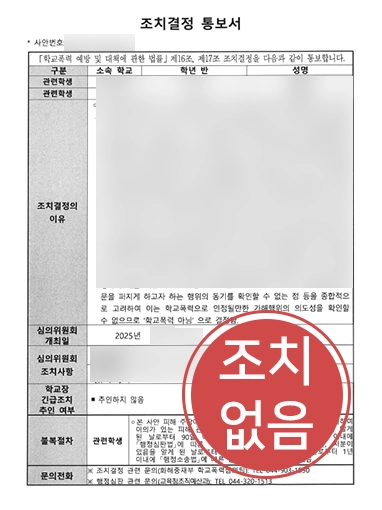
As a result of the deliberation by the School Violence Countermeasures Deliberation Committee, the committee decided not to impose any school violence measure on the client, on the following grounds.
1. The conduct is difficult to regard as persistent or intentional harassment
2. After the other party expressly stopped contact, there was no further approach
3. The main cause of the rumors cannot be definitively attributed to the client
Accordingly, a result was reached that fundamentally blocked the risk of entry on the school life record and a deduction in university admissions.
From the 2026 academic year, the submission of whether a school violence measure exists will become mandatory in all universities and all types of admissions.
This means that an era has arrived in which students and guardians can no longer respond by waiting and saying, “Let us respond to the school violence matter once the result comes out.”
Our firm forms a dedicated task force of school violence committee attorneys who have experience as members of School Violence Countermeasures Deliberation Committees and experience in student disciplinary administrative appeals and stay-of-execution litigation, and responds to cases accordingly.
Through proving the relational context, emotional flow, and facts of a case and structuring the legal reasoning, we assist the School Violence Countermeasures Deliberation Committee in reaching a correct decision.
If a committee session is scheduled or a decision has already been received, we recommend that you consult with a school violence committee attorney as soon as possible and respond to the school violence matter.
See More
This content is based on actual case studies of Daeryun Law LLC with some adaptations, and the copyright belongs to our firm.
Unauthorized reproduction, duplication, or distribution and other copyright infringements may result in legal action under applicable laws.