
CONTENTS
- 1. Client Case of a Lawsuit Claiming Payment for Goods

- 2. The Concept of a Lawsuit Claiming Payment for Goods and the Statute of Limitations
- - The Statute of Limitations, Which Is Especially Important in a Lawsuit Claiming Payment for Goods
- - Procedure of a Lawsuit Claiming Payment for Goods
- 3. Assistance Provided to the Client in the Lawsuit Claiming Payment for Goods
- - Result of the Assistance in the Lawsuit Claiming Payment for Goods: A Favorable Judgment

1. Client Case of a Lawsuit Claiming Payment for Goods
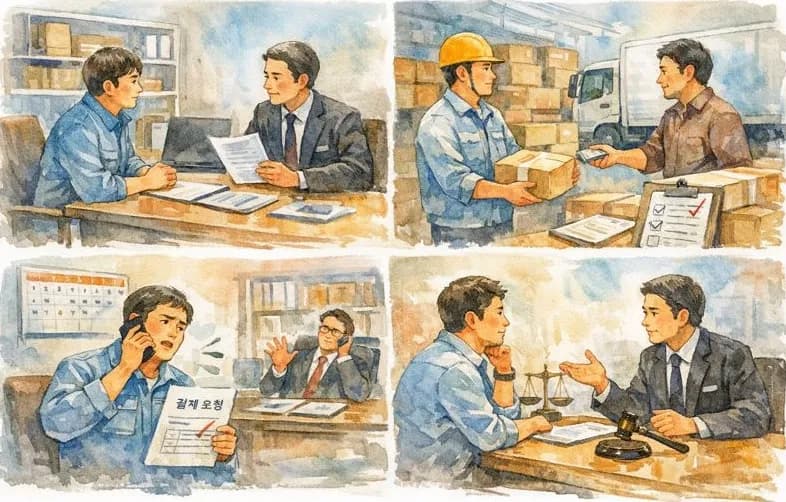
The client who came to us for a lawsuit claiming payment for goods is a company that operates a materials supply business, and it came to consider legal action after failing to receive the agreed payment from its counterparty.
Although the client had delivered all of the agreed goods, it had received only a portion of the amount, and despite repeated requests for payment of the remaining balance, the counterparty continued to delay payment.
Accordingly, the client recognized the need for legal action to recover the unpaid amount and requested assistance with the case as a whole.
2. The Concept of a Lawsuit Claiming Payment for Goods and the Statute of Limitations
A lawsuit claiming payment for goods is a civil lawsuit in which, even though the seller has duly supplied the goods, the buyer fails to pay the agreed price, and the seller seeks payment of the unpaid amount through the court.
In other words, it refers to the procedure that a seller pursues to legally recover its monetary claim in a situation where the goods have been delivered under the contract but the consideration has not been received.
The Civil Act clearly sets out the obligations of the seller and the buyer in a contract of sale.
Civil Act Article 568 (Effect of Sale)
|
Therefore, if the goods have already been delivered but the price has not been paid, the buyer is in a clear state of default on the obligation, and the seller may take legal action through a lawsuit claiming payment for goods.
 The Statute of Limitations, Which Is Especially Important in a Lawsuit Claiming Payment for Goods
Where the payment for goods corresponds to the consideration for products sold by a merchant, a short extinctive prescription of three years may apply under Article 163 of the Civil Act.
Civil Act Article 163 (Short Extinctive Prescription of Three Years) | The consideration for products and goods sold by producers and merchants |
Therefore, if you have not received payment for goods, it is important to review a response strategy without delay.
Procedure of a Lawsuit Claiming Payment for Goods
A lawsuit claiming payment for goods generally proceeds through the following stages.
Stage | Procedure | Key Content |
Stage 1 | Organizing evidence and reviewing the feasibility of litigation | Comprehensively reviewing the contractual relationship, whether the goods were delivered, the unpaid amount, and whether the extinctive prescription applies |
Stage 2 | Sending a certified mail notice | Urging payment before litigation or using it as evidence in preparation for a future dispute |
Stage 3 | Filing the complaint and commencing the lawsuit | Filing the lawsuit claiming payment for goods with the court that has jurisdiction |
Stage 4 | Exchange of briefs and submission of evidence | Submission of arguments and evidence by both parties, focusing on the fact of delivery of the goods and the fact of nonpayment |
Stage 5 | Pronouncement of judgment and review of compulsory execution | If payment is still not made even after a favorable judgment, proceeding with compulsory execution procedures such as attachment |


3. Assistance Provided to the Client in the Lawsuit Claiming Payment for Goods
1. Organizing the Facts of Contract Performance and the Transaction Structure
The corporate attorney systematically organized the facts of the case, focusing on the content of the goods supply contract concluded between the client and the counterparty and on the structure of the transaction.
Specifically, by comprehensively reviewing the contract, the estimate, the order records, the transaction statements, and the tax invoice issuance records, the attorney clearly established that the client had delivered all of the agreed goods and that the counterparty had received them.
2. Clarifying the Circumstances of the Unpaid Amount and Where Responsibility Lies
The corporate attorney analyzed the case by focusing on the circumstances in which only a portion of the amount had been paid and the remaining balance had been left unpaid for a long period.
The attorney emphasized that, even though the defendant had received and used all of the goods delivered under the contract, it was delaying payment of the remaining price for the goods without any legitimate reason.
3. Organizing the Structure of the Claim Including Damages for Delay
The corporate attorney did not stop at claiming only the principal of the unpaid price for the goods but established a strategy to also claim the damages for delay that had arisen from the delayed payment.
By organizing the structure of the claim based on the contractual payment due date and the actual period of delay, the attorney systematically constructed a litigation strategy with a legal basis so that the obligation to pay not only the unpaid principal but also the damages for delay accruing until the date of full payment could be recognized.
Result of the Assistance in the Lawsuit Claiming Payment for Goods: A Favorable Judgment
In this lawsuit claiming payment for goods, the court accepted the client's claim and ordered payment of approximately 90 million won in unpaid amounts together with the damages for delay thereon.
In addition, through a system of collaboration with accountants, tax accountants, and others, the group does not stop at simple legal interpretation but presents comprehensive solutions centered on corporate practice that take into account the transaction structure, tax treatment, and claim recovery strategy.
If you need a response strategy suited to the nature and scale of your case, we encourage you to seek a more stable solution through a consultation with a corporate attorney.
If you are in a situation where you need legal assistance regarding a lawsuit claiming payment for goods, please proceed right now with a 🔗legal consultation reservation.
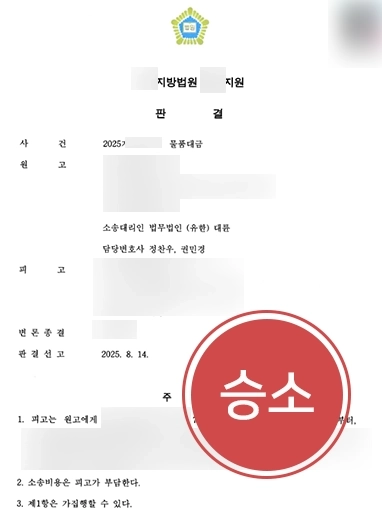
This content is based on actual case studies of Daeryun Law LLC with some adaptations, and the copyright belongs to our firm.
Unauthorized reproduction, duplication, or distribution and other copyright infringements may result in legal action under applicable laws.