
CONTENTS
- 1. The Client Who Visited Daeryun for a Lawsuit Claiming the Price of Goods

- - The Lawsuit Claiming the Price of Goods: What Were the Detailed Circumstances?
- - Statutes Relevant to the Lawsuit Claiming the Price of Goods
- 2. Daeryun's Assistance Toward Winning the Lawsuit Claiming the Price of Goods
- - Sending a Certified Content Notice Before the Lawsuit Claiming the Price of Goods
- - The Lawsuit Claiming the Price of Goods: On the Defendants' Avoidance of Liability
- 3. The Outcome of the Lawsuit Claiming the Price of Goods: The Client Wins the Case
- - If You Intend to Proceed with a Lawsuit Claiming the Price of Goods

1. The Client Who Visited Daeryun for a Lawsuit Claiming the Price of Goods
The client, who visited Daeryun Law Firm stating that he wished to pursue a lawsuit claiming the price of goods, was expressing his frustration that he had not been paid for the concrete by the company with which a contract for construction work had been concluded.
 The Lawsuit Claiming the Price of Goods: What Were the Detailed Circumstances?

The client was a company that was receiving subcontracted work from OO Construction.
The client had concluded a contract for work on the construction of an apartment housing complex with the defendant company and had been carrying out the work for approximately 3 months.
At that time, it was agreed that the client would supply concrete and the like and receive the price of goods in cash 2 months later.
However, as OO Construction became unable to pay the construction payment to the subcontractors, including the client, the work was halted, and the defendant subsequently completed the construction through a replacement contractor.
However, the defendant company did not pay approximately 100 million won of the price of goods that it had agreed to pay to the client, and after pressing for payment, the client had received only 65 million won.
In order to recover the remaining price of goods, the client sought to pursue a lawsuit claiming the price of goods, and accordingly visited Daeryun.
Statutes Relevant to the Lawsuit Claiming the Price of Goods
🔗the price of goods refers to the consideration received for selling goods. Once a transaction in goods has been established, the buyer must pay the seller the price for the goods.
If the price has not been received, a lawsuit claiming the return of the price of goods may be filed. The extinctive prescription of the claim is 3 years.
✔ Points to note when pursuing a lawsuit claiming the price of goods
Before filing the lawsuit, a search of the other company's assets should be carried out first. This is because, even if one prevails in the lawsuit claiming the price of goods and obtains a title for execution, it has no practical effect if there are no assets against which to execute.
If, after searching the assets, there are assets exceeding the amount outstanding, it is advisable to apply for a provisional injunction or provisional attachment over them so as to prepare for future execution to proceed smoothly.
▣ Civil Act, Article 568 (Effect of Sale) (1) The seller shall transfer to the buyer the right that is the object of the sale, and the buyer shall pay the price thereof to the seller. (2) In the absence of a special agreement or custom, the obligations of both parties under the preceding paragraph shall be performed simultaneously. |
2. Daeryun's Assistance Toward Winning the Lawsuit Claiming the Price of Goods
In order for the client to recover the full amount claimed through the lawsuit claiming the price of goods, the specialized attorneys of Daeryun Law Firm argued as follows.
Sending a Certified Content Notice Before the Lawsuit Claiming the Price of Goods
A content-certified letter regarding the price of goods is a document certifying matters such as a claim for the price of goods, and is used to publicly certify and demand payment when payment of the price of goods by a business partner has been delayed or remains unpaid.
Although this is not recognized as having legal effect, it becomes important evidence should a lawsuit later be filed, and therefore Daeryun first assisted with the dispatch of the client's content-certified letter.
The Lawsuit Claiming the Price of Goods: On the Defendants' Avoidance of Liability
The defendant's argument was that, since it was OO Construction that ordered the supply of concrete from the client company, the defendants bore no obligation for the price of goods.
However, at the time the concrete supply contract was prepared, the defendant had stated, 'I will take responsibility for all construction payments related to this construction site,' and said that it would suffice to prepare the contract with OO Construction as a formality.
Therefore, it was argued that the claim for the price of goods for the concrete should properly be made against the defendants, and that, accordingly, the unpaid remaining amount should be recovered as soon as possible.
3. The Outcome of the Lawsuit Claiming the Price of Goods: The Client Wins the Case
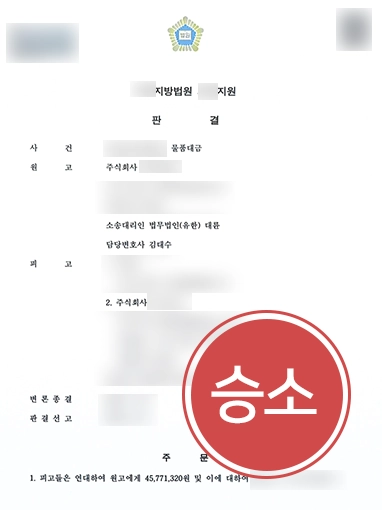
As a result of pursuing the lawsuit claiming the price of goods, the court ruled that the defendant "shall pay in full the remaining price of goods that had not been paid to the client."
The defendant company had continued to argue that it had no obligation to pay the price of goods and had delayed payment, but through Daeryun's assistance, it was proven that the obligation lay with the defendant, and as a result the client was able to win the case.
If You Intend to Proceed with a Lawsuit Claiming the Price of Goods
In a lawsuit claiming the price of goods, the plaintiff bears the burden of proving the fact of the defendant's obligation for the price. Accordingly, it is recommended to proceed with the case through consultation with a specialized attorney.
Daeryun Law Firm actively assists corporate clients with claim litigation in situations where they have not been paid money owed to them in a timely manner, as in the case above.
If you require assistance in a similar situation, please feel free to request a 🔗legal consultation from Daeryun Law Firm.
This content is based on actual case studies of Daeryun Law LLC with some adaptations, and the copyright belongs to our firm.
Unauthorized reproduction, duplication, or distribution and other copyright infringements may result in legal action under applicable laws.