
CONTENTS
- 1. Details of the Administrative Complaint Case

- - Areas of Support Provided by the Daeryun Administrative Law Attorney
- 2. Result of the Administrative Litigation Complaint Case
- - Guide to Drafting the Complaint
- 3. Key Points of Legal Response When Submitting an Administrative Litigation Complaint
- - Daeryun Law Firm One-Stop Response

1. Details of the Administrative Complaint Case
The client who came to Daeryun seeking help in filing an administrative complaint was a cadet enrolled at a military academy, and as an assertion was raised that the cadet had committed indecent assault and assault against a fellow cadet, the cadet was referred to the on-campus disciplinary review committee.
However, the client had never committed the indecent assault or assault in question, and on the contrary, the fellow cadet who claimed to be the victim had continuously made romantic overtures toward the client, and the client possessed objective evidence supporting this, such as KakaoTalk conversation records.
Nevertheless, the disciplinary review committee proceeded with its review on the premise that the client was the perpetrator, and ultimately imposed a serious disciplinary measure of dismissal.
The client filed an appeal in protest of this, but it was dismissed, and in the end the client resolved to file an administrative complaint seeking the revocation of the dismissal disposition, with the assistance of an administrative law attorney at the law firm Daeryun.

 Areas of Support Provided by the Daeryun Administrative Law Attorney
From the stage of filing the administrative complaint, the Daeryun administrative law attorney asserted the unlawfulness of the dismissal disposition in this case from multiple angles.
1. Serious Procedural Unlawfulness in the Examination of Witnesses
Where there is no separate regulation, the discipline of military academy cadets is governed by the Army Disciplinary Regulations applied mutatis mutandis.
According to the Army Disciplinary Regulations, the disciplinary clerk must prepare a statement record for the investigation of a disciplinary case, and when examining a witness, the date and time of the examination, the examiner, and the method of examination must be clearly recorded.
However, in this case, the witness statement prepared during the course of the original disposition was obtained by hearing the statement over the telephone without actually summoning the witness, and the date of hearing the statement, the person who heard it, and the circumstances of the investigation were not recorded at all.
The administrative law attorney pointed out in the administrative complaint that this procedure could not be regarded as a lawful examination of a witness, and that the statement based on it was likewise unlawful evidence without evidentiary capacity.
2. Defect in the Prior Notice of the Disposition
The administrative law attorney invoked, as a key precedent, the Supreme Court judgment in Case No. 2022Du33323.
That judgment makes clear, in connection with a disciplinary case involving sexual misconduct, that the date and time, place, counterpart, type of conduct, and specific circumstances of each act must be specified to a degree that can distinguish them from other acts, and that this is an essential requirement for guaranteeing the right of defense of the person subject to discipline.
However, in this case, neither the notice of the convening of the cadet corps committee nor the notice of the dismissal disposition specified at all the date, time, or circumstances of each statement or act of the client.
The administrative law attorney regarded this as a serious defect in the prior notice of the disposition and emphasized in the administrative complaint that, on this ground alone, the dismissal disposition should be revoked.
3. Infringement of the Right of Defense and the Unlawfulness of Mistake of Fact
A person suspected of a disciplinary offense and a person subject to review has the right to present evidence and witnesses favorable to himself during the course of the investigation.
From the early stage of the investigation, the client clearly stated that there existed a witness who could impeach the victim's statement, and continuously requested the examination of that witness.
However, the disciplinary authority did not conduct even a single examination of the witness requested by the client.
The administrative law attorney structured this as an independent procedural defect that essentially infringed the client's right of defense and reflected it in the administrative complaint.
4. Denial of the Credibility of the Statements
The administrative law attorney, on the basis of the Supreme Court judgment in Case No. 2015Do11428, entirely denied the credibility of the statements of the victim and of the witness favorable to the victim.
The Supreme Court has held that, in order to make a determination based on a statement alone, the rationality of the content of the statement, its objective reasonableness, its consistency before and after, the character and interests of the person making the statement, and the possibility of inducement or intimidation arising from the possibility of an investigation being commenced must be comprehensively examined.
In this case, the administrative law attorney pointed out in the administrative complaint that the statements of the victim and the witness lacked consistency in content, had clear interests at stake, and conflicted with the objective materials in many respects, and therefore did not possess credibility sufficient to exclude reasonable doubt.
2. Result of the Administrative Litigation Complaint Case
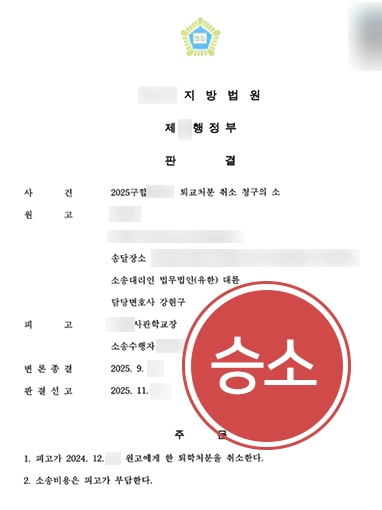
The court fully accepted the claims set forth in the administrative litigation complaint submitted by Daeryun's administrative law attorney, and it rendered a judgment revoking the expulsion disposition that the superintendent of the military academy had imposed on the client.
An administrative lawsuit such as this case is a lawsuit in which a person whose rights or interests have been infringed by a disposition of an administrative agency seeks the revocation of that disposition or confirmation of its nullity.
In general, administrative litigation proceeds in the following order.
- Issuance of the administrative disposition
- Pre-trial procedures such as appeals and objections
- Submission of the administrative litigation complaint
- Oral argument and examination of evidence
- Pronouncement of judgment
Here, the administrative litigation complaint is the central document that determines the success or failure of the lawsuit, and how precisely the grounds of illegality are structured has a direct effect on the judgment.
Guide to Drafting the Complaint
An administrative litigation complaint must include the following elements.
- Identification of the disposition
- Systematic classification of the grounds of illegality (procedure, substance, and abuse of discretion)
- Accurate citation of the relevant statutes and precedents
- Logical connection between the evidence and the arguments
An administrative litigation complaint must be a document that goes beyond merely pleading a sense of injustice and that presents a ‘structure of illegality’ on which the court can render a judgment.


3. Key Points of Legal Response When Submitting an Administrative Litigation Complaint
When submitting an administrative litigation complaint and filing an administrative lawsuit, it is important to respond as follows.
Response Point | Key Practical Considerations |
Procedural illegality | Prior notice, method of investigation, and evidence collection procedures |
Infringement of the right of defense | Exclusion of witness questioning and limitation of the opportunity to explain |
Mistake of fact | Credibility of statements and conflict with objective evidence |
Application of precedent | Citation of Supreme Court judgments in similar matters |
Proportionality of the sanction | Excessiveness of the level of discipline |
Daeryun Law Firm One-Stop Response

Through the following one-stop legal services, Daeryun Law Firm provides one-stop assistance with military-related administrative litigation.
- Drafting of the administrative litigation complaint and conduct of the lawsuit by an administrative law attorney
- Analysis of internal military regulations and the disciplinary system by a military law attorney
- Comprehensive response to cases of discipline, expulsion, and revocation of qualifications
A military disciplinary case is an administrative disposition that has a significant effect on the client's future career path and life as a whole.
This is precisely why professional legal response is necessary from the administrative litigation complaint stage.
If you need legal assistance with a related case, please proceed with a 🔗legal consultation reservation.
This content is based on actual case studies of Daeryun Law LLC with some adaptations, and the copyright belongs to our firm.
Unauthorized reproduction, duplication, or distribution and other copyright infringements may result in legal action under applicable laws.