
CONTENTS
- 1. The Client Who Came to the Fraud Attorney

- - The Circumstances Leading to the Accusation of the Crime of Fraud
- 2. The Fraud Attorney's Strategy in Responding to the Unjust Accusation of the Crime of Fraud
- - Establishing the Key Issues of the Case and the Defense Strategy
- - Rebuttal of the Loan Claim and Denial of the Intent to Defraud
- - Rejection of False Claims through Proof of Actual Treatment
- 3. As a Result of the Fraud Attorney's Assistance, the Case Concluded at the Police Stage
- - When Is the Crime of Fraud Established?
- - Level of Punishment If Convicted of the Crime of Fraud
- - The Crime of Fraud: Advantages Obtainable through an Attorney's Assistance
- - Frequently Asked Questions When Charged with the Crime of Fraud

1. The Client Who Came to the Fraud Attorney
The client who came to the fraud attorney, after being accused of the crime of fraud, pleaded that the accusation was unjust and came to our firm's fraud attorney in order to bring the case to a swift conclusion.
 The Circumstances Leading to the Accusation of the Crime of Fraud
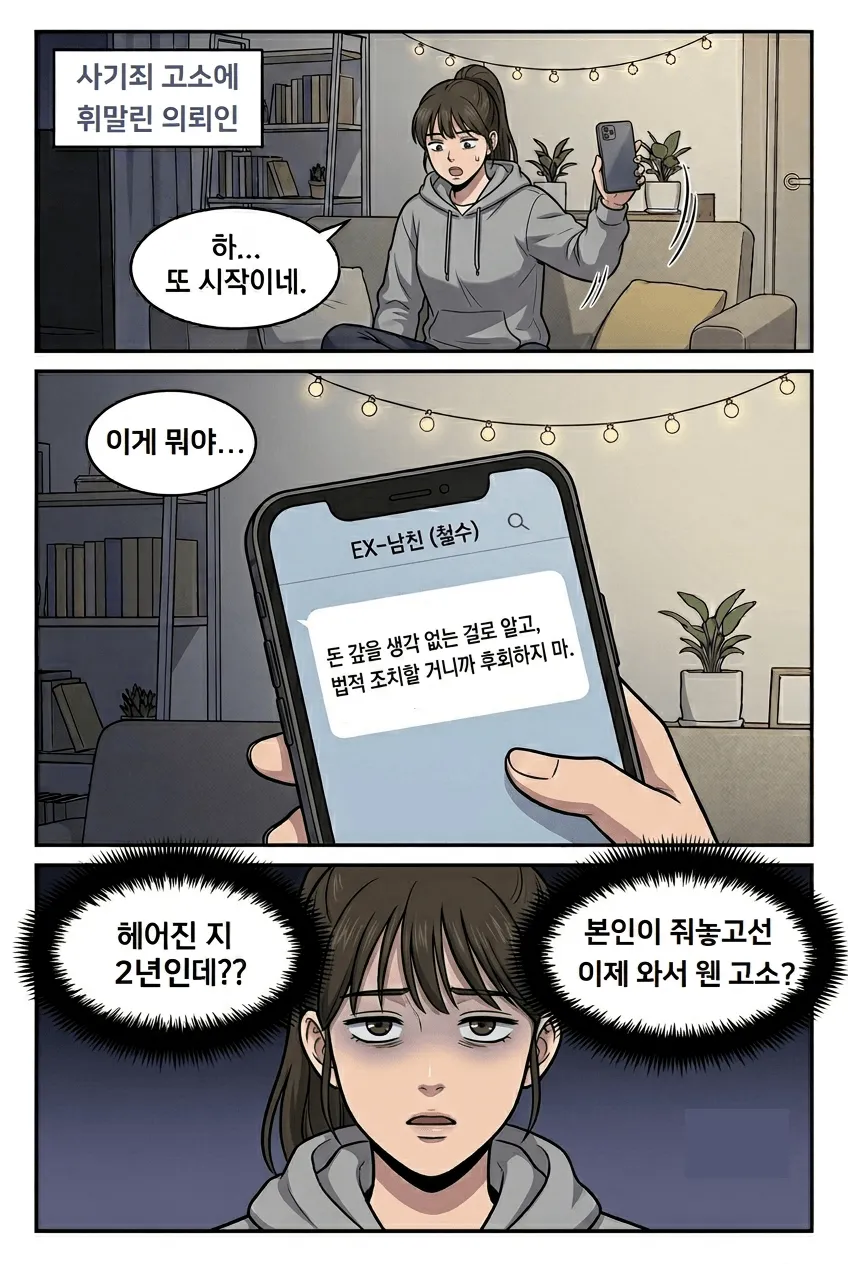
In the past, the client had been unable to arrange hospital expenses in time due to difficult financial circumstances, and her boyfriend at the time, having learned of this, remitted 30 million won to the client and provided financial support.
However, the two later broke up, and several years afterward the ex-boyfriend abruptly demanded the return of the amount, claiming that it constituted money he had lent.
The client said she thought it was contact made out of spite and did not take it seriously; however, the ex-boyfriend (hereinafter the "accuser") went so far as to file a written accusation for the crime of fraud on the ground that he had not been repaid.
The client said, "It was clearly money that my boyfriend gave at the time without any conditions, so I cannot understand why he is suddenly making this claim after we broke up," and requested the help of the fraud attorney in responding to the accusation of the crime of fraud.
2. The Fraud Attorney's Strategy in Responding to the Unjust Accusation of the Crime of Fraud
After reviewing this case as a whole, the fraud attorney proceeded with a step-by-step response in the direction of denying the elements for the establishment of fraud.
Establishing the Key Issues of the Case and the Defense Strategy
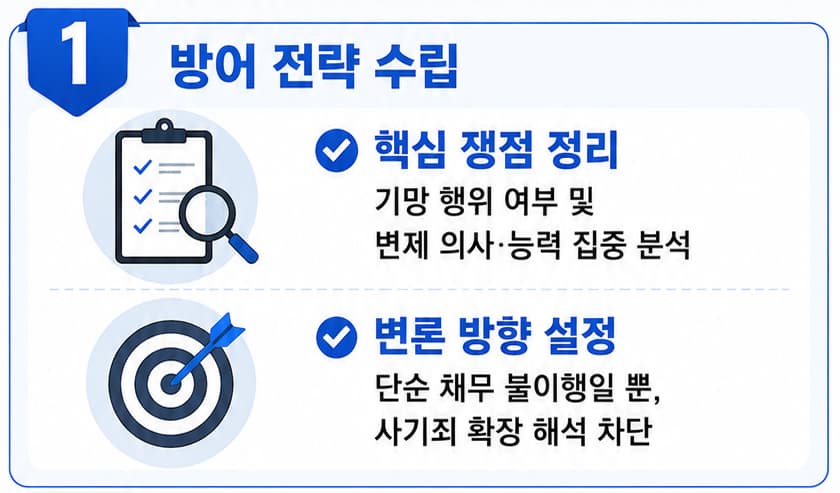
Before mounting a full response, the fraud attorney clearly organized the key issues of the case.
· Can it be said that she had no intention or ability to repay?
Through this, the attorney set the direction of the argument centered on the point that there was no room to expand the interpretation of this matter into the crime of fraud.
Rebuttal of the Loan Claim and Denial of the Intent to Defraud

The accuser claimed that the money in this case constituted loaned money, and asserting that the client had defrauded him of his money even though she had no ability to repay, he had filed not only the accusation for the crime of fraud but also a civil suit for return.
In response, the fraud attorney secured the memo record at the time of the remittance and emphasized that, on the basis of the record indicating that the money was entered as a "gift," no relationship of loan had been established.
In addition, the attorney actively demonstrated that, since the client had the financial means to repay, the intent to defraud could not be recognized, by submitting the following materials.
▶ Financial account records
▶ Income verification materials
Rejection of False Claims through Proof of Actual Treatment

In particular, the complainant asserted that the client had not actually received treatment at the hospital and denied that any treatment costs had been incurred.
In response, the fraud attorney secured the client's treatment records and the hospital cost calculation materials, and submitted objective evidence showing that treatment had in fact been provided and that the costs had been paid by card.
Through this, the attorney emphasized that the complainant's assertion differed from the facts and amounted to nothing more than a false claim.
Related News


3. As a Result of the Fraud Attorney's Assistance, the Case Concluded at the Police Stage
As a result of the fraud attorney's systematic assistance throughout the case, the police issued a decision of no suspicion of crime (non-referral).
In response, the client expressed gratitude, stating, "I felt great anxiety because of the sudden complaint, but thanks to the thorough response, I was able to return to my daily life."
What is non-referral?
When Is the Crime of Fraud Established?
According to Supreme Court precedent, the crime of fraud is established when a person deceives another, causes that person to fall into error, and thereby obtains property or a pecuniary benefit through a disposal of property resulting from that error.
See Supreme Court Decision 87Do1872, March 8, 1988, and Supreme Court Decision 2011Do8829, October 13, 2011, among others
The crime of fraud is established when a person deceives another, causes that person to fall into error, induces a disposal of property, and thereby receives property or obtains a pecuniary benefit, and there must be a causal relationship among the deception, the error, and the disposal of property.
Level of Punishment If Convicted of the Crime of Fraud
The crime of fraud may be punished as follows under the Criminal Act (Penal Code).
In addition, criminal liability may be recognized even when the offense remains an attempt, so an early response to the case is of great importance.
If the gain obtained through fraud is 500 million won or more, the Act on Aggravated Punishment of Specific Economic Crimes applies, and the level of criminal punishment increases significantly.
| Article 347 of the Criminal Act (Fraud) | Imprisonment for not more than 20 years or a fine not exceeding 50 million won |
The Crime of Fraud: Advantages Obtainable through an Attorney's Assistance
A property crime case such as the crime of fraud is not one from which a person can escape merely by asserting that they "did not know it was money that had to be repaid" or that they "did not have such an intention at first."
Therefore, a careful and strategic response is necessary from the initial statement stage.
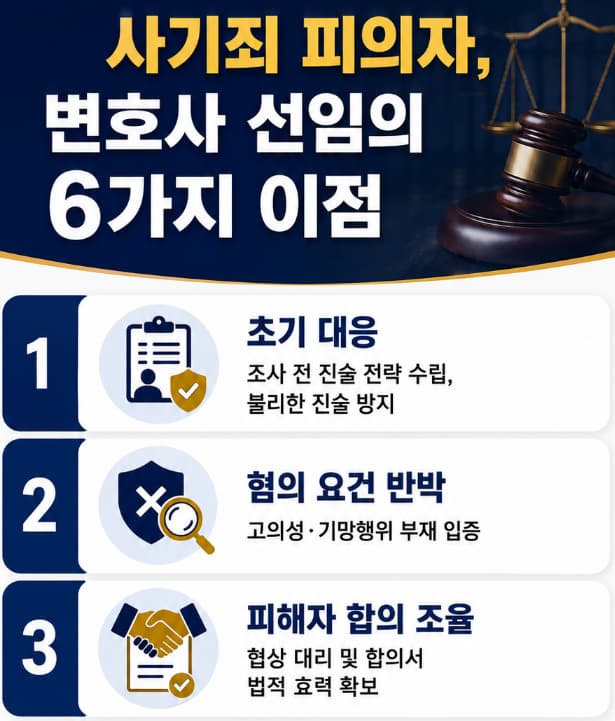
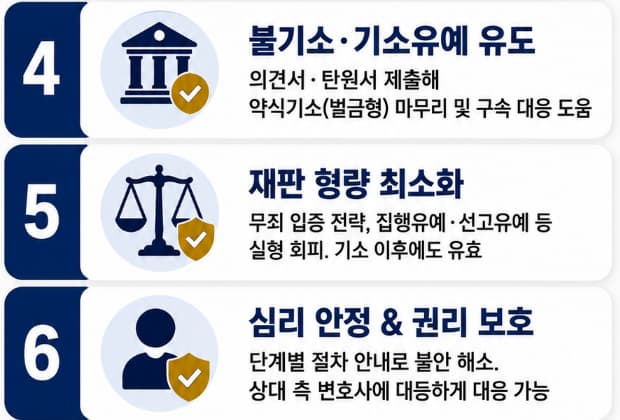
The criminal law specialist attorneys of Daeryun LLC, the ninth-largest law firm in the country (based on the 2025 value-added tax filings), focus on key issues such as whether deception occurred, the intent to defraud, and the intention and ability to repay, and they precisely review the facts and evidence to accurately identify the essence of the case.
In addition, throughout the investigation and trial stages, they carefully organize the factors that may affect sentencing, and they systematically prepare materials such as evidence of remorse, efforts toward recovery of the victim's losses, and contextual evidence to provide assistance aimed at reduction of sentence and lenient treatment.
If you have become involved in a fraud case under circumstances such as those described above, 🔗Legal Consultation Reservation may help you receive legal assistance suited to the stage and circumstances of your case.
Frequently Asked Questions When Charged with the Crime of Fraud
A. Deception refers to conduct in which a person communicates false information about a fact that has a significant influence on the other party's judgment, or intentionally conceals a fact important to the decision of whether to enter into a transaction while being aware of it.Q. Attorney, what kind of conduct constitutes "deception" in the crime of fraud?
Beyond the level of mere exaggeration or misunderstanding, the key criterion for judgment is whether there was an intent to cause the other party to fall into error.
A. Being charged with the crime of fraud does not mean that every case proceeds to trial.Q. Attorney, if I am charged with the crime of fraud, will the case necessarily proceed to trial?
When deceptive conduct or an intent to defraud is not recognized during the investigation, the case may be concluded with a decision of non-referral or a decision of non-prosecution, and there are also many cases that are concluded due to insufficient evidence or a failure to meet the requirements for establishing the crime.

This content is based on actual case studies of Daeryun Law LLC with some adaptations, and the copyright belongs to our firm.
Unauthorized reproduction, duplication, or distribution and other copyright infringements may result in legal action under applicable laws.