




CONTENTS
- 1. An Overview of How the Client Became Involved in the Fraud Case Under the Act on Aggravated Punishment of Specific Economic Crimes

- 2. The Key Issues and Strategy in the Fraud Case Under the Act on Aggravated Punishment of Specific Economic Crimes
- - The Defense Strategy Regarding Whether a Deceptive Act Existed
- - The Defense Strategy Regarding Whether There Was Intent to Take the Money by Deception
- - The Defense Strategy Regarding Whether It Was Investment Funds or Borrowed Money
- 3. The Result of the Response to the Fraud Case Under the Act on Aggravated Punishment of Specific Economic Crimes, a Non-Referral
- 4. A Summary of Legal Information on Fraud Under the Act on Aggravated Punishment of Specific Economic Crimes
- - The Level of Punishment for a Violation of the Act on Aggravated Punishment of Specific Economic Crimes
- - A Webtoon on the Case of Acquittal in a Large-Scale Fraud of Around 10 Billion Won
- 5. If You Are Suspected as a Suspect of Fraud Under the Act on Aggravated Punishment of Specific Economic Crimes
- - A Checklist of Situations in Which the Assistance of a Criminal Defense Lawyer Is Needed

1. An Overview of How the Client Became Involved in the Fraud Case Under the Act on Aggravated Punishment of Specific Economic Crimes
The client identified as a suspect in a case of fraud under the Act on Aggravated Punishment of Specific Economic Crimes was a businessperson in the 40s who was operating a manufacturing plant.
The client had proceeded with a contract with one business partner (hereinafter the counterpart).
At the time of the contract, the client said that if the counterpart provided business funds to the client, the client would return more than double the profit.
Believing these words of the client, the counterpart transferred approximately 800 million won to the client.
However, as the business grew difficult, the client came to face a situation in which it was hard to pay even the interest that had been promised monthly, let alone the more than double the profit that had been promised to the counterpart.
In the end, the counterpart concluded that the client had deceived the counterpart and taken a large sum of money by deception under the pretext of business funds.
Thereafter, the counterpart proceeded with a criminal complaint against the client on suspicion of fraud under the Act on Aggravated Punishment of Specific Economic Crimes.
The client came to face, along with the management crisis of the company, the risk of criminal punishment on suspicion of the crime of fraud.
Although a management crisis can be handled alone, the client, judging that the risk of criminal punishment was a matter difficult to handle alone, requested a consultation with a criminal defense lawyer on this matter.
2. The Key Issues and Strategy in the Fraud Case Under the Act on Aggravated Punishment of Specific Economic Crimes

The core of this fraud case under the Act on Aggravated Punishment of Specific Economic Crimes was "was it a business failure, or was it a fraud planned from the outset."
For the crime of fraud, a deceptive act intended to obtain a pecuniary benefit by deceiving the counterpart from the time the money is received and the intent to take the money by deception must be proved.
Therefore, in the client's case, the following three points could be said to be the key issues.
Whether there was intent to take the money by deception : whether the client received the funds with the intent, from the outset, not to repay the money or to use the investment funds personally
Whether it was investment funds or borrowed money : whether the legal nature of the 800 million won paid by the counterpart was investment funds, a loan, or money taken through a fraudulent offense
In accordance with the key issues thus identified, the criminal defense lawyer promptly devised a strategy to defend against criminal punishment.
 The Defense Strategy Regarding Whether a Deceptive Act Existed
The criminal defense lawyer noted that, at the time the client received the funds from the counterpart, the client was the representative of a manufacturing company that was actually in operation.
Accordingly, the criminal defense lawyer secured and submitted to the investigative authorities the transaction statements, supply contracts, tax invoices, and business plan materials from before and after the client concluded the contract.
In addition, cooperating with the 🔗Evidence Investigation Center, the lawyer analyzed the plant's operating status and the business partners' performance at the time and objectively organized the fact that the client had attracted the investment for the purpose of raising funds to expand the business, and submitted a defense counsel's written opinion.
The Defense Strategy Regarding Whether There Was Intent to Take the Money by Deception
Generally, one of the most important issues in a fraud case under the Act on Aggravated Punishment of Specific Economic Crimes is whether there was intent to take the money by deception at the time of receiving the investment funds.
The criminal defense lawyer closely reviewed the record of how the 800 million won received by the client was used.
The problem was that the data on how this 800 million won was used had, in many cases, already been deleted or damaged.
As a result of analyzing the account transaction records, accounting materials, and electronic documents in cooperation with the 🔗Digital Forensics Center, the criminal defense lawyer confirmed that a substantial portion had been used for business purposes such as raw material purchase costs, employee wages, and plant operating expenses.
Accordingly, the lawyer emphasized that there were no circumstances indicating that the funds had been personally misappropriated or concealed, and developed the argument that a default on debt due to business failure must be distinguished from the crime of fraud.
The Defense Strategy Regarding Whether It Was Investment Funds or Borrowed Money
The criminal defense lawyer closely analyzed the legal nature of the 800 million won paid by the counterpart.
In this process, the lawyer restored deleted conversations and electronic materials through the Digital Forensics Center and, in cooperation with the Evidence Investigation Center, systematically organized the materials prepared during the investment negotiation process.
Based on this, the criminal defense lawyer emphasized the facts that the money in question was funds of an investment nature rather than a mere loan or money taken by deception, and asserted that an investment loss cannot immediately be evaluated as the criminal offense of fraud.
3. The Result of the Response to the Fraud Case Under the Act on Aggravated Punishment of Specific Economic Crimes, a Non-Referral

The investigative authorities accepted the criminal defense lawyer's arguments and judged that the charge of fraud under the Act on Aggravated Punishment of Specific Economic Crimes did not apply to the client.
As a result, the client received a non-referral decision on the ground of no suspicion of crime.
The client, who had faced the risk of heavy criminal punishment, conveyed words of gratitude and returned to daily life.
4. A Summary of Legal Information on Fraud Under the Act on Aggravated Punishment of Specific Economic Crimes
In fraud cases under the Act on Aggravated Punishment of Specific Economic Crimes, criminal complaints are often filed over investment funds, business funds, loans, real estate transaction payments, and the like.
However, it is not established merely by the circumstance that money was not repaid due to a business failure or a default on debt.
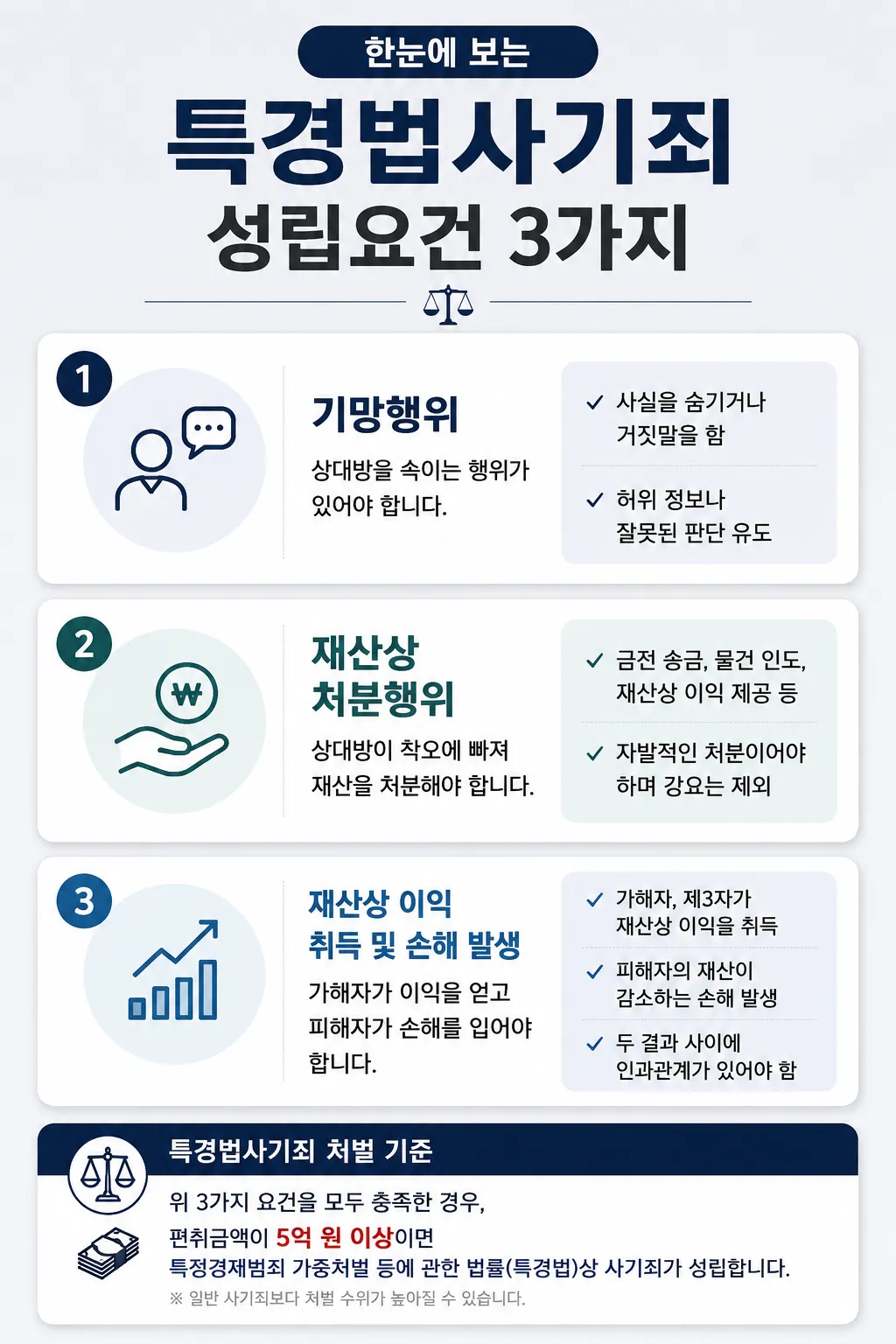
In particular, in practice the judgment is made by comprehensively reviewing whether there was an intent and the ability to repay at the time the contract was concluded, whether the counterpart was deceived, and what the record of the use of the funds was.
Therefore, if you are suspected of the crime of fraud in violation of the Act on Aggravated Punishment of Specific Economic Crimes, it is important to closely analyze the circumstances of the transaction and the related evidence and establish a response direction.
The Level of Punishment for a Violation of the Act on Aggravated Punishment of Specific Economic Crimes
The crime of fraud is a crime punishable, under Article 347 of the Criminal Act, by imprisonment for not more than 20 years or a fine of 50 million won.
| Article 347 of the Criminal Act (Fraud) |
|---|
| (1) A person who takes property or obtains a pecuniary benefit by deceiving another shall be punished by imprisonment for not more than 20 years or a fine not exceeding 50 million won. |
If a person commits such a crime of fraud and the amount of the benefit is 500 million won or more, the Act on Aggravated Punishment of Specific Economic Crimes applies.
| Scale of the amount of benefit | Level of punishment |
|---|---|
| 500 million won or more and less than 5 billion won | Imprisonment for a definite term of not less than three years |
| 5 billion won or more | Life imprisonment or imprisonment for not less than five years |
As you can see, the crime of fraud under the Act on Aggravated Punishment of Specific Economic Crimes is classified as a serious crime with no option of a fine, and from the point at which the amount of benefit is 500 million won or more, a much heavier punishment than for ordinary fraud applies.
In particular, where the amount of harm is large, the period of the offense is long, or there are numerous victims, the possibility of an actual custodial sentence being imposed can increase.
Therefore, if you are suspected of a violation of the Act on Aggravated Punishment of Specific Economic Crimes, it is important to closely examine, from the early investigation stage, whether it was an actual investment relationship, whether there was a deceptive act, and whether an intent and the ability to repay existed, and to prepare a response strategy.
A Webtoon on the Case of Acquittal in a Large-Scale Fraud of Around 10 Billion Won

In a fraud case under the Act on Aggravated Punishment of Specific Economic Crimes, it is important to identify which evidence and legal principles influenced the outcome of the disposition.
We invite you to look at which defense strategy was actually used through the 🔗webtoon on the case of acquittal in a large-scale fraud of around 10 billion won.
5. If You Are Suspected as a Suspect of Fraud Under the Act on Aggravated Punishment of Specific Economic Crimes
A charge of fraud under the Act on Aggravated Punishment of Specific Economic Crimes can carry a much heavier punishment than the ordinary crime of fraud, so an early response is very important.
That is, as with the client in the case, the key is to prepare a systematic defense strategy from the police questioning stage.
- Organizing the circumstances of the conclusion of the contract : organizing the process of the contract in chronological order based on the proposals, explanatory materials, text messages, and emails exchanged, and objectively proving that there were no circumstances of deceiving the counterpart or communicating false facts
- Organizing the record of the use of the funds : analyzing in detail the transaction records of the account into which the investment funds or loan were deposited, and confirming that they were used in accordance with the actual purpose of the contract
- Proving the intent and ability to repay : organizing the credit status, business status, and projected revenue materials at the time the money was received, and explaining that there was a sufficient intent and ability to repay at that time
- Securing the record of communication with the victim : objectively explaining, through text messages, call records, and messenger conversations, the circumstances in which the business or contract became difficult, and organizing the fact that there had been continuous consultation to resolve the problem
A Checklist of Situations in Which the Assistance of a Criminal Defense Lawyer Is Needed
| Checklist item |
|---|
| □ Where there is a fact that you received 500 million won or more under the pretext of investment funds or business funds |
| □ Where the counterpart asserts that the suspect (defendant) had no intent to repay the money from the outset |
| □ Where you were unable to pay the promised profit or principal due to a business failure |
| □ Where you have received a request to appear before the police or notice of suspect status |
| □ Where the amount of harm is large or there are several victims |
| Where digital evidence has been damaged and needs to be recovered |
| □ Where you have been identified as an accomplice or as the person in charge of attracting the investment |
| □ Where there is a possibility that a search and seizure or a forensic examination of a mobile phone will be conducted |
| □ Where a settlement with the victim is necessary |
Daeryun Law Firm is the ninth-largest law firm in Korea (based on 2025 value-added tax filings with the National Tax Service), and its criminal defense lawyers provide close assistance throughout the entire process, from the initial consultation on the case to responding to police questioning, preparing the defense counsel's written opinion, reaching a settlement with the victim, and establishing a trial strategy.
In addition, depending on the matter, the firm cooperates with the Evidence Investigation Center and the Digital Forensics Center to secure objective evidence and analyze the facts with precision.
If you have currently been booked as a suspect of fraud under the Act on Aggravated Punishment of Specific Economic Crimes, we invite you to review the issues of the case and establish a response direction through a 🔗reservation for a legal consultation.
This content is based on actual case studies of Daeryun Law LLC with some adaptations, and the copyright belongs to our firm.
Unauthorized reproduction, duplication, or distribution and other copyright infringements may result in legal action under applicable laws.










