




CONTENTS
- 1. A Client Facing Police Questioning on Suspicion of Officetel Sale Fraud

- 2. The Main Assistance for Clearing the Officetel Sale Fraud Suspicion
- - Rebutting the Assertion That the Defects Were Concealed Before the Contract
- - Asserting That Some Repairs Had Been Provided
- - Highlighting That the Matter Is a Civil Dispute
- - Asserting That It Was Not a Disposition to Avoid Compulsory Execution
- 3. The Result of the Assistance on the Officetel Sale Fraud Suspicion, a Non-Referral
- 4. What You Should Know If You Have Become a Suspect in Officetel Sale Fraud
- - Frequently Asked Questions to Lawyers

1. A Client Facing Police Questioning on Suspicion of Officetel Sale Fraud

The client, who had become a suspect in officetel sale fraud, decided to sell an officetel and concluded a sale contract with the buyer.
The buyer paid the down payment, but as the balance-payment date approached, the buyer demanded additional repairs or a reduction of the price, citing traces of interior defects and a bathroom drainage problem.
The client indicated the position that some repairs were possible, but the buyer sent a message stating, "If the conditions do not match, it may be better to look for another buyer."
The client took this content to mean that there was no intention to proceed with the contract.
The client thereafter sold the officetel to a new buyer, and, judging that the contract with the existing buyer had effectively ended, did not return the down payment.
However, the existing buyer asserted that the contract had never been rescinded, and that the client had received the down payment while concealing the officetel's defects, filing a civil lawsuit claiming its return.
After prevailing in the civil lawsuit, the buyer filed a complaint on suspicion of fraud, asserting that the client had known of the defects from the outset and had not disclosed them.
Ahead of the police questioning, the client sought out the law firm Daeryun and requested help.
2. The Main Assistance for Clearing the Officetel Sale Fraud Suspicion
In the officetel sale fraud case, the real estate lawyer reviewed, in order, the content of the explanation at the time of the contract, the opportunity to inspect the site, the point at which the defects arose, the circumstances of the repair response, and the point of the resale.
In this case, the key was whether the client had intended, from the time of the contract, to deceive the buyer and receive the down payment.
 Rebutting the Assertion That the Defects Were Concealed Before the Contract
Before actually concluding the contract, the buyer had, together with the broker, looked around the interior of the building to be contracted and personally and carefully confirmed the interior structure and condition, the bathroom drainage condition, and the like.
Nevertheless, the buyer made the assertion that the client had deliberately concealed a particular defect.
In addition, explaining that condensation and drainage problems can appear belatedly depending on the usage environment or the season, the real estate lawyer explained that the client had no intention to deceive the buyer.
Asserting That Some Repairs Had Been Provided
After the buyer raised issues citing defects and the like, the client had in fact carried out repair work.
Accordingly, in order to prove that the client had taken active measures to improve the officetel's condition, the real estate lawyer submitted to the investigative authorities the materials showing that a bathroom drain inspection and silicone repair had been carried out.
Through this, it was possible to assert that, although the client had the intention to normally perform the officetel sale transaction, the buyer had declined it.
Highlighting That the Matter Is a Civil Dispute
The real estate lawyer determined that this case was closer to a civil dispute over rescission of the sale contract and the return of the down payment than to criminal fraud.
This was because there were insufficient circumstances to regard an intent to defraud as having existed from the time of the contract, and the subsequent refusal to return could be seen as having arisen from a misunderstanding.
Accordingly, the lawyer closely reviewed the circumstances of the conclusion of the contract, the content of the conversations between the parties, and the process of performance of the contract, and intensively rebutted whether the fraud charge was established.
Asserting That It Was Not a Disposition to Avoid Compulsory Execution
The complainant raised an additional charge of the crime of evading compulsory execution regarding the client's act of selling the officetel to a third party, asserting that it had been an attempt to avoid compulsory execution.
However, the client had understood, upon seeing the buyer's message, that the contract would no longer proceed, and the point at which the client concluded the contract with the new buyer was before the arrival of the existing buyer's certified content-registered mail.
Because it was before the lawsuit was filed, it was difficult to regard the client as having anticipated compulsory execution and diverted his property.
Through this, the lawyer asserted that the client had not acted for the purpose of avoiding compulsory execution, but had proceeded with a new transaction in a state of mistakenly believing that the contract had been broken.
3. The Result of the Assistance on the Officetel Sale Fraud Suspicion, a Non-Referral

In the course of the officetel sale fraud investigation, the investigative authorities judged that it was difficult to find that the client had intentionally concealed the officetel's defects and had sought to defraud the buyer of the down payment.
As a result, the client was able to receive a non-referral decision on the fraud charge.
4. What You Should Know If You Have Become a Suspect in Officetel Sale Fraud
For an officetel sale fraud suspicion to be recognized, it must be confirmed that the seller sought, from the time of the contract, to deceive the buyer and receive the down payment or the sale price.
Because the crime of fraud is not established merely on the ground that a contract fell through, or that there is a defect, it is important, from the suspect's standpoint, to organize the content of the conversations before and after the contract and the circumstances of the buyer's confirmation of the defects.
In this case as well, it was confirmed that, after the buyer raised the issue, the client carried out some repair work and even bore the cost, and such circumstances could be used as a basis showing an intention to perform the contract rather than an intent to defraud.
Therefore, it is important to organize the facts and the supporting materials centered on the following matters.
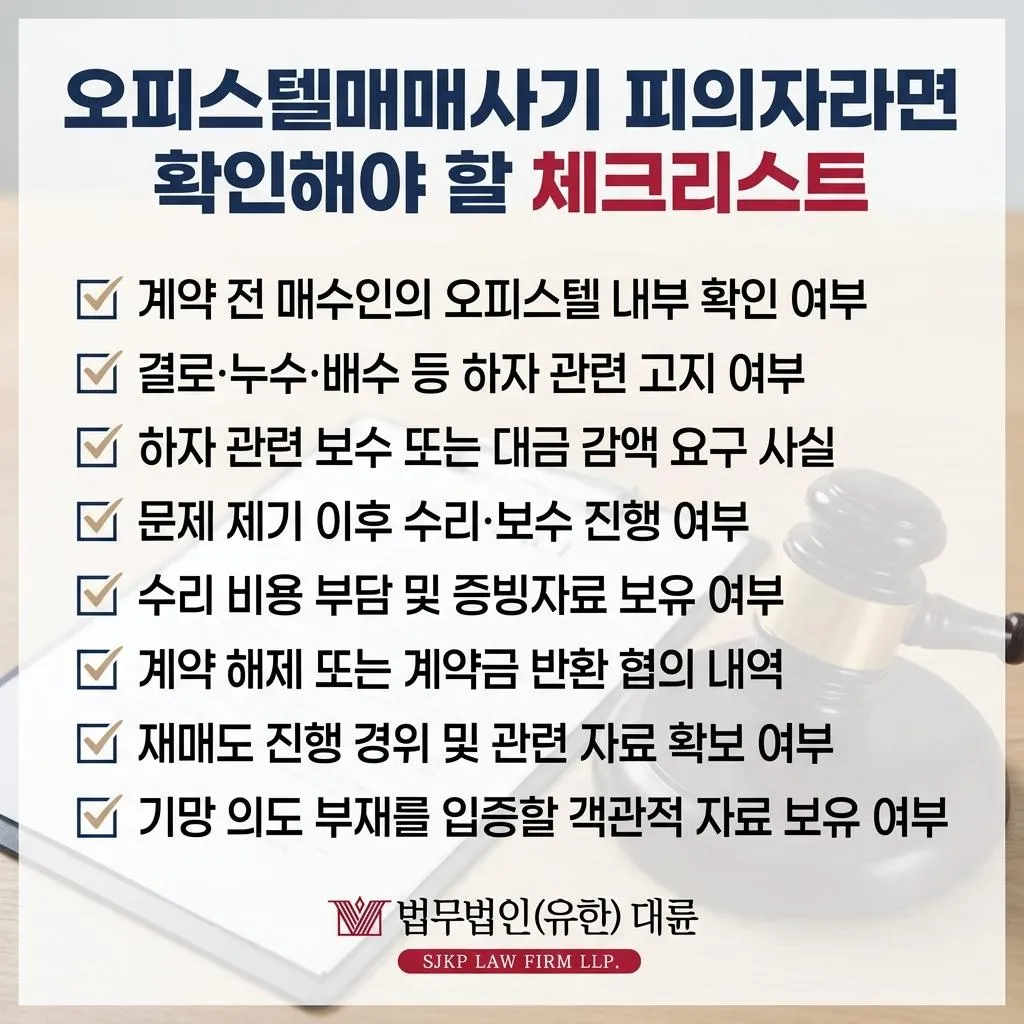
Frequently Asked Questions to Lawyers
Q. If an officetel sale fraud suspicion is recognized, what punishment will be imposed?
A. If the crime of fraud is recognized, under Article 347 of the Criminal Act the offender may be punished by imprisonment for not more than twenty years or a fine not exceeding 50 million won. However, the actual level of punishment is determined by comprehensively considering the amount of the loss, the circumstances of the offense, whether the loss has been recovered, whether a settlement has been reached, and the like.
Q. In an officetel sale fraud case, can a charge of the crime of evading compulsory execution also be applied?
A. Yes. In connection with officetel sale fraud, if circumstances are confirmed in which property was transferred to the name of family members or acquaintances or concealed in order to avoid the return of the down payment or a liability for damages, a charge of the crime of evading compulsory execution may additionally be applied. Whether it is actually applied is judged by comprehensively reviewing the circumstances and timing of the disposal of the property, whether a debt exists, and the like.
Daeryun, the ninth-largest law firm in Korea (based on 2025 value-added tax filings with the National Tax Service), comprehensively reviews the circumstances of the conclusion of the contract, the defect assertions, the process of rescission of the contract, the point of the resale, and the like in officetel sale fraud cases.
Depending on the matter, criminal, civil, and real estate lawyers collaborate to analyze the contract, the KakaoTalk conversations, the defect-repair records, and the brokerage-process materials, and respond to the police questioning procedures.
If you have been suspected of officetel sale fraud, 🔗legal consultation reservation through which please review your current materials and confirm a solution.
This content is based on actual case studies of Daeryun Law LLC with some adaptations, and the copyright belongs to our firm.
Unauthorized reproduction, duplication, or distribution and other copyright infringements may result in legal action under applicable laws.










