




CONTENTS
- 1. The Client Who Sought a Criminal Lawyer After a Defamation Complaint Was Filed

- 2. The Assistance of an Attorney Specializing in Criminal Matters in Responding to the Defamation Complaint
- - Arguing That the Remarks Made by the Client Could Not Be Proven by Evidence
- - Arguing That There Was No Purpose of Disparaging the Company
- - Emphasizing That the Client Did Not Spread False Facts to Interfere With Business
- 3. The Result of Assisting the Client Facing the Defamation Complaint Risk, a Non-Prosecution Disposition
- - Can Voicing a Complaint Also Amount to Defamation?
- 4. If You Are in a Situation That Requires Defense Against a Defamation Complaint
- - Frequently Asked Questions Regarding Defamation Complaints

1. The Client Who Sought a Criminal Lawyer After a Defamation Complaint Was Filed

The circumstances the client faced, against whom a defamation complaint had been filed, were as follows.
The client had entered into a contract with a company and was conducting streaming broadcasts.
At first the client held regular meetings with the company and exchanged much discussion about broadcasting, which was the client's work, and the client also attended most of the meetings.
At a certain point, however, no meetings were held for several months, and although the client requested the company several times to hold a meeting, none was held.
In addition, even when the client asked about the company's circumstances, the only answer that came back from the company was that it had no obligation to inform the client, and as time passed it also became difficult to reach the company's representative.
Feeling frustrated, the client, wishing to communicate with the company's representative, spoke during a broadcast about the difficulty of reaching the company, about not knowing the plans going forward, and about dissatisfaction with the management.
The company then proceeded with a defamation complaint on the ground that the client had spoken content that was not true and had damaged the company's reputation, and a suspicion of interference with business was also added, on the ground that the client had even interfered with the company's business.
Having suddenly become entangled in a criminal case, the client came to an attorney specializing in criminal matters to find a way to respond.
2. The Assistance of an Attorney Specializing in Criminal Matters in Responding to the Defamation Complaint
In this case, in which the defamation complaint was at issue, the important questions were whether what the client said during the broadcast was indeed content that was not true, and whether the company's business had been interfered with as a result.
Accordingly, the attorney specializing in criminal matters began the response by examining the situation in which the client came to make the remarks about the company during the broadcast and the relationship between the client and the company at the time the problem arose.
 Arguing That the Remarks Made by the Client Could Not Be Proven by Evidence
In a situation in which communication with the company was not going well, the client, while conducting a broadcast, said, "I do not even know the plans going forward" and "Nothing about the operation is working."
Regarding this part, the criminal lawyer argued that these remarks were an expression of the client's thoughts and evaluation of the way the company was operated.
In other words, the lawyer emphasized that, because these were not specific facts whose truth or falsity could be proven through evidence but rather amounted to an expression of opinion, it was difficult to establish the crime of defamation by stating false facts.
The Supreme Court has in fact held as follows.
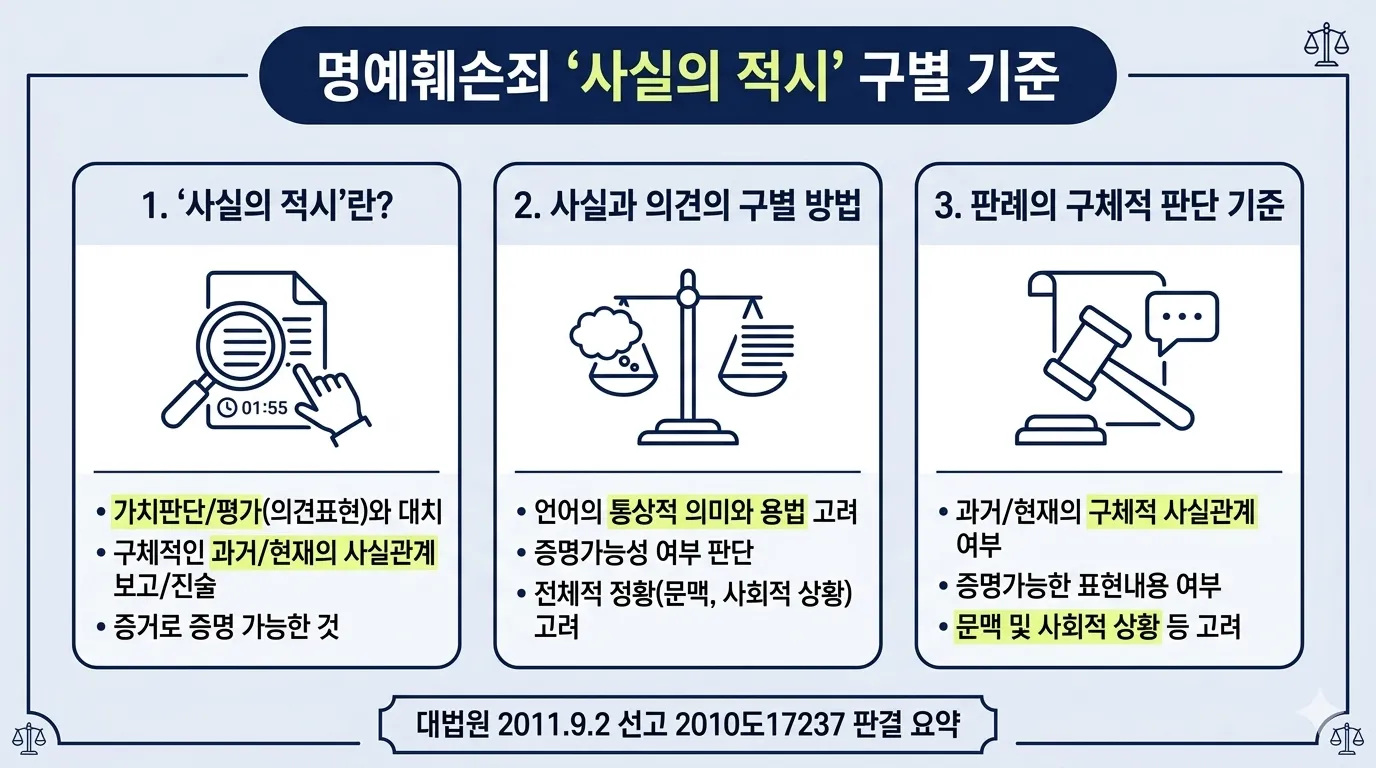
Supreme Court Decision 2010Do17237, September 2, 2011
In the crime of defamation, the ‘statement of fact’ is a concept opposed to the ‘expression of opinion’ whose content is a value judgment or evaluation, and it means a report or statement concerning a concrete past or present factual relationship in terms of time and space, referring to content whose expression can be proven by evidence; and in distinguishing whether the report or statement to be judged is fact or opinion, the determination must be made, by considering the overall circumstances, such as the ordinary meaning and usage of the language, the possibility of proof, the context in which the words at issue were used, and the social situation in which the expression was made.
Arguing That There Was No Purpose of Disparaging the Company
What the client said during the streaming broadcast was an expression of frustration with the situation in which communication with the company, including meetings, was not going well.
In connection with this, as a result of analyzing the broadcast video at issue in cooperation with an expert from the Digital Forensics Center, it was found that within the broadcast the client had precisely stated that communication with the company was not going well.
In addition, no remarks criticizing the company's representative or attacking his character were found.
On this basis, the lawyer emphasized that the client's remarks were not made for the purpose of disparaging the company but were merely an account of dissatisfaction with the situation the client was experiencing with the company.
Emphasizing That the Client Did Not Spread False Facts to Interfere With Business
The complainant company asserted that the client had spread false facts and thereby interfered with the internet business work conducted by the company.
To rebut this assertion, in cooperation with an expert from the Evidence Investigation Center, the lawyer collected evidence of the text messages in which the client had requested a meeting from the company several times, as well as evidence that the client had asked about the company's overall situation but had received no answer.
Supreme Court Decision 93Do1278, January 28, 1994
In the crime of interference with business, which is established by interfering with another person's business by means of spreading false facts, to spread false facts means to disseminate to an unspecified number of people facts whose content differs from the actual objective facts, and in particular, in such a case it is required that the actor actively recognized, at the time of the act, that the facts he spread were false.
In addition, on the basis of the above precedent, the lawyer actively argued that the client's remarks did not amount to the spreading of false facts, and that the crime of interference with business was also difficult to establish.
3. The Result of Assisting the Client Facing the Defamation Complaint Risk, a Non-Prosecution Disposition
The client, who faced the risk of punishment on suspicion of the defamation complaint and interference with business, was under suspicion that the remarks made during the broadcast amounted to false facts.
Accordingly, the criminal lawyer explained and argued, together with evidentiary materials and relevant precedents, that the client's remarks were an expression of opinion reflecting dissatisfaction with the company's operation, that there had been no purpose of disparaging the company, and that the client had not spread false facts to interfere with business.
As a result, the investigative authorities determined that the client's remarks were difficult to view as a statement of false facts or as interference with business, and the client received a non-prosecution disposition.
Can Voicing a Complaint Also Amount to Defamation?
In this case, the issues were whether the remarks the client mentioned during the broadcast were false facts, and whether there had been a purpose of disparaging the complainant company.
In fact, the crime of defamation is not established simply because a person said something negative about another.
Whether the content of the words was fact or false, whether it was a general opinion, and whether there was a purpose of demeaning the other person are examined.
If the elements of the offense are met, the following punishments apply.
Category | Content | Punishment |
Article 307 (1) of the Criminal Act | Where reputation is damaged by stating a fact | Imprisonment or imprisonment without labor for not more than two years, or a fine not exceeding 5 million won |
Article 307 (2) of the Criminal Act | Where reputation is damaged by stating a false fact | Imprisonment for not more than five years, suspension of qualifications for not more than ten years, or a fine not exceeding 10 million won |
Article 70 (1) of the Network Act | Where reputation is damaged by revealing a fact through the internet or the like | Imprisonment for not more than three years, or a fine not exceeding 30 million won |
Article 70 (2) of the Network Act | Where reputation is damaged by revealing a false fact through the internet or the like | Imprisonment for not more than seven years, suspension of qualifications for not more than ten years, or a fine not exceeding 70 million won |
As the internet develops, cases in which speaking through streaming broadcasts such as YouTube, and personal broadcasts or through SNS becomes an issue on suspicion of violating the Network Act are common.
However, as in the client's case, the crime of defamation is not established merely because a person voiced a general complaint or expressed an opinion based on his own experience.
4. If You Are in a Situation That Requires Defense Against a Defamation Complaint
A case in which a defamation complaint has been filed is not established for the general reason that a person said something negative about the other party.
As mentioned earlier, it is important to examine comprehensively not only the content of the remarks but also the situation at the time and the process by which the expression came to be made.
Daeryun, the ninth-largest law firm in Korea (based on 2025 value-added tax filings with the National Tax Service), cooperates with experts from the Digital Forensics Center and the Evidence Investigation Center to closely analyze the circumstances of a case and the related materials, and an attorney specializing in criminal matters provides a systematic response from the police investigation stage.
If you are currently in a situation that requires a response due to a defamation complaint, please review the direction of your response through a 🔗reservation for a legal consultation.
Frequently Asked Questions Regarding Defamation Complaints
Q. Can I become the subject of a defamation complaint merely for expressing an opinion?
A. If it amounts to a general expression of opinion or evaluation, there are cases in which the crime of defamation is not established. In practice, whether the content of the remark is a fact that can be objectively proven or is an individual's opinion or evaluation, is examined comprehensively.
Q. Can a defamation complaint proceed even if I stated a fact?
A. It is possible in some cases. Even where a person stated a fact, it may become a problem if it damaged the other party's reputation. However, the determination is made by also considering the circumstances of the remark, the public interest, and the manner of expression.
This content is based on actual case studies of Daeryun Law LLC with some adaptations, and the copyright belongs to our firm.
Unauthorized reproduction, duplication, or distribution and other copyright infringements may result in legal action under applicable laws.










