




CONTENTS
- 1. The Taxi Driver Client Who Wanted an Acquittal on the Drunk Driving Charge

- 2. The Drunk Driving Attorney's Assistance in Arguing for an Acquittal on the Drunk Driving Charge
- - The Drunk Driving Attorney's Assistance | ① Review of the Marginal Measured Figure
- - The Drunk Driving Attorney's Assistance | ② Organization of the Issue of the Rising Phase of the Blood Alcohol Concentration
- - The Drunk Driving Attorney's Assistance | ③ Pointing Out the Limits of the Intoxication Circumstances Materials
- 3. The Client Who Avoided a Disadvantage Through the Acquittal on the Drunk Driving Charge
- - The Standards for Punishment for Drunk Driving and the Level of Criminal Punishment
- - The Standards for License Suspension and Revocation for Drunk Driving
- - The Widmark Formula for Drunk Driving and the Determination of the Rising Phase
- 4. If You Wish to Contest a Drunk Driving Charge for an Acquittal?
- - A Checklist for Responding for an Acquittal
- - Frequently Asked Questions During a Drunk Driving Consultation

1. The Taxi Driver Client Who Wanted an Acquittal on the Drunk Driving Charge
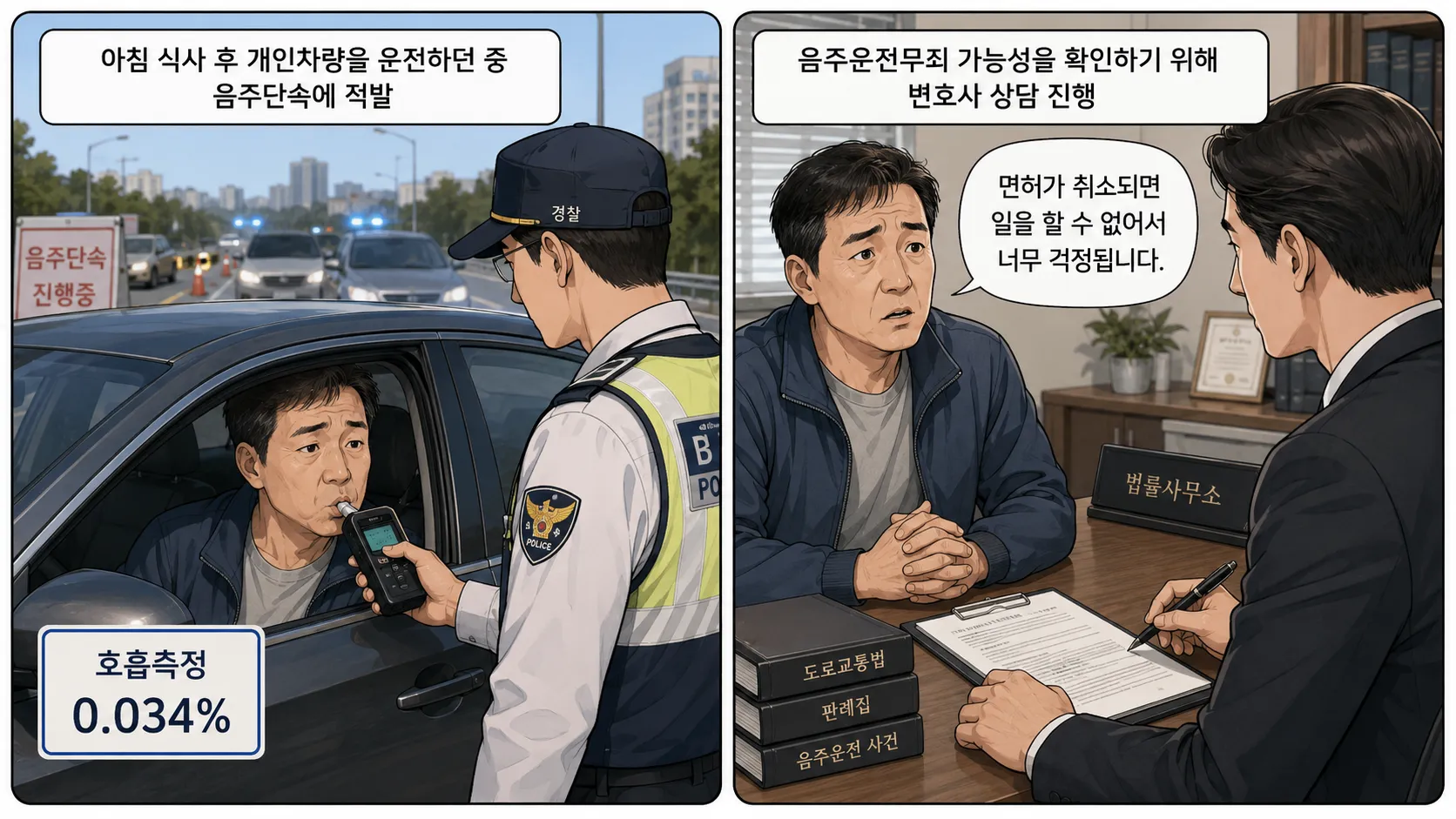
The client, after drinking at a breakfast gathering, was caught in a drunk driving check while driving the vehicle.
The breath test result at the time was a blood alcohol concentration of 0.034 percent.
Although this was a figure slightly exceeding 0.03 percent, the threshold for punishment for drunk driving under the Road Traffic Act, it was not a situation the client could take lightly.
The client had had a license revoked for drunk driving long ago and was greatly concerned that the license might be revoked this time as well.
Moreover, because the client worked as a taxi driver, license revocation could lead to a direct blow to the client's livelihood.
"If my license is revoked, I cannot work, so I am very worried."
Accordingly, the client sought a drunk driving attorney at the law firm Daeryun in order to confirm the possibility of an acquittal on the drunk driving charge.
2. The Drunk Driving Attorney's Assistance in Arguing for an Acquittal on the Drunk Driving Charge
In order to obtain an acquittal on the drunk driving charge, the drunk driving attorney, immediately after the consultation, confirmed in turn the circumstances of the check, the time of drinking, the time of driving, and the time of measurement.
Even though the measured figure exceeded the threshold for punishment, whether the figure at the actual time of driving was at or above the threshold had to be examined again.
In view of this, the Daeryun drunk driving attorney, after reviewing the records, prepared an argument for acquittal centered on the possibility of the rising phase of the blood alcohol concentration.
 The Drunk Driving Attorney's Assistance | ① Review of the Marginal Measured Figure
The Daeryun drunk driving attorney noted that the client's blood alcohol concentration exceeded the threshold for punishment by only 0.004 percent.
In view of this, the drunk driving attorney reviewed the possibility of the rising phase of the blood alcohol concentration and closely organized the relevant facts in order to argue that the figure at the time of measurement and the figure at the actual time of driving could differ.
In addition, by comprehensively reviewing the time of drinking, the time of driving, and the time of measurement, the attorney emphasized that it was difficult to conclude that the blood alcohol concentration at the time of driving was at or above the threshold for punishment.
Based on this, the drunk driving attorney developed an argument for acquittal to the effect that the facts charged had not been sufficiently proved.
The Drunk Driving Attorney's Assistance | ② Organization of the Issue of the Rising Phase of the Blood Alcohol Concentration
The drunk driving attorney closely confirmed the final time of drinking based on the check records and the payment history.
As a result, it was confirmed that the client had undergone the breath test at a point approximately 70 minutes after the last drink.
In view of this, the drunk driving attorney noted the possibility that the blood alcohol concentration at the time was still in the process of rising.
Because it is difficult to calculate the figure at the time of driving precisely during the rising phase of the blood alcohol concentration, the attorney emphasized that it could not be concluded, on the basis of the measured figure alone, that the blood alcohol concentration at the time of driving was at or above the threshold for punishment.
Based on this, the attorney actively argued that there was a possibility that the blood alcohol concentration at the actual time of driving had not reached 0.03 percent, the threshold for punishment.
The Drunk Driving Attorney's Assistance | ③ Pointing Out the Limits of the Intoxication Circumstances Materials
The drunk driving attorney also closely confirmed the content recorded in the intoxicated driver circumstances report.
This report recorded the client's manner of speech, gait, and facial color at the time of the check.
However, the report stated that the client's speech and conduct were in a 'good' condition.
There was also no content indicating that the client had been unable to speak properly, had caused an accident, or had driven dangerously.
On the basis of the above content, the drunk driving attorney argued that it could not immediately be found that the client's blood alcohol concentration had been 0.03 percent or higher at the time of driving.
3. The Client Who Avoided a Disadvantage Through the Acquittal on the Drunk Driving Charge
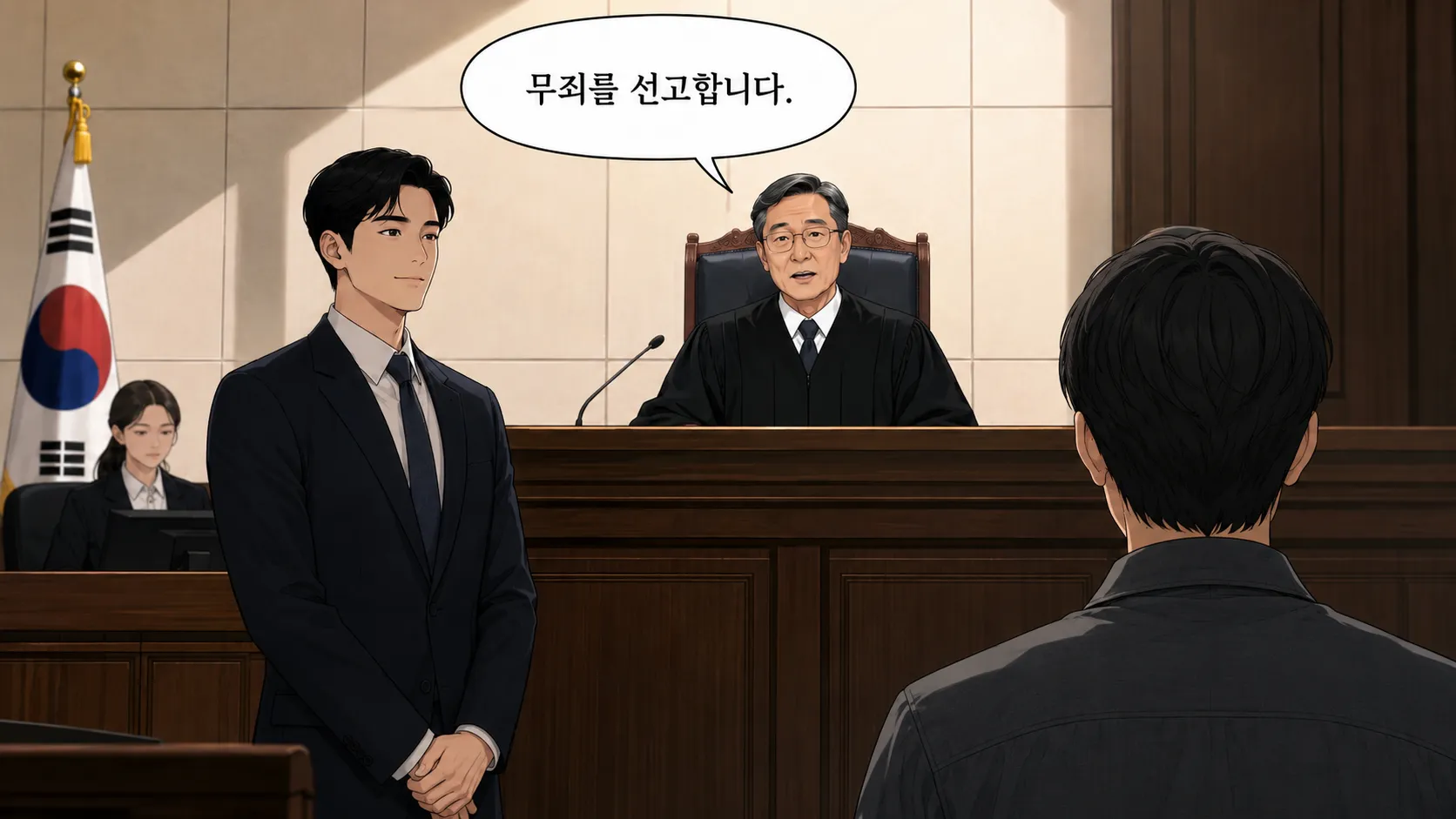
As a result of responding to the case with the goal of an acquittal on the drunk driving charge, the client escaped the crisis in which it could have become difficult to continue working owing to the drunk driving charge and was able to receive an acquittal.
The court did not immediately determine the state of intoxication at the time of driving on the basis of the breath test figure alone.
Examining together the final time of drinking, the time of measurement, and the condition at the time of the check that the Daeryun drunk driving attorney had argued, the court gave weight to the following circumstances.
The Standards for Punishment for Drunk Driving and the Level of Criminal Punishment
For drunk driving, the level of punishment varies according to the blood alcohol concentration figure.
Article 148-2, Paragraph 3 of the Road Traffic Act sets the standards for punishment by blood alcohol concentration range as follows.
Standards for Punishment for a First-Time Drunk Driving Offense
Blood alcohol concentration | Standard for criminal punishment |
|---|---|
0.2 percent or higher | Imprisonment for not less than two years and not more than five years, or a fine of not less than 10 million won and not more than 20 million won |
0.08 percent or higher but below 0.2 percent | Imprisonment for not less than one year and not more than two years, or a fine of not less than 5 million won and not more than 10 million won |
0.03 percent or higher but below 0.08 percent | Imprisonment for not more than one year, or a fine not exceeding 5 million won |
Where there is a record of a prior drunk driving offense, the punishment may become heavier.
Article 148-2, Paragraph 1 of the Road Traffic Act provides for the following standards for aggravated punishment where a person, having received a finalized sentence of a fine or heavier for drunk driving or the like, violates it again within 10 years.
Standards for Punishment for a Repeat Drunk Driving Offense
Blood alcohol concentration | Standard for punishment for a repeat offense within 10 years |
|---|---|
0.2 percent or higher | Imprisonment for not less than two years and not more than six years, or a fine of not less than 10 million won and not more than 30 million won |
0.03 percent or higher but below 0.2 percent | Imprisonment for not less than one year and not more than five years, or a fine of not less than 5 million won and not more than 20 million won |
In a drunk driving case, the range of criminal punishment is determined according to which range the measured figure falls into.
However, where the figure is close to the threshold for punishment, as in this case, the difference between the time of measurement and the actual time of driving must also be examined.
The Standards for License Suspension and Revocation for Drunk Driving
Drunk driving is accompanied by an administrative disposition on the driver's license, separately from criminal punishment.
A blood alcohol concentration of 0.03 percent or higher but below 0.08 percent is subject to license suspension, and 0.08 percent or higher is subject to license revocation.
Standards for the Administrative Disposition on a License for Drunk Driving
Standard | Administrative disposition |
|---|---|
Blood alcohol concentration of 0.03 percent or higher but below 0.08 percent | License suspension |
Blood alcohol concentration of 0.08 percent or higher | License revocation |
Occurrence of an accident causing personal injury while at a blood alcohol concentration of 0.03 percent or higher | |
Drunk driving again after refusal of a breath test, and the like |
Where driving is connected to one's livelihood, as in this case, license suspension or license revocation can have a great effect on daily life.
Therefore, in a drunk driving case, the possibility of an administrative disposition on the license must be confirmed early, together with criminal punishment.
The Widmark Formula for Drunk Driving and the Determination of the Rising Phase
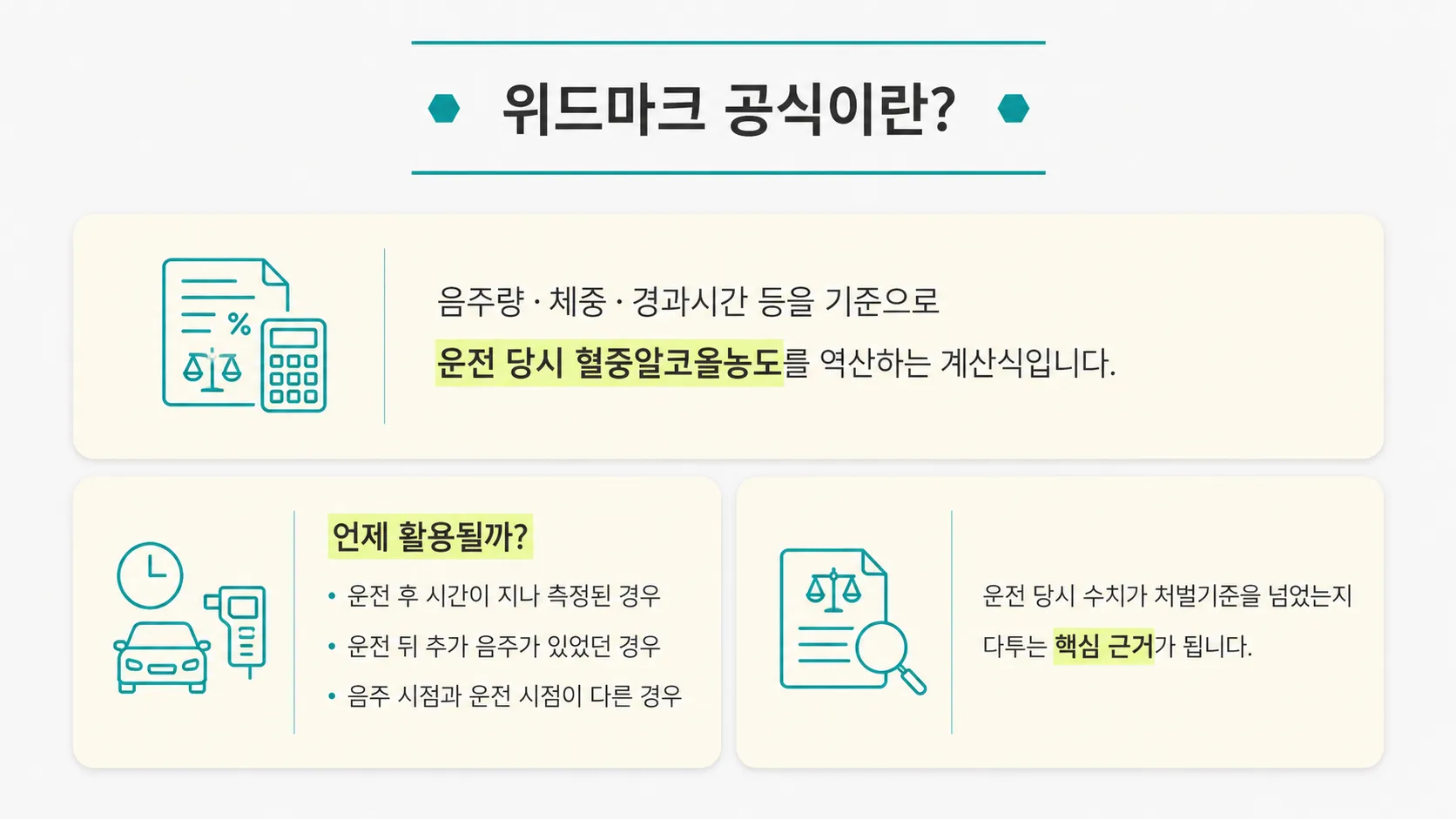
In a drunk driving case, the Widmark formula is used to estimate the blood alcohol concentration at the time of driving.
Because the breath test is often conducted after the actual driving has ended, the measured figure is not immediately concluded to be the figure at the time of driving.
The Widmark formula is a method of calculating the blood alcohol concentration based on the amount of alcohol consumed, body weight, sex, the time elapsed after drinking, and the rate of alcohol breakdown.
Widmark formula: C = A ÷ (P × R) - βt
Symbol | Meaning |
|---|---|
C | Estimated blood alcohol concentration |
A | Amount of alcohol consumed |
P | Body weight |
R | Distribution coefficient according to sex and physical condition |
β | Rate of alcohol decrease per hour |
t | Time elapsed after drinking |
For a certain period of time after drinking, the blood alcohol concentration can rise.
This period is called the rising phase of the blood alcohol concentration, and even if the figure at the time of measurement exceeded 0.03 percent, the possibility that it had not reached the threshold for punishment at the moment of driving can be contested.
4. If You Wish to Contest a Drunk Driving Charge for an Acquittal?
In order to contest a drunk driving charge for an acquittal, the time of drinking, the time of driving, and the time of measurement must first be confirmed.
If the figure is a case close to the threshold, the time of measurement and the time of driving must be compared, and it must also be examined whether the notification of a re-measurement or blood sampling was properly given during the check.
A Checklist for Responding for an Acquittal
Checklist item | Content to confirm | Check |
|---|---|---|
Final time of drinking | When the last drink was consumed | □ |
Time of driving | When the actual driving began and ended | □ |
Time of measurement | At what time the breath test was conducted | □ |
Measured figure | How much the blood alcohol concentration figure differs from the threshold for punishment | □ |
Whether it was the rising phase | Whether the blood alcohol concentration may have been rising at the time of measurement | □ |
Check procedure | Whether there is anything to contest in the request for a re-measurement, the notification of blood sampling, or the signing process | □ |
Circumstances materials | How the speech and conduct, gait, complexion, and whether there was an accident were recorded | □ |
Objective materials | Whether there are receipts, card payment records, CCTV, or navigation records | □ |
License disadvantage | Whether license suspension or revocation has an effect on one's livelihood | □ |
In order to contest for an acquittal, the above items must first be organized.
This is because whether it was the rising phase of the blood alcohol concentration can be examined according to how the time of drinking, the time of driving, and the time of measurement were connected.
Whether the request for a re-measurement or the notification of blood sampling was properly given during the check, and whether there is anything exaggerated or contestable in the intoxication circumstances materials, must also be examined.
In addition, where driving is connected to one's livelihood, it is necessary to quickly confirm the risk of license suspension or revocation, together with the possibility of criminal punishment.
The drunk driving attorney of Daeryun, the ninth-largest law firm in Korea (based on 2025 value-added tax filings with the National Tax Service), reviews the parts of a case that can be contested, based on the measured figure, the time of drinking, the time of driving, and the check records.
Where necessary, it collaborates with the Evidence Investigation Center and the Digital Forensics Center to analyze case materials such as CCTV, movement routes, and statement materials.
If you are facing an investigation on a drunk driving charge or wish to confirm the possibility of an acquittal on a drunk driving charge, you may confirm the materials to prepare and the direction of the response in your current situation through a 🔗reservation for a legal consultation.
Frequently Asked Questions During a Drunk Driving Consultation
Q. Is an acquittal on a drunk driving charge possible if the blood alcohol concentration figure is low?
A. An acquittal on a drunk driving charge is not granted merely on the ground that the figure is low, but if the figure is close to the threshold for punishment, it can be contested whether the blood alcohol concentration at the time of driving was at or above the threshold. It must be confirmed how the time of drinking, the time of driving, and the time of measurement were connected, and if there is a possibility of the rising phase of the blood alcohol concentration, it can become a key issue in the argument for acquittal.
Q. What materials are needed to contest a drunk driving charge for an acquittal?
A. In order to contest for an acquittal, materials that can confirm the final time of drinking, the time of driving, and the time of the breath test are needed. Receipts, card payment records, a notification of the result of the drunk driving check, an intoxicated driver circumstances report, CCTV, and navigation records may be used, and they help in examining whether the figure at the time of driving and the figure at the time of measurement were the same.
This content is based on actual case studies of Daeryun Law LLC with some adaptations, and the copyright belongs to our firm.
Unauthorized reproduction, duplication, or distribution and other copyright infringements may result in legal action under applicable laws.










