




CONTENTS
- 1. Overview of the Case in Which the Client Came to Be Suspected of Assault

- 2. Three Strategies to Defend Against Criminal Punishment for Assault
- - Criminal Defense Lawyer Strategy 1) The Client's Conduct Was a Justifiable Act
- - Criminal Defense Lawyer Strategy 2) The Degree of the Act Was Minor and Reasonable
- - Criminal Defense Lawyer Strategy 3) Comprehensively Presenting the Circumstances of the Offense and Emphasizing the Need for Leniency
- 3. The Result of Assistance in the Assault Case, a Judgment of Suspension of Sentencing
- 4. The Level of Criminal Punishment for Assault and Points to Note When Responding
- - Points to Note When Responding to a Suspicion of Assault
- - Why the Assistance of a Criminal Defense Lawyer Is Needed

1. Overview of the Case in Which the Client Came to Be Suspected of Assault
The client who sought a criminal defense lawyer on suspicion of assault was a man in his seventies.
The client had usually spent much of his time at the senior center next to the playground, and on the day of the incident he had also spent time at the senior center.
The problem began when the profanity of some adolescents was heard through the window of the senior center.
Shocked that the still-young adolescents were using such severe profanity, the client went outside the senior center and admonished them.
However, one of the adolescents who was being admonished (hereinafter the counterpart) approached the client in a threatening manner.
The counterpart threatened the client, saying, 'Since we are juveniles below the age of criminal responsibility, it does not matter even if we hit someone,' and in the course of moving to avoid him, the client pushed the counterpart's face away with his hand.
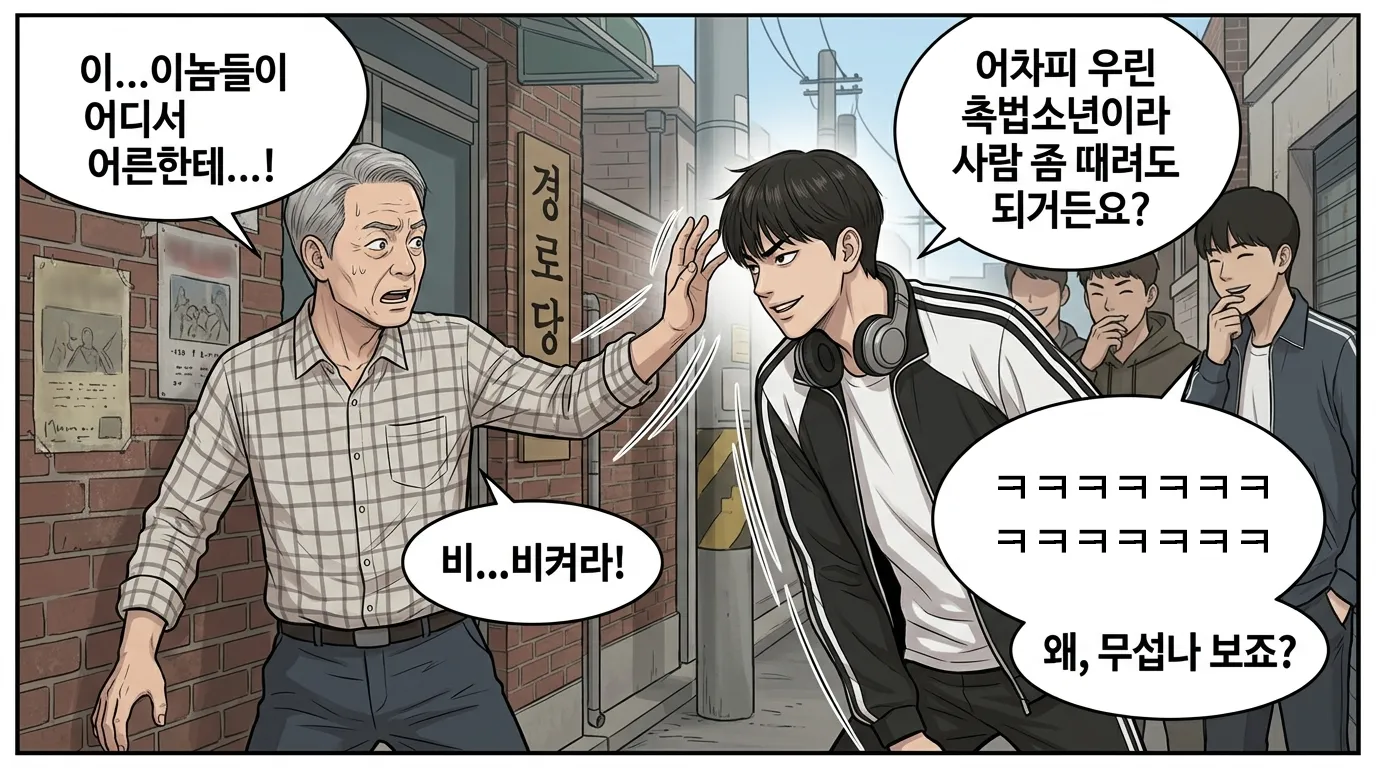
In response, the counterpart reported to the police, claiming that the client had exercised force against him.
Having suddenly had a criminal complaint filed against him by the counterpart, who was young enough to be his grandson, the client requested a consultation with a criminal defense lawyer.
2. Three Strategies to Defend Against Criminal Punishment for Assault

The criminal defense lawyer conducted several thorough consultations with the client, who faced the risk of punishment on suspicion of assault.
In this process, the criminal defense lawyer quickly grasped the facts of the case, collected evidentiary materials, and established a strategy to defend against criminal punishment.
The key was to objectively establish that the client had acted defensively and that, since the resulting injury was minor, the motive for the act could also be taken into account.
The criminal defense lawyer worked with the 🔗Evidence Investigation Center to collect the following evidentiary materials and assist the client.
| Evidentiary material | Strategy for use |
|---|---|
| Senior center CCTV | To confirm the adolescents' profanity and disturbance immediately before the incident and the circumstances that led the client to admonish them |
| Playground and nearby storefront CCTV | To secure the entire flow of the incident and emphasize that this was accidental contact rather than a one-sided assault. To establish that the adolescent first approached in a threatening manner and that the contact occurred while the client was stepping back and moving away |
| Witness statements | To establish, through the statements of senior center users, residents, and others, that the counterpart first showed a threatening attitude |
| Police statement record | To establish that the client's statement was maintained consistently from the initial reporting stage |
| The counterpart's medical certificate of injury | If the degree of injury is minor or the treatment period is short, to be used as a factor favorable to sentencing |
| Materials on the client's age and life record | To be submitted as sentencing materials showing that he is an elderly person in his seventies with no criminal history who has lived diligently |
 Criminal Defense Lawyer Strategy 1) The Client's Conduct Was a Justifiable Act
Article 20 of the Criminal Act provides that a justifiable act that does not violate socially accepted norms is not punishable.
An act performed pursuant to statutes or in the course of duties, or any other act that does not violate the social rules, is not punishable.
Based on the above legal principle, the criminal defense lawyer emphasized that the client's conduct had been a defensive measure taken to escape a threatening situation and to restrain rude conduct.
In addition, the lawyer specifically established the facts that the client had, from the outset, sought to resolve the situation through amicable dialogue, but had unavoidably responded owing to the counterpart's continued profanity and threats.
At this point, the CCTV footage and witness statements collected in the early stage of the case were used as evidentiary materials.
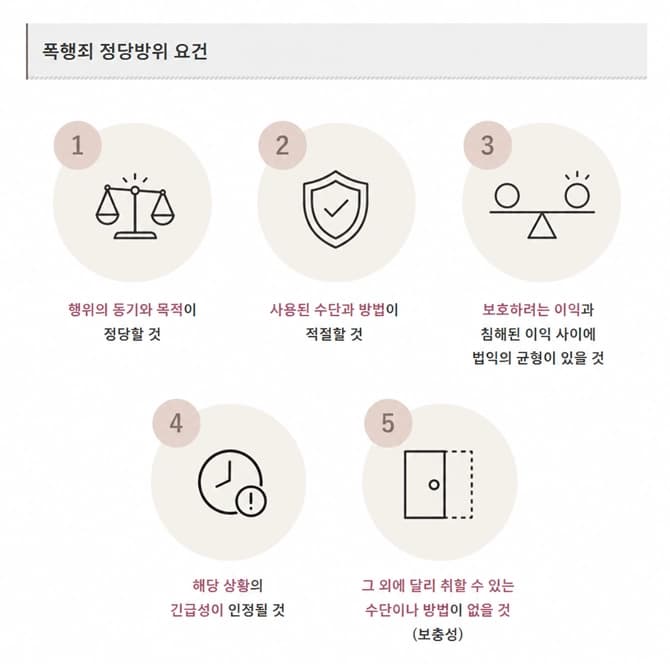
Through this evidence, the criminal defense lawyer actively argued that the client's act was permissible under the social rules, satisfying the legitimacy of the motive and purpose, the reasonableness of the means, and the balance of legal interests, and that its unlawfulness was therefore precluded.
Criminal Defense Lawyer Strategy 2) The Degree of the Act Was Minor and Reasonable
In a situation in which the counterpart was approaching in a threatening manner, the client did no more than push the face area once with his hand in order to restrain him, and he did not strike the counterpart or make repeated physical contact.
This was not an active attacking act intended to harm the counterpart, but a minimal defensive act to secure his own safety in a sudden situation.
In addition, during the investigation the counterpart failed to submit objective materials showing that he had suffered bodily injury, and no evidence supporting the intensity of the force, such as a medical certificate or photographs of the wound, was confirmed.
Accordingly, the criminal defense lawyer actively established that the client's act was difficult to regard as an exercise of excessive physical force beyond the bounds permissible under generally accepted social norms.
Furthermore, since courts in similar cases judge minor physical contact arising in the course of admonishment or restraint by comprehensively considering the degree and circumstances of the act, the lawyer developed the defense argument, emphasizing that the reasonableness and proportionality of the act should likewise be recognized in the present matter.
At this point, the criminal defense lawyer cited Daegu District Court Western Branch Decision 2022Gojeong627, May 10, 2023, in which a suspension of sentencing was rendered on the ground that the degree of assault was minor in a case where the accused pushed the neck area of a young victim twice for the purpose of disciplining the victim.
The criminal defense lawyer argued that the client's case was similar to that matter and that, accordingly, the client should likewise receive the same judgment, asserting that the degree of assault was minor and that there had been no intent.
Criminal Defense Lawyer Strategy 3) Comprehensively Presenting the Circumstances of the Offense and Emphasizing the Need for Leniency
The criminal defense lawyer emphasized that, even if the client's act were regarded as constituting assault, this was a matter warranting leniency in light of the circumstances in which the incident arose and the circumstances after the act.
The client was a first-time offender with no particular criminal history or investigation record, an elderly citizen who had diligently continued his social life.
In addition, the incident had arisen accidentally in the course of trying to correct the adolescents' profanity and rude conduct, and there had been no intent whatsoever to cause serious harm to the counterpart.
Immediately after the incident, the client did not hide his conduct or leave the scene; rather, out of concern about further delinquency by the adolescents, he personally reported the matter to the police and requested guidance.
The criminal defense lawyer comprehensively organized and submitted the sentencing factors below that applied to the client, actively arguing that the client had a low risk of reoffending and that there were sufficient circumstances warranting consideration.
- Where the assault was committed with willful negligence
- Where the degree of assault was minor
- Where only minor injury resulted
- Where there are circumstances warranting consideration in how the person came to participate in the offense
- Where the victim also bears responsibility for the occurrence of the incident or the expansion of the harm
- Where the resulting death did not arise from the defendant's direct act
- Where there is a hearing or speech disability
- Where the offense was committed in a state of mental or physical weakness (not attributable to the person)
- Where the person turned himself in or made an internal report
- Where the victim does not wish for punishment
- Where substantial recovery of the harm has been achieved
- Where the person participated passively in the offense
- Where the offense was committed in a state of mental or physical weakness (attributable to the person)
- Where the person sincerely reflects after the offense
- Where the person is a first-time offender with no history of criminal punishment
- Where a considerable level of recovery of the harm has been achieved
3. The Result of Assistance in the Assault Case, a Judgment of Suspension of Sentencing
With the assistance of the criminal defense lawyer, the client received a judgment of suspension of sentencing on the suspicion of assault.
The court rendered the judgment of suspension of sentencing, taking into account that the client was a first-time offender, that the degree of assault against the counterpart was very minor, and that there were circumstances warranting consideration in how this offense arose.
Having escaped the risk of an actual sentence and returned to daily life, the client expressed his gratitude to the criminal defense lawyer.
4. The Level of Criminal Punishment for Assault and Points to Note When Responding
The crime of assault is established where force is exercised against a person's body.
Here, force does not necessarily mean only assault strong enough to cause an injury.
It includes any act that applies physical contact to the counterpart's body and may infringe the safety of the body.
Therefore, acts such as pushing, pulling, or throwing objects may also, depending on the circumstances, be recognized as the crime of assault.
Where the crime of assault is established, under Article 260 of the Criminal Act it may be punishable by imprisonment for not more than two years, a fine not exceeding 5 million won, detention, or a minor fine.
At this point, not all physical contact is recognized as the crime of assault.
If the act is one to prevent a present and unjust infringement of one's own or another person's legal interests, self-defense may be recognized.
However, where the act exceeds the minimum scope necessary for defense, self-defense may not be recognized, so it is important to objectively establish the circumstances at the time and the reasonableness of the act.
Points to Note When Responding to a Suspicion of Assault
□ Did you refrain from any direct dispute or further contact with the counterpart?
□ Have you secured evidentiary materials such as CCTV and dashboard camera footage?
□ Have you organized the circumstances of the incident in chronological order?
□ Did you sufficiently review the direction of your statement before the police investigation?
□ Have you reviewed the possibility that it constitutes self-defense or a defensive act?
□ Have you confirmed whether a settlement was reached and the means of recovering the harm?
If even one of the items in the above checklist applies, a careful approach is needed from the early stage.
In an assault case, the judgment of the investigative authorities may vary depending on the circumstances at the time and the evidentiary materials, so it is important to organize the facts objectively and to maintain a consistent statement.
In particular, in a matter where self-defense or a defensive act is at issue, it is necessary to secure objective materials such as CCTV and witness statements in advance.
In other words, since whether charges are brought and the level of the disposition may vary depending on how the case proceeds in its early stages, it is important to establish a systematic response strategy.
Why the Assistance of a Criminal Defense Lawyer Is Needed
In a suspicion of assault, the direction of the case may vary depending on objective evidence such as CCTV, witness statements, and a medical certificate of injury, so the initial response is very important.
Even in a situation where self-defense or a justifiable act may be recognized, if this is not effectively explained and established to the investigative authorities, it may lead to an unfavorable outcome.
Therefore, it is necessary to carefully review the facts and evidentiary materials before making a statement and to discuss the direction of the response with a criminal defense lawyer.
Daeryun, the ninth-largest law firm in Korea (based on 2025 value-added tax filings with the National Tax Service), works with the Evidence Investigation Center and the Digital Forensics Center, centered on its 🔗attorneys specializing in criminal matters, to establish a response strategy tailored to each case.
If, like the client in the present case, you are facing an investigation on a suspicion of assault, rather than judging alone, please begin your response through a 🔗legal consultation reservation.
This content is based on actual case studies of Daeryun Law LLC with some adaptations, and the copyright belongs to our firm.
Unauthorized reproduction, duplication, or distribution and other copyright infringements may result in legal action under applicable laws.










