




CONTENTS
- 1. The Account of the Client Who Came Suspected of the Crime of Interference With Business

- 2. The Assistance for a Client at Risk of the Crime of Interference With Business
- - Arguing That the Act of Not Handing Over a Password Does Not Establish the Crime of Interference With Business
- - Emphasizing That the Client Had Responded to the Complainant's Work Request After Leaving the Company
- - Arguing That the Act of Saving Work Files Does Not Constitute Theft
- 3. The Result of the Assistance in the Crime of Interference With Business Case, a Non-Referral Decision
- - In What Cases Is the Crime of Interference With Business Established?
- 4. The Need for an Early Response in a Crime of Interference With Business Case
- - Frequently Asked Questions

1. The Account of the Client Who Came Suspected of the Crime of Interference With Business

The account of the client who sought a criminal defense lawyer on suspicion of the crime of interference with business was as follows.
The client had worked for a long time as a design employee at a company and was in charge of marketing and public relations work as a whole.
However, the client related that an employee with whom the client ordinarily had conflict came to take charge of overall work, and at the same time, as the company's payment of wages became unstable due to management difficulties, the client decided to leave the company.
After thus leaving the company, the client came to file a complaint for unpaid wages against the company and proceed with the related procedures over the matter of unpaid severance pay.
In the meantime, the complainant filed a complaint for the crime of interference with business, claiming that the client had not properly handed over the client's own work to the successor upon leaving the company and had interfered with normal work by not providing the passwords for the program accounts used at the company.
In addition, it was a situation in which the complainant also asserted a suspicion of theft, claiming that the client had saved to a personal laptop and taken out various files that the client had managed in the course of work upon leaving the company.
However, the client appealed to a sense of unfairness that, for about one year after leaving the company, the client had never been contacted regarding any problem arising from the handover or regarding the return of files, and that the client had rather come to be criminally complained of after proceeding with the complaint for unpaid wages.
2. The Assistance for a Client at Risk of the Crime of Interference With Business
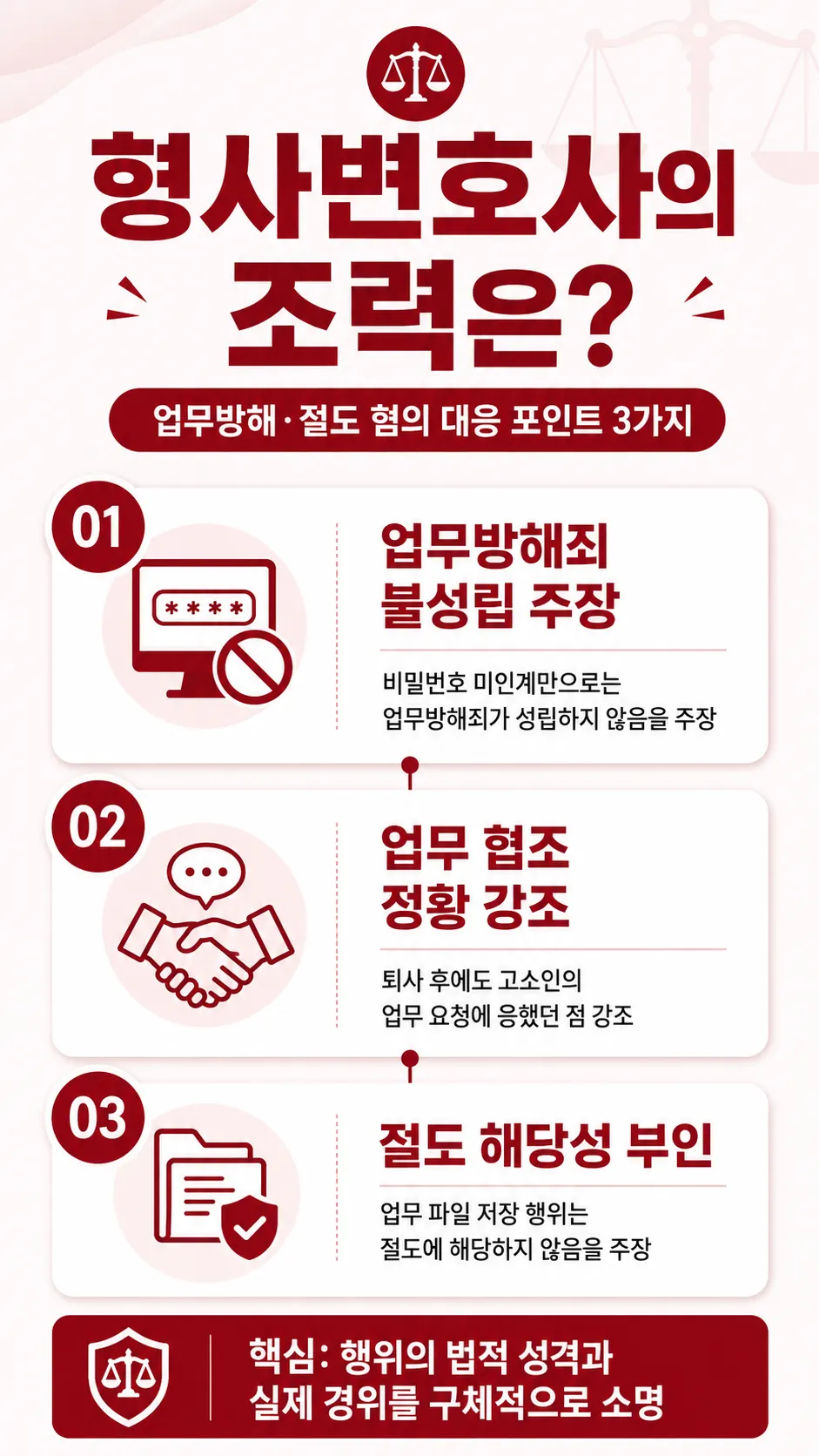
This case, in which the client was suspected of the crime of interference with business and of theft, required an assessment of whether one could be suspected of interference with business on the ground of not having disclosed a password upon leaving the company.
And it was necessary to examine together whether the theft offense applied to saving company files on a personal computer.
 Arguing That the Act of Not Handing Over a Password Does Not Establish the Crime of Interference With Business
The complainant claimed that the client had interfered with the company's work by not disclosing to the successor the passwords for the accounts needed for company work.
However, the victim company had a system in which the accounts and passwords needed for work were managed in an Excel file and shared with employees.
In fact, the firm's Digital Forensics Center secured the content of the in-house messenger through which the company's employees had communicated by exchanging the Excel file.
In addition, the lawyer argued that because the accounts used at the company used an email address owned by the company, access and use were possible through an authentication procedure even without knowing the password.
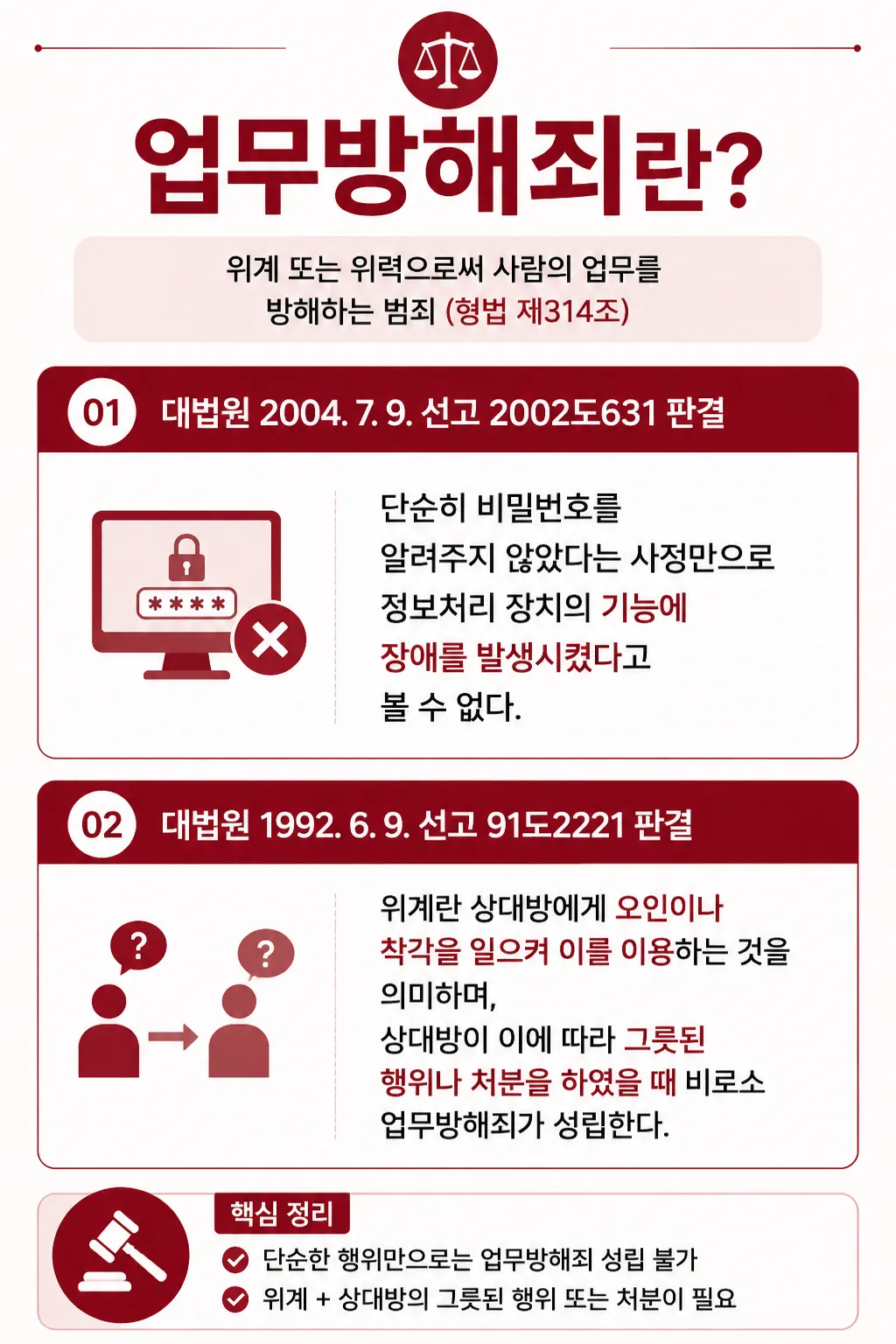
In this regard, the Supreme Court held that, because the password of the main computer is no more than a security means for accessing the system, it cannot be found that a disturbance to the function of an information processing device was caused solely on the circumstance that a password was not disclosed, and thus the crime of interference with business by disturbance to a computer or the like is not established (Supreme Court Decision 2002Do631, July 9, 2004).
In addition, the Supreme Court held that the deceit referred to in the crime of interference with business by deceit means causing a misperception or mistake in the other party and making use of it, and that the crime of interference with business is established only when the other party performs a mistaken act or disposition accordingly (Supreme Court Decision 91Do2221, June 9, 1992).
Emphasizing That the Client Had Responded to the Complainant's Work Request After Leaving the Company
Even after leaving the company, the client received a request from the complainant and the overall manager to help a little more with the work the client had originally been in charge of, and supported the work in the form of remote work about once a week.
At the time, the complainant made a proposal, stating that the daily wage for helping with the work would be paid together with the severance pay, and asking the client to express an intention not to seek punishment regarding the complaint for unpaid wages.
Accordingly, the criminal defense lawyer, in collaboration with an evidence investigation specialist, secured and submitted the work emails and messenger conversation content from that time.
The lawyer emphasized that, if it had been clear that the company had suffered harm because the handover was not performed, the company would not have requested work support from the client who had left, and, along with this, emphasized that there had been no intention to interfere with business.
Arguing That the Act of Saving Work Files Does Not Constitute Theft
The complainant claimed that the client's act of saving to a personal laptop and taking out the work files and materials that the client had used while employed constituted theft.
However, because the client's departure was scheduled, the client, at the manager's request, carried out the task of moving the materials on the computer the client had been using to a computer within the team, and employees in the same department also helped with this task together.
The criminal defense lawyer secured the statements of the employees who had worked together at the time and established that the client had left the company while leaving behind the materials the company would use.
In this regard, the Supreme Court in fact held that information stored on a computer does not itself constitute property, and even if it is copied or printed out, the victim's possession or possibility of use is not reduced, so the crime of larceny cannot be found to be established (Supreme Court Decision 2002Do745, July 12, 2002).
Accordingly, the criminal defense lawyer, along with the above holding, actively argued that the client's act was a duplication of materials generated in the course of work and did not infringe the company's possession, so the theft suspicion could not be found.
3. The Result of the Assistance in the Crime of Interference With Business Case, a Non-Referral Decision
In this case in which the client was suspected of the crime of interference with business, the key was that the client had caused a disruption to the company's normal operation by not providing the passwords for the in-house program accounts and by not properly performing the handover.
However, the investigative authorities stated that it was clear that, even immediately after the client left the company, the company had updated posts on the in-house program, and that no fact of having changed the passwords was confirmed.
In addition, judging that it was clear that theft also had no object, they decided on non-referral for the interference with business and the theft.
In What Cases Is the Crime of Interference With Business Established?
The crime of interference with business is not established merely on the ground that discomfort was caused to the other party.
The Criminal Act provides for the crime of interference with business as follows.
Category | Punishment |
Where a person interferes with another's business by deceit or force | Imprisonment for not more than five years or a fine not exceeding 15 million won |
Where a person interferes with business by causing a disturbance to an information processing device | Imprisonment for not more than five years or a fine not exceeding 15 million won |
Basis provision | Article 314 of the Criminal Act |
For the crime of interference with business to be established, another's business must be interfered with by deceit or force.
Here, 'deceit' means causing a misperception, mistake, or ignorance in the other party and making use of it, and 'force' means any and all power that can suppress or confuse a person's free will.
In addition, the crime of interference with business is difficult to find on the basis of an ordinary conflict or discomfort alone. (Supreme Court Decision 2003Do5004, March 25, 2005)
Furthermore, the crime of interference with business may also be established where a person interferes with business by causing a disturbance to an information processing device.
Ultimately, the crime of interference with business is judged by comprehensively reviewing what actual effect there was on the other party's normal performance of business and whether deceit or force existed.
4. The Need for an Early Response in a Crime of Interference With Business Case
A crime of interference with business case is not one in which the conclusion is set solely on the circumstance that a password was not disclosed or that work materials were kept.
Since the judgment may vary depending on whether a result of interference with business actually occurred and how the related materials were managed, the process of accurately organizing the facts from the early stage is important.
Daeryun, the ninth-largest law firm in Korea (based on 2025 value-added tax filings with the National Tax Service), forms a specialist task force centered on a criminal defense lawyer suited to the case and provides assistance in the case.
If you are facing an investigation on suspicion of the crime of interference with business or theft, or if you are in a situation requiring a response, please receive help through an 🔗attorney legal consultation reservation.
Frequently Asked Questions
Q. If I am complained of for the crime of interference with business, must I necessarily undergo a police investigation?
A. The fact that a complaint for the crime of interference with business has been received does not necessarily mean that an in-person investigation will take place. Depending on the content of the case and the materials submitted, the matter may proceed by way of a written investigation, or a procedure of establishing the facts through the submission of additional materials may take place.
Q. Is the crime of interference with business case concluded if I settle with the victim company?
A. A settlement with the victim company can be an important factor in the judgment of the investigative authorities. However, because the crime of interference with business is not necessarily terminated by the fact that a settlement has been reached, it is important to respond by comprehensively reviewing the specific facts and the evidence.
This content is based on actual case studies of Daeryun Law LLC with some adaptations, and the copyright belongs to our firm.
Unauthorized reproduction, duplication, or distribution and other copyright infringements may result in legal action under applicable laws.










