




CONTENTS
- 1. The Client Subject to a Criminal Complaint for Occupational Breach of Trust

- 2. Organizing the Response Measures to the Occupational Breach of Trust Allegation
- - Criminal Defense Lawyer's Assistance 1) Establishing the Lawful Disciplinary Procedure
- - Criminal Defense Lawyer's Assistance 2) Arguing the Possibility of a Retaliatory Complaint
- - Criminal Defense Lawyer's Assistance 3) Rebutting the Counterpart's Assertions
- 3. The Result of the Response to the Occupational Breach of Trust Allegation, a Non-Referral Decision
- 4. The Elements for Establishing Occupational Breach of Trust and the Level of Punishment
- - Evidentiary Materials for Rebutting the Occupational Breach of Trust Allegation
- - If You Need the Assistance of a Criminal Defense Lawyer

1. The Client Subject to a Criminal Complaint for Occupational Breach of Trust
The client, against whom a complaint had been filed on suspicion of occupational breach of trust, was a man in his fifties who was a representative director.
As a matter of company welfare, the client had been supporting employees so that they could have lunch using the corporate card.
In the meantime, the client discovered that one employee (hereinafter the counterpart) was continuously using the corporate card for personal purposes.
The client, who was on a business trip at the time, cautioned the counterpart through a messenger not to use the corporate card for personal purposes in the future.
However, the counterpart continued to use the corporate card for personal purposes thereafter, and in the end the client imposed disciplinary action on the counterpart in accordance with the company's internal rules.
The day after receiving the disciplinary action, the counterpart did not come to work and accused the client to the police, claiming that the client had committed occupational breach of trust.

The client, who had suddenly come to face the risk of criminal punishment, requested a consultation with a criminal defense lawyer.
2. Organizing the Response Measures to the Occupational Breach of Trust Allegation

The client, who had been accused on suspicion of occupational breach of trust, immediately requested the assistance of a criminal defense lawyer.
The criminal defense lawyer conducted several consultations with the client and identified the key issues of the case as follows.
| Key Issue | Specific Content |
|---|---|
| 1. Whether the exercise of disciplinary authority constitutes a breach-of-trust act | Whether the client's act of disciplining the employee was an act harming the company's interests, or a legitimate exercise of personnel authority |
| 2. Whether damage to the company arose | Occupational breach of trust can be established only where pecuniary damage arises to the company or there is a risk of such damage arising |
| 3. The motive for the complaint and the reliability of the statement | Whether it was a retaliatory complaint, given that the counterpart made the accusation immediately after the disciplinary action |
 Criminal Defense Lawyer's Assistance 1) Establishing the Lawful Disciplinary Procedure
The criminal defense lawyer organized the point that the client had not sanctioned the employee out of personal feelings, but had imposed disciplinary action after giving warnings and cautions step by step in accordance with the company's internal rules.
Submitting the disciplinary materials and the internal regulations, the lawyer established that the client's act had been a legitimate exercise of personnel authority as a representative director.
In this process, the lawyer proved the facts by submitting as evidence the messenger conversation records in which the client had carefully admonished and cautioned the counterpart before the disciplinary action, as well as the record of the corporate card that the counterpart had actually used personally.
Criminal Defense Lawyer's Assistance 2) Arguing the Possibility of a Retaliatory Complaint
The criminal defense lawyer analyzed the circumstances in which the counterpart, immediately after receiving the disciplinary action, did not come to work and promptly proceeded to make the accusation.
In this process, combining the record of the corporate card that the counterpart had used personally, the warning records, and the course of the disciplinary procedure, the lawyer argued that the complaint had originated from dissatisfaction with the disciplinary action.
At this time, the criminal defense lawyer submitted, as key evidence, the record of a threatening text message in which the counterpart had said to the client, ‘You committed breach of trust, director. I am going to report this.’
Criminal Defense Lawyer's Assistance 3) Rebutting the Counterpart's Assertions
The counterpart asserted, ‘The client entered into a contract with a company operated by his own family, using company funds, at an amount higher than the market price, and thereby caused a loss to the company,’ but this was not true.
The client had not transacted with a company operated by family, and had moreover transacted at a reasonable amount at the market level through a normal bidding procedure.
At the time of the accusation of occupational breach of trust, the counterpart had made that assertion without being able to submit evidence.
Based on these facts, the criminal defense lawyer emphasized that the counterpart had accused the client out of malicious feelings and that there was no evidence for the assertion.
In this process, the lawyer submitted as evidence the actual transaction contract and the record of the bidding procedure.
3. The Result of the Response to the Occupational Breach of Trust Allegation, a Non-Referral Decision

The investigative authorities judged that the client's disciplinary action fell within the scope of legitimate performance of duties in accordance with the company's internal rules, and that there was also insufficient evidence to find that it had caused damage to the company.
They also found that it was difficult to recognize the elements of occupational breach of trust on the basis of the content of the complaint alone.
In the end, the client received a non-referral decision and returned to everyday life.
The client, though flustered by the sudden criminal complaint, expressed gratitude to the criminal defense lawyer, saying that the prompt response had made it possible to prevent disadvantage.
4. The Elements for Establishing Occupational Breach of Trust and the Level of Punishment
Occupational breach of trust is a crime that is established when a person who administers another's affairs, by an act in violation of the duties of that occupation, obtains a pecuniary benefit or causes a third party to obtain it, thereby causing damage to the principal.
| Article 356 of the Criminal Act (Occupational Embezzlement and Breach of Trust) |
| A person who commits the crime under Article 355 in violation of the duties of that occupation shall be punished by imprisonment for not more than ten years or a fine not exceeding 30 million won. |
The key point in such occupational breach of trust is the intent to gain an unlawful benefit.
The intent to gain an unlawful benefit means the intent to commit an act in violation of one's occupational duties for the purpose of seeking a benefit for oneself or a third party.
However, in accordance with Supreme Court Decision 2024Do11353, December 4, 2025, the intent to gain an unlawful benefit must be capable of being proved by evidence with probative force sufficient to leave no room for reasonable doubt.
In the crime of occupational breach of trust, the intent to gain an unlawful benefit means the intent to commit an act in violation of one's occupational duties for the purpose of seeking a benefit for oneself or a third party. Furthermore, because the existence of an intent to gain an unlawful benefit must be proved by strict evidence with probative force sufficient to give the judge a conviction leaving no room for reasonable doubt, and, where there is no such evidence, even if there is a suspicion of guilt against the defendant, the matter cannot but be judged in the defendant's favor.
Evidentiary Materials for Rebutting the Occupational Breach of Trust Allegation
| Evidentiary Material | Purport of Proof |
|---|---|
| Account transfer records | Proving that it was a normal transaction or for company operating purposes, not personal use |
| Loan certificate and loan-for-consumption agreement | Proving that there was an intent to borrow temporarily or to return |
| Repayment records and repayment plan | Proving that there was no intent to acquire permanently |
| Text messages and KakaoTalk conversations | Proving that there was the other party's consent, approval, or prior agreement |
| Email records | Proving the purpose of the use of funds and the occupational necessity |
| Minutes and approval documents | Proving that the company's approval or an internal decision-making procedure had been undergone |
| Corporate card usage records | Proving that it was a work-related expenditure |
| Tax invoices and receipts | Proving that the funds were used for an actual business purpose |
| Client contracts | Proving that it was an execution of funds arising in the course of performing duties |
| Pay statements and personnel materials | Proving circumstances warranting recognition as a normal salary or allowance |
| Accounting books and vouchers | Proving that the flow of funds had been recorded transparently |
| Recording files | Proving that there had been permission for or a report on the use of funds |
| Work logs and business trip reports | Proving that it was a cost arising in the course of performing duties |
| Loan usage records | Proving that it was used for a specific purpose, not for personal benefit |
| Official documents and internal messenger records | Proving that it was an act pursuant to the company's instruction or approval |
| Return proposals and materials on attempts at settlement | Proving that there was no intent to acquire the property permanently |
| Written statements of colleagues and clients | Proving objective circumstances regarding the course of the use of funds |
| Audit reports and accounting review materials | Proving that there were no circumstances of concealment or personal misappropriation |
In particular, in embezzlement and breach-of-trust cases, the issue is not so much the fact that the money was used, but what awareness and purpose the person had at the time of use.
Therefore, the key is to use the above evidentiary materials to prove the point that "there was no intent to misappropriate for personal use, and the money was used for the company or for a legitimate purpose."
If You Need the Assistance of a Criminal Defense Lawyer
Occupational breach of trust is a crime that applies when a person entrusted with occupational duties commits the offense, rather than ordinary breach of trust, and if the suspicion is recognized, heavier punishment may be imposed.
However, because whether it is established may differ depending on whether actual damage arose to the company, whether there was an act in violation of duties, and whether an intent to gain an unlawful benefit existed, the facts and the evidence must be closely reviewed.
Daeryun, the ninth-largest law firm in Korea (based on 2025 value-added tax filings with the National Tax Service), provides the following assistance for a client facing the risk of punishment for occupational breach of trust.
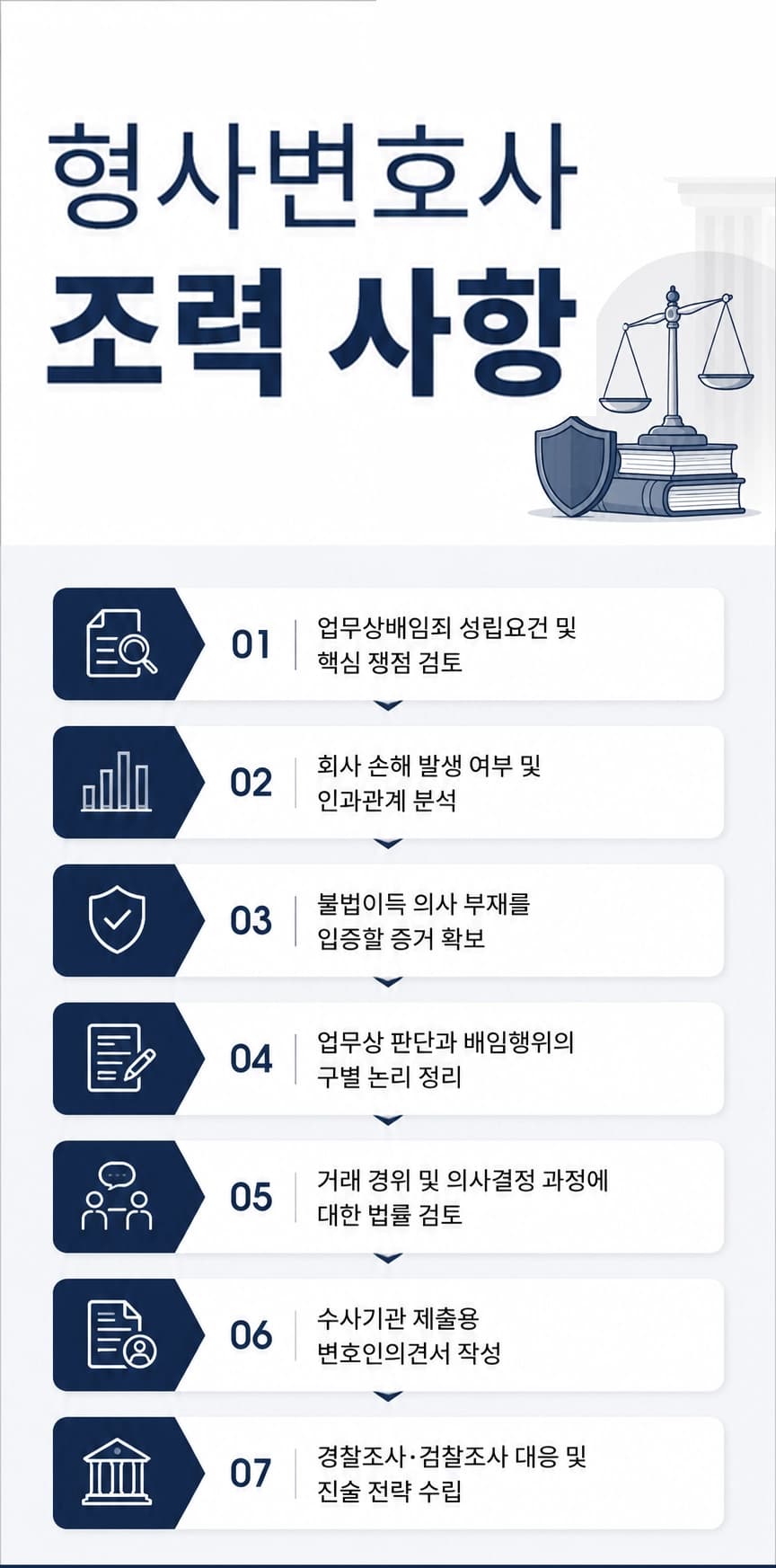
If, like the client in the case, you have suddenly come to face the risk of criminal punishment, we invite you to prepare a response measure through 🔗reserving a legal consultation.
This content is based on actual case studies of Daeryun Law LLC with some adaptations, and the copyright belongs to our firm.
Unauthorized reproduction, duplication, or distribution and other copyright infringements may result in legal action under applicable laws.










