CONTENTS
- 1. The Detailed Circumstances of the Case as Identified by the Jeonju Attorney Office

- - What Brought the Client to the Jeonju Law Office?
- - Relevant Statutes Explained by the Jeonju Law Office
- 2. The Jeonju Law Office's Strategy for Mitigation on Behalf of the Client
- - The Jeonju Law Office Emphasizes the Client's Changed Personal Circumstances
- - The Jeonju Law Office Emphasizes the Hardship to the Client's Family's Livelihood
- - The Jeonju Law Office Emphasizes the Unavoidable Reason for Taking the Wheel
- 3. Result of the Jeonju Law Office's Assistance: 'Reduced to a Fine'
- - Have You Been Sentenced to an Actual Custodial Sentence for Repeated Drunk Driving?

1. The Detailed Circumstances of the Case as Identified by the Jeonju Attorney Office
The client who requested assistance from the Jeonju attorney office had been sentenced to one year of imprisonment on a charge of drunk driving. However, the client wished to receive a suspended sentence or a fine on appeal, and accordingly came to the Jeonju attorney office to request assistance.
 What Brought the Client to the Jeonju Law Office?
The client was a man in his forties with two prior instances of drunk driving.
In particular, at the time of the second drunk driving incident, the client had received a suspended sentence of imprisonment from the court and was driving without a license.
However, only two weeks after the judgment became final, he once again took the wheel while intoxicated.
Brought to trial once again, the client was ultimately sentenced to one year of imprisonment and was detained in the courtroom.
Relevant Statutes Explained by the Jeonju Law Office
Road Traffic Act Article 148-2 (Penalty Provisions) (1) A person who, in violation of Article 44 (1) or (2), was sentenced to a fine or heavier and, within 10 years from the date on which that judgment became final, again violates paragraph (1) or (2) of the same Article(including a person whose sentence has lapsed) shall be punished as provided in the following subparagraphs. 1. A person who violates Article 44 (2) shall be punished by imprisonment for not less than 1 year and not more than 6 years, or by a fine of not less than 5 million won and not more than 30 million won. 2. Among persons who violate Article 44 (1), a person whose blood alcohol concentration is 0.2 percent or higher shall be punished by imprisonment for not less than 2 years and not more than 6 years, or by a fine of not less than 10 million won and not more than 30 million won. 3. Among persons who violate Article 44 (1), a person whose blood alcohol concentration is 0.03 percent or higher but less than 0.2 percent shall be punished by imprisonment for not less than 1 year and not more than 5 years, or by a fine of not less than 5 million won and not more than 20 million won.
(2) A person who, although there are reasonable grounds to recognize that the person is in a state of intoxication, does not comply with a police officer's measurement under Article 44 (2) shall be punished by imprisonment for not less than 1 year and not more than 5 years, or by a fine of not less than 5 million won and not more than 20 million won.
(3) A person who, in violation of Article 44 (1), drives a motor vehicle or a tram while intoxicated shall be punished as provided in the following subparagraphs. 1. A person whose blood alcohol concentration is 0.2 percent or higher shall be punished by imprisonment for not less than 2 years and not more than 5 years, or by a fine of not less than 10 million won and not more than 20 million won 2. A person whose blood alcohol concentration is 0.08 percent or higher but less than 0.2 percent shall be punished by imprisonment for not less than 1 year and not more than 2 years, or by a fine of not less than 5 million won and not more than 10 million won 3. A person whose blood alcohol concentration is 0.03 percent or higher but less than 0.08 percent shall be punished by imprisonment for not more than 1 year, or by a fine of not more than 5 million won |
2. The Jeonju Law Office's Strategy for Mitigation on Behalf of the Client
The Jeonju Law Office immediately began consultations with the client. The attorneys visited the client, who was held in prison, in person and ascertained the precise circumstances.
In the client's case, he had committed the same offense during the period of his suspended sentence, and he took the wheel again while intoxicated only two weeks after the judgment became final. The nature of the offense was therefore very serious, and mitigation was very difficult.
Because the client placed his trust in the firm and entrusted the case to it, the Jeonju Law Office devoted careful effort to establishing a professional and systematic strategy aimed at mitigation for the client.
The Jeonju Law Office Emphasizes the Client's Changed Personal Circumstances
The client had a wife whom he loved.
Although the two had not held a wedding ceremony, they became a legally married couple by registering their marriage.
However, less than two days after being recognized as a married couple, the client was sentenced to an actual custodial sentence and was detained in the courtroom.
While continuing his incarceration, the client learned that his wife was pregnant.
Faced with the fact that he could not be by the side of his wife, who needed physical and emotional protection, the client could not help but shed tears.
The Jeonju Law Office referred to these surrounding circumstances and sought leniency.
The Jeonju Law Office Emphasizes the Hardship to the Client's Family's Livelihood
Until his incarceration, the client had been responsible for his family's livelihood.
However, after losing his job due to his detention in the courtroom, his family came to face significant difficulty in making ends meet.
In particular, as the client's wife became pregnant, it became more difficult for her to engage in economic activity, and the client's parents were also receiving treatment in an intensive care unit due to chronic illness.
The Jeonju Law Office emphasized a request that they be allowed to return to society as soon as possible so that he could contribute to his family's livelihood.
The Jeonju Law Office Emphasizes the Unavoidable Reason for Taking the Wheel
After receiving the suspended sentence, the client entrusted the vehicle to his wife and did not take the wheel.
However, when his wife suddenly became ill, he drove briefly on an exceptional basis in order to take her to the hospital.
Of course, the client deeply regretted, again and again, that even this decision had been a mistake.
The Jeonju Law Office emphasized that there had been an unavoidable reason for the drunk driving.
3. Result of the Jeonju Law Office's Assistance: 'Reduced to a Fine'
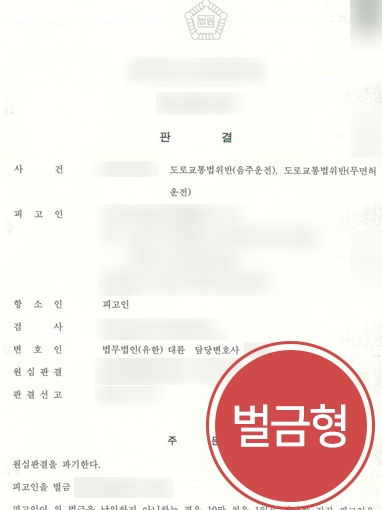
As a result of the Jeonju Law Office's assistance, the appellate court set aside the first-instance judgment, which had imposed one year of imprisonment, and sentenced the client to a fine.
The court explained that the client acknowledged his offense and was showing remorse, that no traffic accident occurred as a result of the drunk driving in this case, and that, taking into account the client's age and circumstances as a whole, the first-instance sentence was excessive and unjust in some respects.
Have You Been Sentenced to an Actual Custodial Sentence for Repeated Drunk Driving?
Because drunk driving can pose a significant threat not only to oneself but also to the property and lives of others, it is classified as a serious crime.
In particular, if a person has a record of having been punished for a related offense within the past 10 years, a more severe punishment is likely to be imposed.
For this reason, if you become involved in a drunk driving offense, it is advisable to receive the assistance of an experienced legal team from the early stages of the case.
At the Jeonju Law Office, a legal team with extensive related experience assists clients in a systematic manner.
If you are concerned because a drunk driving charge has been brought against you, please visit the Jeonju Law Office.
This content is based on actual case studies of Daeryun Law LLC with some adaptations, and the copyright belongs to our firm.
Unauthorized reproduction, duplication, or distribution and other copyright infringements may result in legal action under applicable laws.