
CONTENTS
- 1. The Story of the Client Who Received a Namyangju Legal Consultation

- - The Client's Circumstances Identified Through a Namyangju Legal Consultation
- - Statutes Relating to Stalking, Explained Through a Namyangju Legal Consultation
- 2. Namyangju Legal Consultation: Assistance to Prevent the Client's Punishment
- - Namyangju Legal Consultation: The Client's Conduct Cannot Be Regarded as Constituting Stalking Conduct
- - Namyangju Legal Consultation: The Client Deeply Reflects on Her Conduct
- 3. Namyangju Legal Consultation: As a Result of the Assistance, the Client Obtained a Non-Prosecution Decision

1. The Story of the Client Who Received a Namyangju Legal Consultation
The client who visited Daeryun's Namyangju office for a legal consultation was in a situation in which, due to a husband who did not cooperate at all with visitation with the children after the divorce, she violated the mediation term stating that she ‘would not contact the children first,’ and was reported on suspicion of stalking as a result.
 The Client's Circumstances Identified Through a Namyangju Legal Consultation
The circumstances under which the client, suspected of stalking, requested a legal consultation are as follows.
The client divorced her husband through divorce mediation, and at that time the husband became the holder of parental authority and the custodian of the two children.
However, the husband did not cooperate at all with visitation between the client and the children.
As a result, she violated the mediation term that 'the client shall not make contact until the persons concerned (the children) call or contact her first' by attempting to contact them first, and the former husband's side reported the client on suspicion of stalking.
The client experienced psychological difficulties because visitation with the children was not taking place at all, and she had made contact out of concern for their well-being, so she was shocked to be suspected of stalking.
She therefore visited Daeryun for a Namyangju legal consultation in order to seek legal assistance.
Statutes Relating to Stalking, Explained Through a Namyangju Legal Consultation
“Stalking conduct” refers to conduct that, regardless of the other party's intent, intentionally follows the other party and causes psychological or physical harm.
The following acts are among those that constitute stalking.
- Approaching, following, or blocking the path of the other party
- Waiting for or watching the other party at or near the residence, school, workplace, or other place where the person ordinarily lives (hereinafter referred to as the “residence, etc.”)
- Causing objects, words, writing, symbols, sounds, pictures, images, or video (hereinafter referred to as “objects, etc.”) to reach the other party by mail, telephone, fax, or an information and communications network
- Causing objects, etc. to reach the other party directly or through a third party, or placing objects, etc. at or near the residence, etc.
- Damaging objects, etc. placed at or near the residence, etc.
A stalking offense, which in the past resulted only in minor punishment such as a fine of not more than 100,000 won, detention, or a minor fine, is now, with the enforcement of the “Act on Punishment of Crime of Stalking,” subject to stronger punishment of imprisonment for not more than 3 years or a fine not exceeding 30 million won.
Where the stalking offense is committed while carrying or using a deadly weapon or other dangerous object, it is subject to imprisonment for not more than 5 years or a fine not exceeding 50 million won.
(“Act on Punishment of Crime of Stalking,” Article 18(1) and (2))
In addition, the court may impose on a person who has committed a stalking offense one or more dispositions of an attendance order, an order to complete a stalking treatment program, or probation or community service, as necessary to prevent recidivism.
2. Namyangju Legal Consultation: Assistance to Prevent the Client's Punishment
After hearing the client's circumstances through the Namyangju legal consultation, Daeryun worked to defend against punishment by presenting statements favorable to the client based on the situation she faced.
In addition, in order to determine whether the suspicion of stalking applied to the client, the firm closely analyzed the relevant legal principles and precedents, and argued as follows.
Namyangju Legal Consultation: The Client's Conduct Cannot Be Regarded as Constituting Stalking Conduct
The Supreme Court held that, to constitute stalking conduct, the conduct must be capable of being assessed, objectively and generally, as 'sufficient to cause anxiety or fear in the other party who perceives it,' and held that - Supreme Court, September 27, 2023, 2023Do6411 |
The attorney argued that the client, as the children's biological mother, mostly conveyed content expressing concern and curiosity about their well-being, such as wishing to give the children pocket money, and that, with a contact frequency of about twice a week, it was difficult to regard the conduct as continuous and repeated, so that, considering these circumstances together, it was insufficient to find that the client's conduct constituted stalking conduct.
Namyangju Legal Consultation: The Client Deeply Reflects on Her Conduct
It was argued that, after learning that the children were refusing her contact, the client understood and reflected on this, and resolved to wait patiently in the future until the children contacted her first in accordance with their wishes.
In addition, it was argued that an amicable settlement had been reached by paying a settlement amount to the former husband, the children's legal representative.
3. Namyangju Legal Consultation: As a Result of the Assistance, the Client Obtained a Non-Prosecution Decision
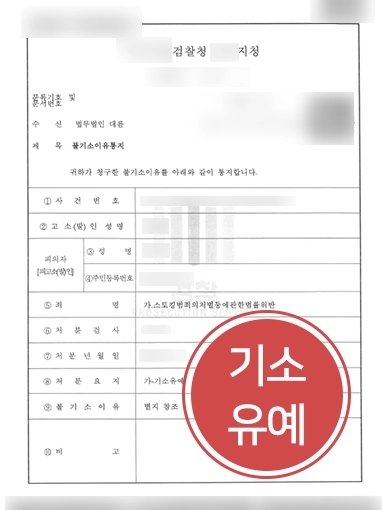
Having continued the matter together with Daeryun through the Namyangju legal consultation, the client was able to obtain a non-prosecution decision from the prosecution, which accepted Daeryun's arguments.
This was a case in which the client was suspected of stalking because, as visitation with the children was not taking place, she violated the mediation order and contacted the children.
When the Supreme Court assesses stalking conduct, it judges objectively by taking into account the various circumstances before and after the conduct, including the relationship, status, and disposition of the other party and the circumstances leading to the conduct, so in order to resolve an unfair situation and prevent punishment, these matters must be actively explained and emphasized.
At Daeryun, many attorneys with extensive experience handling related matters form a team dedicated solely to the client and develop strategies aimed at a favorable outcome, so if you need assistance, you may receive a Namyangju legal consultation at any time.
This content is based on actual case studies of Daeryun Law LLC with some adaptations, and the copyright belongs to our firm.
Unauthorized reproduction, duplication, or distribution and other copyright infringements may result in legal action under applicable laws.