
CONTENTS
- 1. The Client Who Came to the Jinju Law Firm

- - The Background to the Client's Coming to the Jinju Law Firm
- 2. Statutes Relating to the Case, Explained by the Jinju Law Firm
- 3. The Assistance Provided by the Jinju Law Firm
- - The Jinju Law Firm Emphasized That the Client Was Deeply Remorseful
- - The Jinju Law Firm Emphasized That the Client Was Making Efforts on His Own to Prevent Reoffending
- - The Jinju Law Firm Emphasized That the Client's Family Was Hoping for Leniency
- 4. The Prosecution's Decision on the Jinju Law Firm's Arguments
- - If You Need the Assistance of the Jinju Law Firm

1. The Client Who Came to the Jinju Law Firm

The client who came to the Jinju law firm had been encouraged by a close friend to use cannabis.
The client had no interest in cannabis and declined the friend's suggestion.
However, a few months later, the client, having accumulated stress from work, eventually turned to cannabis.
Not long afterward, the client's use of cannabis was discovered, and the client was placed in a situation in which punishment was difficult to avoid.
The client then came to the Jinju law firm to seek the assistance of an attorney specializing in this area.
 The Background to the Client's Coming to the Jinju Law Firm
The client in this case first learned that a close friend was smoking cannabis.
The friend talked to the client about cannabis and even encouraged the client to use it.
As the client had no interest in cannabis at all, the client declined the friend's suggestion.
Then one day, the client was under a great deal of stress at work and felt that he had reached his mental limit.
Recalling what the friend had said a few months earlier, the client eventually turned to cannabis.
Not long afterward, the client's use of cannabis was discovered by the police, and the client faced the prospect of criminal punishment.
Anxious about possibly losing his job, the client came to the Jinju law firm.
The following is an account of how the Jinju law firm resolved the case.
2. Statutes Relating to the Case, Explained by the Jinju Law Firm
Let us review the statutes relating to the case together with the Jinju law firm.
Statutes Relating to Narcotics
Narcotics
▶ In Korea, this refers to poppy, opium, coca leaves, and the like.
▶ In addition, drugs that act on the central nervous system and may cause serious harm if misused or abused are classified as psychotropic drugs,
and are categorized from item 'Ga' through item 'Ma' according to their degree of seriousness.
Acts Constituting a Violation of the Narcotics Control Act and the Applicable Sentences
Administration (Use)
▶ For cannabis and psychotropic drugs of item 'Ra,' imprisonment for not more than 5 years or a fine of not more than 50 million won.
▶ For all other drugs, imprisonment for not more than 10 years or a fine of not more than 100 million won.
▶ In the case of possession, if the quantity is judged to be too large for personal use alone, additional charges such as sale may be brought.
Distribution Charge
▶ Imprisonment for not more than 10 years or a fine of not more than 100 million won.
Import and Export
▶ Up to life imprisonment.
▶ In the case of an offense committed in an organized or professional manner, imprisonment for a long term of 10 years or more.
3. The Assistance Provided by the Jinju Law Firm

The Jinju law firm conducted a detailed consultation with the client and analyzed the circumstances favorable to the client.
On that basis, it prepared an appropriate and systematic response and provided assistance to the client.
The Jinju law firm made the following arguments.
The Jinju Law Firm Emphasized That the Client Was Deeply Remorseful
The Jinju law firm emphasized that the client admitted all of the facts of the offense and cooperated faithfully throughout the investigation.
It emphasized that the client firmly resolved never to commit the same wrong again and wrote a letter of reflection.
The Jinju Law Firm Emphasized That the Client Was Making Efforts on His Own to Prevent Reoffending
The Jinju law firm noted that the client was a first-time offender with no prior criminal record and was receiving psychiatric treatment in order not to commit the same wrong again, among other things,
and it emphasized that the client was making efforts on his own to prevent reoffending.
It also emphasized that the client's social ties were stable, indicating a low likelihood of reoffending.
The Jinju Law Firm Emphasized That the Client's Family Was Hoping for Leniency
The Jinju law firm stated that the client's family and acquaintances would actively help ensure that the client did not repeat the same wrong,
and it emphasized that they were earnestly hoping for leniency for the client.
4. The Prosecution's Decision on the Jinju Law Firm's Arguments
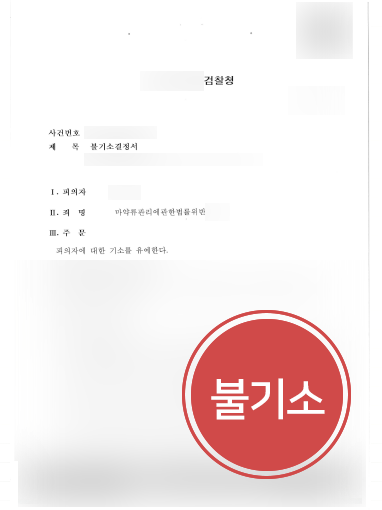
The prosecution accepted the arguments of the Jinju law firm and made a 'non-prosecution' decision.
If You Need the Assistance of the Jinju Law Firm
In narcotics cases, the investigative procedures and sentencing guidelines differ markedly from those in ordinary criminal cases, depending on the particular nature of the case.
The investigative authorities and the courts have announced rigorous investigation and punishment for narcotics offenses.
Accordingly, there is a high 'possibility of detention during the investigation and of severe punishment.'
It is therefore advisable to respond thoroughly with the assistance of an attorney specializing in this area from the early stages of the case.
At Daeryun Law Firm, a narcotics team composed of attorneys specializing in criminal matters who accurately understand the methods and flow of investigations and trials
provides assistance to clients through a proactive response.
If you face a situation similar to this case and need the assistance of an attorney specializing in this area,
Daeryun Law Firm offers consultations and is available to assist you.
This content is based on actual case studies of Daeryun Law LLC with some adaptations, and the copyright belongs to our firm.
Unauthorized reproduction, duplication, or distribution and other copyright infringements may result in legal action under applicable laws.