
CONTENTS
- 1. The Story of the Client Who Came to the Daejeon Law Office

- - The Detailed Circumstances Identified by the Daejeon Law Office
- - Administrative Litigation, Explained by the Daejeon Law Office
- 2. The Daejeon Law Office's Process of Assistance
- - Daejeon Law Office: Argument That There Was No Basis for the Resolution to Deny the Permit
- - Daejeon Law Office: Argument That the Client Satisfied All Permit Conditions
- - Daejeon Law Office: Argument Regarding the Violation of the Principle of Protection of Trust
- 3. Success in Revoking the Denial Disposition with the Assistance of the Daejeon Law Office

1. The Story of the Client Who Came to the Daejeon Law Office
The client who came to the Daejeon law office had satisfied all of the conditions required by the city government after filing the report for permission and authorization for the waste disposal business, yet had received a notice of disapproval on the ground that complaints had been raised by residents.
 The Detailed Circumstances Identified by the Daejeon Law Office

The client prepared to file a report for permission and authorization in order to install waste disposal facilities and equipment in the OO area and operate an intermediate waste recycling business.
A business plan was submitted to the OO city government, and the OO city government issued a notice of conformity for the waste disposal business plan.
However, the conditions of that notice required ‘obtaining permission for a change of use’ and ‘compliance with odor emission standards and the establishment of special measures to reduce odor’.
Accordingly, the client installed facilities to reduce odor and, through an agency handling changes of use, filed an application for a change of use.
However, on the ground that complaints arose from residents, the application for a change of use was rejected and a notice of disapproval was issued.
Accordingly, the client, appealing the unfairness of the matter, visited Daeryun to bring an administrative litigation seeking revocation of the notice of disapproval.
Administrative Litigation, Explained by the Daejeon Law Office
The Daejeon law office first explained to the client the 🔗administrative litigation that the client could bring.
Administrative litigation is a judicial procedure that provides remedy for the infringement of a citizen's rights or interests caused by an unlawful disposition, etc. of an administrative agency, and seeks to resolve disputes concerning legal relations under public law or the application of the law.
Administrative litigation may generally be brought only within 90 days from the date on which one becomes aware that the disposition has been made, and within one year from the date on which the disposition was made.
Then, how does this differ from 🔗administrative appeal?
Administrative appeal is a system established for an administrative agency itself to without the intervention of a court secure efficiency and consistency on its own, by raising an objection to the administrative agency that performed the disposition, etc. so that the superior body of the disposition agency reviews the matter once more, whereas administrative litigation is a judicial procedure of a court.
In the past, in order to bring administrative litigation, one was necessarily required to first go through an administrative appeal; however, following the amendment of the Administrative Litigation Act, it changed to read, ‘A revocation lawsuit may be brought without going through an administrative appeal against the relevant disposition even where such an administrative appeal may be filed under the provisions of statutes’ (Article 18, paragraph (1) of the Administrative Litigation Act).
2. The Daejeon Law Office's Process of Assistance
The Daejeon law office actively assisted with the administrative litigation to obtain revocation of the client's disapproval disposition. To this end, by emphasizing that the client had satisfied all of the supplementary conditions for obtaining permission and authorization, it argued that the city government's disposition was unreasonable.
Daejeon Law Office: Argument That There Was No Basis for the Resolution to Deny the Permit
The notice of disapproval in this case stated only the ground that "the matter was resolved as a disapproval following the deliberation of the OO City th Civil Petition Mediation Committee," and it contained no description whatsoever of the reasons for the disapproval resolution.
We emphasized that, even though there is no legal obligation to disclose the contents of the deliberation to the petitioner, an administrative agency must in principle present to the party the basis and reasons for an administrative disposition, and that, because none of this could be ascertained, an obstacle also arose in pursuing the administrative remedy procedure.
Daejeon Law Office: Argument That the Client Satisfied All Permit Conditions
When OO City Hall issued the client the conditional notice of conformity for the waste treatment business, it required the "establishment of special measures to reduce odor," and in accordance with this the client installed a dust collector and additionally submitted analysis values showing levels of not more than 500 times below the permissible standard for air pollutants.
However, we argued that it was unjust to issue a disposition of disapproval without any particular reason.
Daejeon Law Office: Argument Regarding the Violation of the Principle of Protection of Trust
|
After receiving the notice of conformity for the business plan from OO City Hall, the client relied on it and invested a great deal of time, expense, and effort to install various facilities, but received a disposition of disapproval on improper grounds and thereby suffered enormous disadvantage; accordingly, we argued that this violated the principle of protection of trust.
3. Success in Revoking the Denial Disposition with the Assistance of the Daejeon Law Office
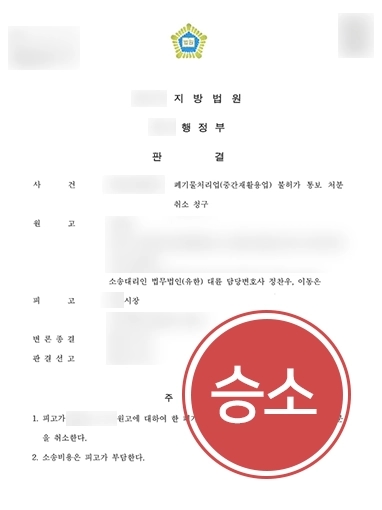
After actively assisting with the client's administrative litigation, the Daejeon law office succeeded in revoking the disposition of disapproval for the waste treatment business.
As with this client, if a disposition by an administrative agency is unjust, one may pursue administrative litigation; however, an application must be filed within 90 days from the date one becomes aware that the disposition was made and within 1 year from the date the disposition was made, so it is necessary to promptly consult with an attorney specializing in administrative matters and then prepare the litigation.
Daeryun LLC includes attorneys specializing in administrative matters who have served at local administrative appeals commissions, the Ministry of Employment and Labor, the Korea Workers' Compensation and Welfare Service, and the Central Disciplinary Committee for public officials, among others, professional attorneys who have accumulated diverse official practical experience and know-how in the fields of administrative litigation and administrative remedies and who actively assist clients with their administrative litigation, so if you require assistance, please feel free at any time to request a 🔗legal consultation.
This content is based on actual case studies of Daeryun Law LLC with some adaptations, and the copyright belongs to our firm.
Unauthorized reproduction, duplication, or distribution and other copyright infringements may result in legal action under applicable laws.