
CONTENTS
- 1. The client who came to the Fair Trade Commission attorney

- 2. The matters requested of the Fair Trade Commission attorney
- - Franchise business transaction dispute conciliation explained by the Fair Trade Commission attorney
- 3. The assistance of the Fair Trade Commission attorney
- - The Fair Trade Commission attorney's dispatch of a certified content letter
- - The Fair Trade Commission attorney's handling of the franchise business transaction dispute conciliation
- - The Fair Trade Commission attorney's rebuttal of confectionery company A's arguments
- 4. With the assistance of the Fair Trade Commission attorney, the franchise fees were fully refunded

1. The client who came to the Fair Trade Commission attorney
The client who came to the Fair Trade Commission attorney had received a startup consultation from Confectionery Company A and was told that startup would be possible upon payment of a franchise fee of 20 million won.
At the time of the contract, Confectionery Company A said that it would directly make and supply the jam used in the cookies at its head office and would charge only the cost of that.
The client agreed to this and decided not to purchase a machine for making jam,
The client paid 20 million won to Confectionery Company A and concluded a franchise contract with Confectionery Company A.
However, after the franchise outlet began operating, Confectionery Company A did not provide any guidance at all on the overall handling of operations, and from one month after operations began, it abruptly expressed an intention to terminate the franchise contract, saying that it could no longer supply the jam.
The client accordingly requested the return of the franchise fee, but because Confectionery Company A was not returning it, the client said that the client came to the Fair Trade Commission attorney.
2. The matters requested of the Fair Trade Commission attorney
The client told the Fair Trade Commission attorney to make it possible to recover the franchise fee.
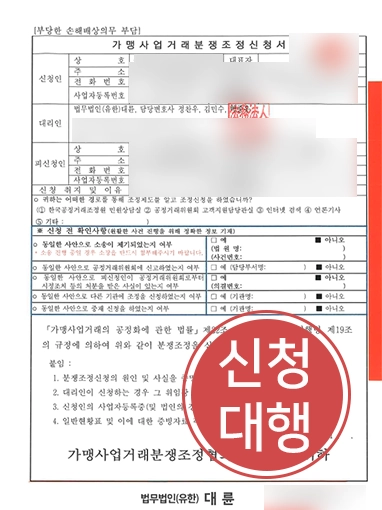
The Fair Trade Commission attorney decided to make it possible for the client to recover the franchise fee through franchise business transaction dispute mediation.
 Franchise business transaction dispute conciliation explained by the Fair Trade Commission attorney
Let us look into the Fair Trade Commission attorney and franchise business transaction dispute mediation.
Franchise business transaction dispute mediation can be applied for at the Korea Fair Trade Mediation Agency, and it is operated to mediate disputes between a franchisor and a franchisee arising from unfair trade practices.
Franchise business transaction dispute mediation proceeds according to the following procedure.
Filing of application > Receipt of the case by the Korea Fair Trade Mediation Agency > Dispute Mediation Council > Resolution to present a mediation proposal > Resolution to terminate the mediation procedure > Conclusion of the dispute mediation
Dispute mediation takes a great deal of time and requires legal knowledge, so it is advisable to request the assistance of a specialist attorney of the Daeryun Fair Trade Group.
3. The assistance of the Fair Trade Commission attorney
The Fair Trade Commission attorney provided assistance as follows in order to recover the client's franchise fee.
The Fair Trade Commission attorney's dispatch of a certified content letter
On behalf of the client, the Fair Trade Commission attorney prepared and sent a certified content-proof mail with the following content.
-Confectionery Company A concluded a franchise contract with the client.
-Confectionery Company A did not properly perform the contents of the contract.
-Confectionery Company A unilaterally terminated the franchise contract.
-Confectionery Company A has still not returned the franchise fee, and because losses arose, such as taking down the sign and installing a new sign due to the termination of the franchise contract, it has an obligation to return these amounts. |
The Fair Trade Commission attorney's handling of the franchise business transaction dispute conciliation
On behalf of the client, the Fair Trade Commission attorney applied for franchise business transaction dispute mediation.
The Fair Trade Commission attorney's rebuttal of confectionery company A's arguments
In the Fair Trade Commission attorney's case, Confectionery Company A is making the unreasonable argument that it never concluded a franchise contract.
However, when concluding the franchise contract, Confectionery Company A had the client use Confectionery Company A's trade name by stipulating that the client could use the trade name without a time limit, had the client use packaging and coupons bearing the face of Confectionery Company A's chief executive in operating this franchise outlet, and had a sign bearing that trade name produced and used, thereby permitting the client to use Confectionery Company A's business identifiers.
In addition, Confectionery Company A instructed the client to sell products according to a certain quality or business method.
Moreover, the client paid a franchise fee of 20 million won to Confectionery Company A.
Accordingly, it is clear that the client concluded a franchise contract with Confectionery Company A, and Confectionery Company A has acknowledged this point on several occasions.
4. With the assistance of the Fair Trade Commission attorney, the franchise fees were fully refunded

Having heard the account of the Fair Trade Commission attorney, the Dispute Mediation Council presented a mediation proposal that Confectionery Company A return the franchise fee of 20 million won to the client, and both Confectionery Company A and the client agreed to the mediation proposal, so the dispute mediation concluded.
The Fair Trade Commission attorney provides assistance in responding to unfair trade, franchise disputes, and the like.
As with the client, one may be placed in a wrongful situation, so if you need a Fair Trade Commission attorney, please visit the Daeryun Fair Trade Group at any time.
This content is based on actual case studies of Daeryun Law LLC with some adaptations, and the copyright belongs to our firm.
Unauthorized reproduction, duplication, or distribution and other copyright infringements may result in legal action under applicable laws.