
CONTENTS
- 1. The Reason for Claiming Consolation Money in a Common-Law Marriage

- 2. Filing the Lawsuit for Consolation Money in a Common-Law Marriage
- - The Defendant's Response to the Claim for Consolation Money in a Common-Law Marriage
- - The Attorney's Response on Consolation Money in a Common-Law Marriage
- - The Defendant's Counterclaim on Consolation Money in a Common-Law Marriage
- 3. The Court's Decision on Consolation Money in a Common-Law Marriage

1. The Reason for Claiming Consolation Money in a Common-Law Marriage
The account of the client who sought assistance in claiming consolation money in a common-law marriage is as follows.
The client claimed that his wife, with whom he was in a common-law marriage, had an affair with another man.
The client explained that he and his wife had maintained a common-law marriage as a weekend couple for more than about 10 years, and that he learned one day that his wife had begun having an affair with another man.
When he became angry with his wife over this, she went so far as to change her mobile phone number and begged for forgiveness, promising never to have an affair again.

The client believed his wife, but this was a deception.
While the client was away in the provinces for work on weekdays, his wife invited another man to their home, had sexual relations with him, and exchanged messages with him every single day.
Accordingly, the client sought the assistance of an attorney in order to claim consolation money in a common-law marriage against his wife.
2. Filing the Lawsuit for Consolation Money in a Common-Law Marriage
The attorney, entrusted with the litigation authority of the client seeking consolation money in a common-law marriage, filed a complaint containing the following and brought a 🔗dissolution of common-law marriage lawsuit.
2. The costs of the litigation shall be borne by the defendant.
3. Paragraph 1 above may be provisionally executed.
We seek a judgment to the foregoing effect.
 The Defendant's Response to the Claim for Consolation Money in a Common-Law Marriage
The defendant, who received the claim for consolation money in a common-law marriage, made the following argument.
The defendant stated that the common-law marriage with the client had already broken down 3 years earlier, and that the fault for this lay with the client.
The defendant argued that, because they had given up the home where they had lived together and each moved out, the common-law marriage had been completely ended, and that this claim for consolation money in a common-law marriage should be dismissed.
The Attorney's Response on Consolation Money in a Common-Law Marriage
In response to the argument of the defendant who received the claim for consolation money in a common-law marriage, the attorney representing the client argued as follows.
The defendant had maintained the common-law marriage with the client until only a few months earlier, and the defendant's argument is entirely false.
As recently as a few months ago, the client attended the defendant's family gathering as the defendant's husband.
In addition, the defendant had treated the client as her husband, calling him terms such as “honey” and “darling.”
A common-law marriage refers to a case in which there is a subjective intention to marry between the parties and there is also, objectively, the substance of a marital life that, under social conventions, can be recognized as a married couple's communal life from the standpoint of family order.
Under the precedent above, it is clear that the client and the defendant had the substance of a marital life and were therefore in a common-law marriage.
The reason they gave up the home where they had lived together was simply that, as the client and the defendant lived as a weekend couple, the rent for a home used only on weekends was burdensome, and so they gave up the home, while their meetings every weekend continued.
The attorney argued that, because the defendant's arguments were all false, the client's claim should be granted in full.
The Defendant's Counterclaim on Consolation Money in a Common-Law Marriage
The defendant, who received the claim for consolation money in a common-law marriage, brazenly filed a counterclaim containing the following and brought a counterclaim.
2. The costs of the litigation, combining both the principal claim and the counterclaim, shall be borne in their entirety by the counterclaim defendant (plaintiff).
3. Paragraph 1 above may be provisionally executed.
We seek a judgment to the foregoing effect.
3. The Court's Decision on Consolation Money in a Common-Law Marriage

The court made the following decision on the claim for consolation money in a common-law marriage.
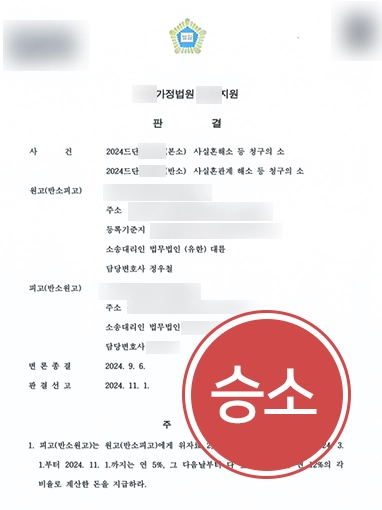
It was possible to be granted about 70 percent of the claimed amount of consolation money in a common-law marriage and to have the defendant's counterclaim dismissed in full.
The client could unfairly have ended up paying 100 million won in consolation money through the counterclaim. Because the attorney proved that the client and the defendant had been in a common-law marriage, the defendant's claim was dismissed and consolation money was recovered.
If you need to claim consolation money in a common-law marriage, you are welcome to receive a Daeryun 🔗attorney referral at any time.
This content is based on actual case studies of Daeryun Law LLC with some adaptations, and the copyright belongs to our firm.
Unauthorized reproduction, duplication, or distribution and other copyright infringements may result in legal action under applicable laws.