
CONTENTS
- 1. The Client Who Decided to File a Lawsuit for Return of Unjust Enrichment

- 2. Assistance for the Lawsuit for Return of Unjust Enrichment
- - Lawsuit for Return of Unjust Enrichment, Argument on the Special Terms of the Settlement Agreement
- - Lawsuit for Return of Unjust Enrichment, Argument That the Defendant's Claim Lacks Evidence
- 3. Result of the Lawsuit for Return of Unjust Enrichment, Full Claim Payment Awarded

1. The Client Who Decided to File a Lawsuit for Return of Unjust Enrichment

The client who decided to file a lawsuit for the return of unjust enrichment was in a situation in which the client was unable to recover overpaid construction costs.
The client had entered into a sub-subcontract agreement with the defendant.
When the construction payment was settled according to the rate of construction progress, it turned out that the amount the client, as plaintiff, had prepaid to the defendant was greater.
The client then requested the return of the roughly 100 million won in construction costs that had been overpaid to the defendant, but the defendant continued not to pay the money.
Because that construction payment was a benefit the defendant obtained without any legal basis, the client decided to file a lawsuit for the return of unjust enrichment.
 What Is a Lawsuit for Return of Unjust Enrichment?
Unjust enrichment refers to a benefit obtained by an improper means that violates the law.
If, for some reason, a person acquires another person's property or labor but has no legal entitlement to the benefit and must return it, the benefit so obtained is unjust enrichment.
The Civil Act provides that a person who obtains a benefit from another's property or services without a legal cause, causing loss to that other person, shall return the benefit.
2. Assistance for the Lawsuit for Return of Unjust Enrichment
For the 🔗lawsuit for the return of unjust enrichment, Daeryun carefully reviewed the settlement agreement between the client and the defendant and set about devising a strategy for the return of the claim.
Lawsuit for Return of Unjust Enrichment, Argument on the Special Terms of the Settlement Agreement
The client originally subcontracted the construction work in this case, worth about 1 billion won, from A Construction.
Afterward, the client and A Construction amended the contract a total of three times, changing the construction amount due to issues such as added volume.
After concluding the subcontract with A Construction, the client entered into a sub-subcontract agreement with the defendant.
The settlement agreement between the client and the defendant specified that progress payments would be made to the defendant after deducting 10% (office operating expenses) from the amount deposited following the issuance of the invoice.
The defendant, however, argues that it agreed to deduct the 10% office operating expenses only with respect to the initial construction amount of 1 billion won for this case, and that it never agreed to pay the same amount with respect to the construction amounts that were subsequently changed and increased.
The attorney handling the client's lawsuit for the return of unjust enrichment rebutted the defendant's argument by pointing out that, although the construction amount was changed several times between the plaintiff and A Construction, no separate contract was prepared between the plaintiff and the defendant on each such occasion, and that the 10% the plaintiff agreed to deduct meant 10% of the total construction progress payments.
Lawsuit for Return of Unjust Enrichment, Argument That the Defendant's Claim Lacks Evidence
The attorney handling the lawsuit for the return of unjust enrichment pointed out that there was no evidence whatsoever to prove the defendant's claim that the plaintiff had agreed not to receive a fee on the additional construction work.
The attorney handling the lawsuit for the return of unjust enrichment emphasized that not only was there no evidence whatsoever to prove it, but it also ran contrary to ordinary contracting practice and therefore lacked any credibility.
The progress amount is about 1 billion won, and the amount after deducting 10% from that progress amount is 900 million won.
Because the amount the plaintiff prepaid to the defendant came to about 1 billion won, the plaintiff overpaid the defendant by 100 million won.
The attorney handling the lawsuit for the return of unjust enrichment argued that the defendant has a duty to return to the plaintiff the 100 million won overpaid, together with the delay damages thereon.
3. Result of the Lawsuit for Return of Unjust Enrichment, Full Claim Payment Awarded
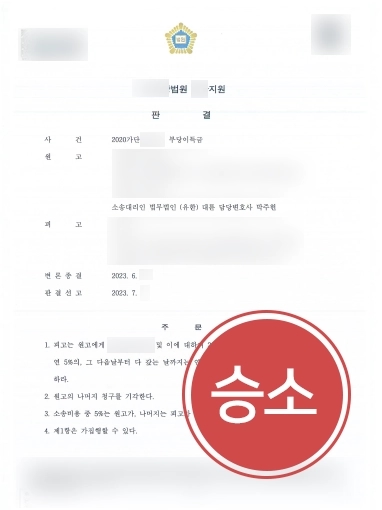
As a result of the lawsuit for the return of unjust enrichment, the court determined that the defendant has a duty to return to the plaintiff the roughly 100 million won in construction costs that the plaintiff overpaid, together with the delay damages thereon.
The client succeeded in recovering the overpaid construction costs along with the delay damages.
Because subcontract agreements involve complex legal relationships and a high likelihood of unfair practices, receiving help from an attorney with a thorough understanding of the law and of on-site practices is recommended.
Daeryun Law Firm has attorneys with an average of more than 10 years of experience who form task forces of 3 to 20 members to provide client-tailored response strategies.
If you are preparing a lawsuit for the return of unjust enrichment, please prepare with the help of Daeryun Law Firm. 🔗attorney
This content is based on actual case studies of Daeryun Law LLC with some adaptations, and the copyright belongs to our firm.
Unauthorized reproduction, duplication, or distribution and other copyright infringements may result in legal action under applicable laws.