
CONTENTS
- 1. The Client Who Sought a Gunsan Criminal Attorney

- 2. The Client's Charges
- 3. The Defense Mounted for the Client
- - “The Client Had No Criminal Intent”
- - “The Client Actively Cooperated with the Investigation”
- 4. A Judgment Led by a Gunsan Criminal Attorney

1. The Client Who Sought a Gunsan Criminal Attorney
The client stated that they were facing charges including aiding and abetting fraud and forgery of a private document.
The client explained that, because of these charges, they needed assistance in defending against criminal punishment.
The attorney set out to understand the case for the client, and the details were as follows.
The client worked at a mobile phone store, handling the sale and activation of phones for walk-in customers.
The store manager at the client's branch instructed the client to obtain several identification documents and to complete subscription applications to activate phones.
Although the client had some doubts, they thought there might be people who wanted to activate phones online and let the matter pass without much concern.
However, by the time this case arose, those phones had been used as burner phones for voice phishing, and as a result the client came to face charges of aiding and abetting fraud, forgery of a private document, and uttering of a forged private document.
2. The Client's Charges

The client was facing charges of aiding and abetting fraud, forgery of a private document, and uttering of a forged private document.
These charges were applied because the client aided a voice phishing 🔗crime of fraud, and, for that voice phishing fraud, forged and uttered burner phone subscription applications to activate the burner phones.
If these charges were established, punishment at the following levels was anticipated.
▷Criminal Act Article 347 (Fraud)
(2) The preceding paragraph applies to a person who, by the method described in that paragraph, causes a third party to take the delivery of property or to obtain a pecuniary advantage.
Criminal Act Article 32 (Accomplice) (1) A person who aids the crime of another is punishable as an accomplice.
(2) The punishment of an accomplice is mitigated below that of the principal offender.
▷Criminal Act Article 231 (Forgery or Alteration of Private Documents, etc.)
▷Criminal Act Article 234 (Uttering of Forged Private Documents, etc.)
3. The Defense Mounted for the Client
The attorney mounted the following defense for the client.
 “The Client Had No Criminal Intent”
The attorney emphasized that the client had no intent to commit the offense.
The client merely followed the instructions of the store manager who had given the work directions, and did not anticipate at all that the phones activated in this way would be used in a voice phishing crime.
“The Client Actively Cooperated with the Investigation”
The attorney emphasized that the client had actively cooperated with the investigation.
From the police questioning onward, the client admitted all of the facts of the offense and answered with all the information they knew without concealment, actively cooperating with the investigation.
4. A Judgment Led by a Gunsan Criminal Attorney
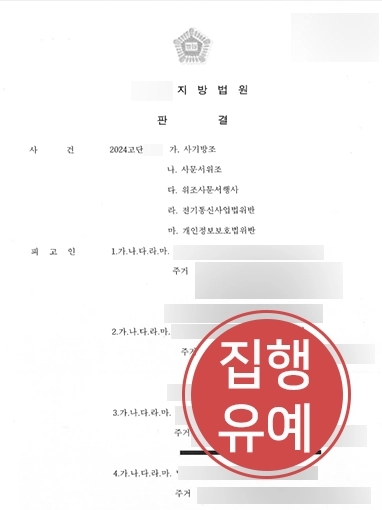
After hearing the Gunsan criminal attorney's argument, the court issued a suspended sentence for the client.
The client had committed a total of three offenses and was expected to receive an actual custodial sentence, yet with the attorney's assistance the client was able to avoid imprisonment.
Even if there was no intent regarding charges such as aiding and abetting fraud, a defendant may be punished severely if this cannot be proven.
In fact, the roughly ten defendants who actually took part in the crime received actual custodial sentences, while the client obtained a suspended sentence.
If, like the client in this case, you need assistance in defending against an actual custodial sentence, please feel free to obtain an 🔗attorney referral and request support at any time.
This content is based on actual case studies of Daeryun Law LLC with some adaptations, and the copyright belongs to our firm.
Unauthorized reproduction, duplication, or distribution and other copyright infringements may result in legal action under applicable laws.