
CONTENTS
- 1. The Client Who Requested Help With the Division of Property in a Common-Law Marriage

- 2. Division of Property in a Common-Law Marriage, What Is a Common-Law Marriage?
- - Division of Property in a Common-Law Marriage, Methods of Dissolution and Issues of Property and Children
- - The Key Issue in Division of Property in a Common-Law Marriage Is Proving the Relationship
- 3. Daeryun's Assistance for Division of Property in a Common-Law Marriage
- - Proving the Common-Law Marriage for Division of Property in a Common-Law Marriage
- - Asserting the Right to Claim for Division of Property in a Common-Law Marriage
- 4. Securing Recognition of Division of Property in a Common-Law Marriage and Succeeding in the Lawsuit

1. The Client Who Requested Help With the Division of Property in a Common-Law Marriage

This is the account of a client who requested help from a divorce attorney with the division of property in a common-law marriage.
The client wished to dissolve the relationship with the common-law partner and to pursue the division of property accordingly.
The client was unaware that division of property is possible even in a common-law marriage.
The divorce attorney explained that, along with the dissolution of the common-law relationship, division of property is possible, and proceeded to provide assistance on this.
2. Division of Property in a Common-Law Marriage, What Is a Common-Law Marriage?
Before examining the division of property in a common-law marriage, let us look at the concept of a common-law marriage.
In our country, which adopts the principle of legal marriage, a couple is recognized as legally married only when both the substantive and the formal requirements of marriage are satisfied.
A common-law marriage refers to a relationship in which the parties have not registered their marriage but, with the intention of living as a married couple, actually live as one.
A common-law marriage is not a fully complete marital relationship in legal terms, but some of the rights and duties of a married couple may be legally recognized.
 Division of Property in a Common-Law Marriage, Methods of Dissolution and Issues of Property and Children
A common-law couple is not a legally married couple, so when they separate they do not need to follow legal procedures such as court confirmation of divorce or filing a divorce report.
A common-law marriage may therefore be dissolved by agreement between the parties, or by notice from one party.
Division of property is also possible in a common-law marriage.
Case law holds that if, during the common-law marriage, the couple jointly formed property and contributed to its maintenance and increase, that property is regarded as the couple's joint property, and division of property may be claimed when the common-law marriage is dissolved.
In addition, if the common-law marriage is wrongfully dissolved through the fault of one common-law spouse or of a third party (for example, parents-in-law), compensation for the resulting mental suffering, that is, consolation money, may be claimed from that spouse or third party.
The following addresses issues concerning children of a common-law marriage.
A child born in a common-law marriage is legally classified as a child born out of wedlock. However, if the father acknowledges the child as his own (acknowledgment), the couple may jointly exercise parental authority and the right of custody over the child.
When a common-law marriage ends, the couple must agree on parental authority, the custodian, and the method of raising the child. If agreement is difficult, they may ask the court to decide.
However, if the father does not acknowledge the child as his own, the child has no legal parent-child relationship with the father, so the father cannot be required to assume parental authority or the right of custody over the child, nor can he directly make decisions about raising the child. A lawsuit for acknowledgment to confirm the father's paternity must therefore be pursued first before the child's rights can be asserted.
The Key Issue in Division of Property in a Common-Law Marriage Is Proving the Relationship
Upon 🔗dissolution of a common-law marriage, the parties may decide the above matters by mutual agreement, but if agreement is difficult or if proper protection of one's rights appears unlikely, the matter must be resolved through a claim for division of property, consolation money, and the like.
What is important in this process is that one must prove that the parties were in a ‘common-law marriage’ rather than mere cohabitation.
Documentary evidence showing that the two people lived together at the same address for a long period, and documentary evidence proving that they formed an economic community, are required.
3. Daeryun's Assistance for Division of Property in a Common-Law Marriage
For the division of property in a common-law marriage, the Daeryun divorce attorney proved that the client and the other party had been in a common-law marriage, and filed a claim for division of the property they had jointly built up.
Proving the Common-Law Marriage for Division of Property in a Common-Law Marriage
The divorce attorney representing the client argued that the client and the defendant had simply not filed a marriage report, but were in a substantive marital relationship.
The divorce attorney argued, with supporting evidence, that because the client was in a substantive marital relationship, she had taken on the role of a daughter-in-law in the defendant's (the other party's) family.
The client also attended the eightieth-birthday celebration of the defendant's father and gave a gift of money when the child of the defendant's brother graduated from university.
The divorce attorney proved the common-law marriage by submitting as evidence the fact that the client appeared in the family photograph commemorating the eightieth-birthday celebration, along with transaction records of expenditures made for various family events of the defendant.
Asserting the Right to Claim for Division of Property in a Common-Law Marriage
The divorce attorney representing the client explained how the client's right to claim division of property had arisen with respect to the real estate at issue in this case, which was the subject of the division of property in the common-law marriage.
Around the time the client and the defendant began the common-law marriage at issue in this case, they entered into a sales contract for the real estate at issue in this case under the defendant's name, and jointly bore the down payment, the balance, and other costs.
The plaintiff also purchased home appliances and other household goods when moving into the real estate at issue in this case.
The divorce attorney submitted the client's transaction records and other materials as evidence, asserted the existence of a right to claim division of property, and requested the corresponding division of property.
4. Securing Recognition of Division of Property in a Common-Law Marriage and Succeeding in the Lawsuit
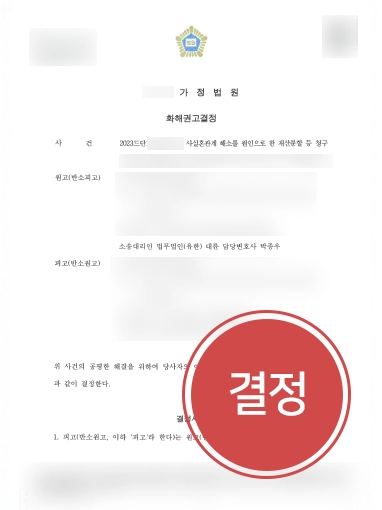
As a result of the lawsuit for division of property in a common-law marriage, the client obtained recognition of the common-law marriage with the defendant and recognition of her contribution to the real estate at issue in this case, and was able to succeed in securing a division of property as well.
Unlike a legal marriage, a common-law marriage can be difficult to prove clearly, so various legal issues may arise in the course of dividing property.
It is recommended to resolve the complex issues of the procedure for dissolving a common-law marriage with the help of a divorce attorney.
Through coordination between its Divorce Group and its Evidence Investigation and Digital Forensics Group, Daeryun Law Firm collects objective evidence to prove a common-law marriage and provides full assistance with the client's division of property.
If you are seeking 🔗an attorney recommendation in connection with division of property in a common-law marriage, please visit Daeryun Law Firm.
This content is based on actual case studies of Daeryun Law LLC with some adaptations, and the copyright belongs to our firm.
Unauthorized reproduction, duplication, or distribution and other copyright infringements may result in legal action under applicable laws.