
CONTENTS
- 1. The Client

- 2. Blood Alcohol Concentration
- - Penalties for Drunk Driving
- 3. Representation of the Client
- - The Judgment Obtained for the Client
- - Mitigating Factors in Drunk Driving Cases

1. The Client
The client explained that he faced the prospect of punishment after driving while intoxicated.
The account the attorney reviewed was as follows.
The client explained that, on the day of the incident, he dined out with his family and then drank about two glasses of beer.
After the meal, he also stopped by a karaoke room and a bowling alley, so he thought the effects of the alcohol had fully worn off and got behind the wheel.
On his way home, his drinking was detected by a police officer conducting a sobriety checkpoint, which led to this case.
The client's blood alcohol concentration at the time of detection was 0.05%, a very minor level.
2. Blood Alcohol Concentration
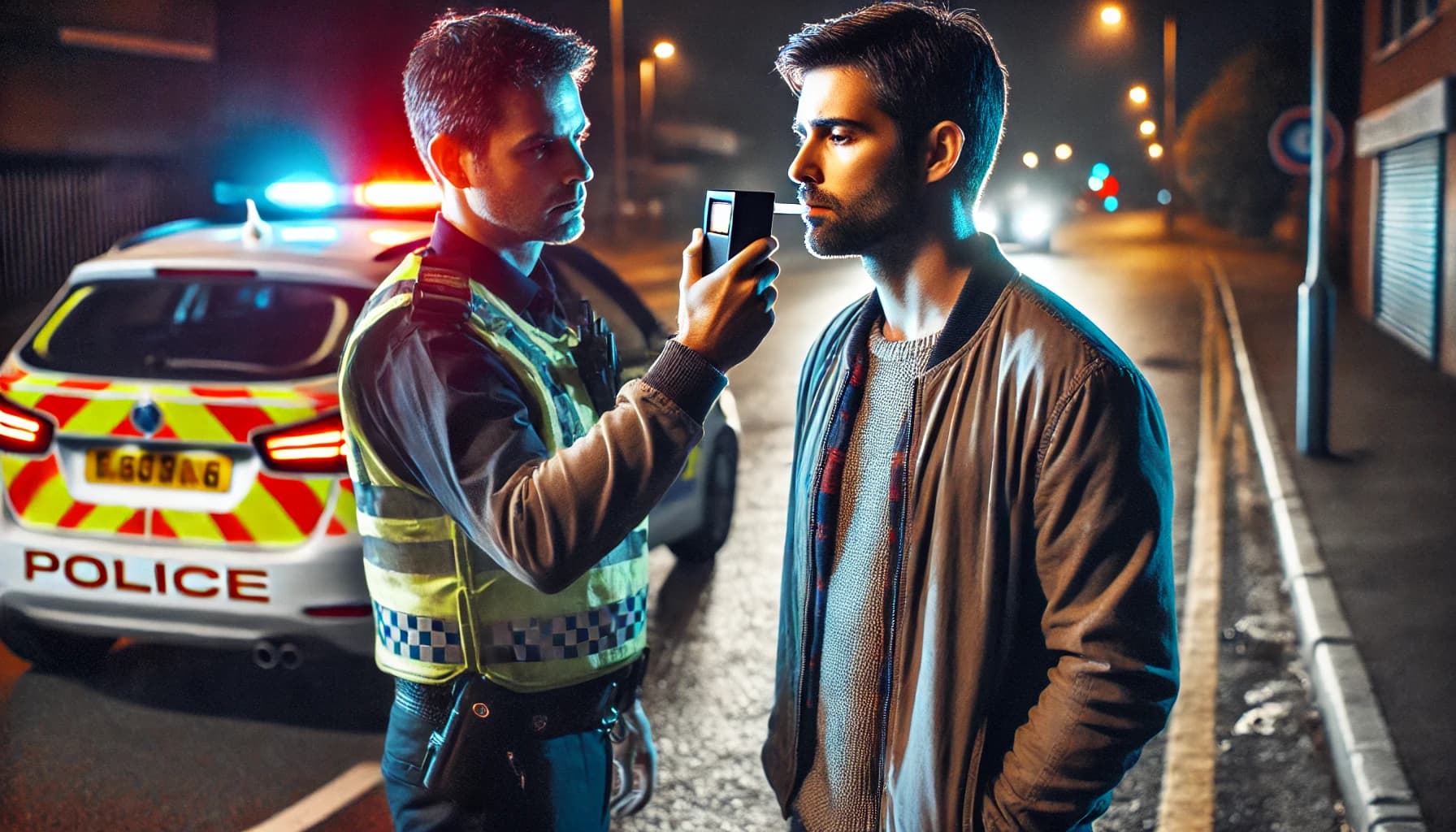
The client's blood alcohol concentration at the time of detection was 0.05%, as noted.
Blood alcohol concentration expresses the concentration of alcohol in the blood as a percentage, and if the blood alcohol concentration is 0.03% or higher, the driver is deemed to be in an intoxicated state and is prohibited from driving.
▷Road Traffic Act Article 44 (Prohibition of Driving While Intoxicated)
④ The standard for the intoxicated state in which driving is prohibited under paragraph (1) shall be a driver's blood alcohol concentration of 0.03 percent or higher.
 Penalties for Drunk Driving
If a drunk driving offense is detected, as in the client's case, the following levels of 🔗drunk driving punishment may be imposed depending on the blood alcohol concentration.
▷Road Traffic Act Article 148-2 (Penalty Provisions)
1. A person with a blood alcohol concentration of 0.2 percent or higher: imprisonment for not less than two years but not more than five years, or a fine of not less than ten million won but not more than twenty million won
2. A person with a blood alcohol concentration of 0.08 percent or higher but less than 0.2 percent: imprisonment for not less than one year but not more than two years, or a fine of not less than five million won but not more than ten million won
3. A person with a blood alcohol concentration of 0.03 percent or higher but less than 0.08 percent: imprisonment for not more than one year, or a fine of not more than five million won
3. Representation of the Client
The attorney undertook the representation, emphasizing the following points for the client.
▶Emphasized that the distance over which the client drove while intoxicated was not long
▶Emphasized that the client was making efforts to prevent reoffending
▶Emphasized that the client fully acknowledged the offense in this case and showed remorse
▶Emphasized that the client's acquaintances were petitioning for leniency toward the client
The Judgment Obtained for the Client
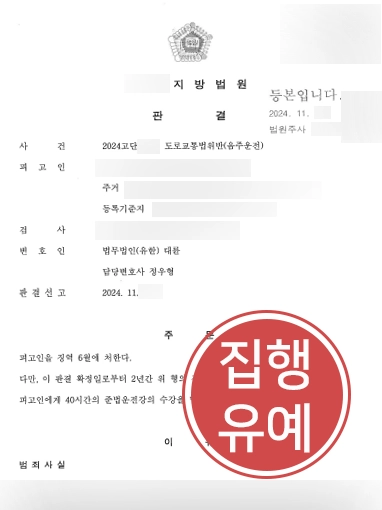
As a result of the attorney's representation of the client, the client received a suspended sentence.
The client had committed drunk driving, an offense that can pose a great danger to society, and an actual custodial sentence was anticipated, but with the attorney's assistance, the client was able to avoid a custodial sentence.
Mitigating Factors in Drunk Driving Cases
Drawing on many years of experience resolving drunk driving cases, the attorney is familiar with approaches to mitigation in drunk driving cases, and a few of them will be shared here with readers of this article.
▶If the person shows genuine remorse
▶If the person has no prior record of criminal punishment
▶If the danger to road traffic caused by the driving was very low
When a case is entrusted to the attorney, the attorney draws on various mitigating factors to obtain a favorable result for the client.
If you wish to move beyond the risk of punishment for drunk driving, please request a 🔗attorney referral and arrange a consultation.
This content is based on actual case studies of Daeryun Law LLC with some adaptations, and the copyright belongs to our firm.
Unauthorized reproduction, duplication, or distribution and other copyright infringements may result in legal action under applicable laws.