
CONTENTS
- 1. How the Client Came to the Daejeon Law Firm

- - The Client's Situation
- - The Statutes Relevant to the Case
- 2. Assistance Provided by the Daejeon Law Firm
- - The Daejeon Law Firm's Argument ① The Defendant's Non-Repayment
- - The Daejeon Law Firm's Argument ② Bank Records
- 3. The Daejeon Law Firm's Result: "Full Award"

1. How the Client Came to the Daejeon Law Firm
The client lent money to an acquaintance but did not get it back even though the agreed repayment date had passed.
The client then came to the Daejeon law firm to recover the loan through a lawsuit.

 The Client's Situation
The client is an ordinary office worker.
One day, an acquaintance from the client's university years explained that he had a promising business venture and asked whether the client would invest.
Having trusted this acquaintance for some time, the client believed the promise of a 3% share of the profits, took out a personal loan, and lent 64 million won.
The acquaintance, however, kept the promise only for the first two months and afterward stopped repaying the agreed amount and gradually avoided contact.
Even so, the client waited five more months, and when the acquaintance failed entirely to keep the promise, the client decided to file a 🔗claim for return of a loan and came to the Daejeon law firm for assistance.
The Statutes Relevant to the Case
A claim for return of a loan is a civil procedure available when a person has lent money to another and has not been repaid within the agreed period.
Against a debtor who does not respond to contact, one may consider filing a claim for return of a loan, sending a certified statement of contents notifying the debtor, filing for a payment order, and seeking provisional attachment or a provisional injunction.
The statutes relevant to a claim for return of a loan are as follows.
A loan for consumption takes effect when one party agrees to transfer to the other the ownership of money or other substitutes, and the other party agrees to return goods of the same kind, quality, and quantity.
■ Civil Act Article 390 (Default and Compensation for Damages)
If an obligor fails to perform in accordance with the substance of the obligation, the obligee may claim compensation for damages. This does not apply, however, where performance has become impossible without the obligor's intent or negligence.
■ Civil Act Article 393 (Scope of Compensation for Damages)
① Compensation for damages arising from default is limited to ordinary damages.
② Damages arising from special circumstances are subject to compensation only if the obligor knew or could have known of those circumstances.
2. Assistance Provided by the Daejeon Law Firm
After reviewing the client's situation in detail, the Daejeon law firm advanced arguments that could work favorably at trial.
The Daejeon Law Firm's Argument ① The Defendant's Non-Repayment
The acquaintance, the defendant, had expressly promised to repay a set amount each month beginning the month after borrowing the money from the client, but did not perform that promise even once after the first two months had passed.
The Daejeon law firm emphasized that the defendant was irresponsibly failing to keep the promises a debtor is bound to honor.
The Daejeon Law Firm's Argument ② Bank Records
The client took out a personal loan in order to lend the money. There were records of the client's loan, records of remitting the loan proceeds to the defendant, and records of the defendant repaying money over two months, and these were submitted as evidence.
Based on this evidence, the Daejeon law firm emphasized that a monetary agreement genuinely existed between the client and the defendant, so the defendant was bound by the obligation to repay.
3. The Daejeon Law Firm's Result: "Full Award"
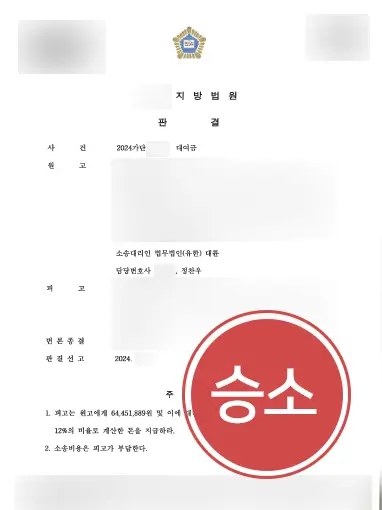
The court accepted the Daejeon law firm's argument and granted the full claimed amount of approximately 64 million won, issuing a judgment that "the defendant shall pay the plaintiff approximately 64 million won."
If You Wish to File a Claim for Return of a Loan
As in the client's case, when a claim for return of a loan is pursued, securing solid evidence of the monetary agreement becomes an important issue.
If a loan certificate exists, proof is quick, but in transactions between acquaintances there is often no loan certificate, so actively proving that a monetary transaction took place is important.
To comprehensively review such evidence together with materials that allow an effective response to be prepared, the assistance of an experienced attorney can be helpful.
Daeryun Law Firm has attorneys who work to analyze the latest laws and precedents and then establish a strategy favorable at trial. You are welcome to seek a consultation at any time through a 🔗legal consultation reservation.
This content is based on actual case studies of Daeryun Law LLC with some adaptations, and the copyright belongs to our firm.
Unauthorized reproduction, duplication, or distribution and other copyright infringements may result in legal action under applicable laws.